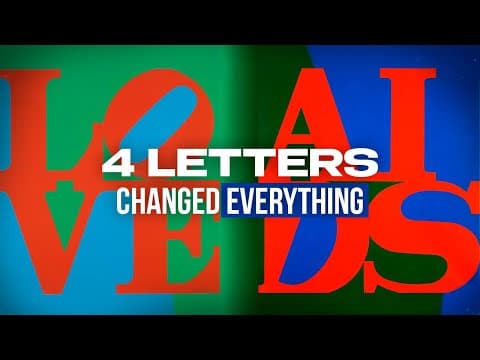
[0:00]In 1989, three artists took the most famous symbol of love in American art and transformed it into a weapon of social change that would appear on gallery walls, protest banners, and street corners around the world. General Idea's AIDS wallpaper took Robert Indiana's iconic Love sculpture and turned it into something that could no longer be ignored. The stark, undeniable reality of a crisis that was killing thousands while governments and society looked away. I'm Oleg G from Art explained simply and quickly and today we're exploring how a simple typographic intervention became one of the most powerful pieces of activist art ever created. A poster that didn't just change minds, it helped save lives. This wasn't just another artwork hanging quietly in a gallery. General Idea's AIDS wallpaper was designed to be everywhere. Repeated endlessly across walls, reproduced without permission, pasted on streets, carried at protests and inserted into spaces where polite society preferred not to discuss the reality of the AIDS epidemic. By the time you understand how this deceptively simple image works, you'll see why it represents a revolutionary moment when art stopped being decoration and became direct political action. To understand the power of this intervention, we need to grasp the cultural and political landscape of 1989. The AIDS epidemic had been devastating communities for nearly a decade, but mainstream media coverage remained limited and often judgmental. The Reagan administration had largely ignored the crisis. With the president not even publicly uttering the word AIDS until 1985. Thousands were dying. But public discourse remained muted, sanitized, and inadequate to the scale of the tragedy. Into this silence, stepped General Idea. The Canadian artist collective of A Bronson, Felix Parts, and Jorge Zontal. They weren't just observers of the AIDS crisis, they were living it. Parts and Zontal were both HIV positive, and their art practice had evolved to directly engage with the epidemic's social, political, and cultural dimensions. They understood that traditional artistic approaches, subtle, metaphorical, gallery-bound, were insufficient for the urgency of the moment. If you're finding this video helpful, please hit like to help the YouTube algorithm push my videos to other art lovers. Want to support further? Check out my affordable membership options with exclusive perks or simply use it to say thanks. YouTube monetization isn't generous. And your support helps me create content like this every week. Every bit of support helps. The genius of their intervention lay in appropriating one of the most recognizable images in American culture. Robert Indiana's Love sculpture, first created in 1964 and endlessly reproduced on everything from postage stamps to tourist souvenirs had become shorthand for 1960s idealism and romantic sentiment. The bold stacked typography L O over V E was instantly recognizable and culturally loaded with positive associations. General Idea's transformation was devastatingly simple. They maintained Indiana's exact typography, color scheme, and composition, but replaced Love with AIDS. The familiar red letters on blue background remain, but now spelled out the awe, the name of the disease that dare not speak its name in mainstream culture. The visual similarity meant that viewers' brains initially processed the familiar Love format before the cognitive dissonance of reading AIDS created a psychological shock. This appropriation strategy worked on multiple levels simultaneously. First, it hijacked the positive emotional associations of the original Love image, forcing viewers to confront AIDS with the same immediate recognition they gave to expressions of love. Second, it demonstrated how quickly cultural meaning could shift. The same formal elements that had signified peace and love now carried messages of illness, death, and social neglect. But the wallpaper format was equally revolutionary. Traditional artworks exist as unique objects in specific locations. Wallpaper, by definition, is meant to be reproduced endlessly, to cover large surfaces, to become environmental rather than focal. By presenting their AIDS image as wallpaper, General Idea was rejecting the preciousness of art objects in favor of ubiquitous, reproduceable messaging. The political implications of this choice were profound. Wallpaper can be collected by wealthy patrons or hidden away in private collections. It demands public space, institutional commitment and widespread visibility. When galleries chose to display the AIDS wallpaper, they were making political statements about their willingness to engage with controversial social issues. When institutions refused, their silence became equally political. The work's first major presentation at the Venice Biennale in 1990 demonstrated its international impact. In the context of this prestigious art world gathering, the AIDS wallpaper transformed exhibition spaces into sites of political consciousness. Viewers couldn't simply appreciate aesthetic qualities, they were forced to confront the global reality of the AIDS pandemic in spaces traditionally reserved for cultural celebration. The typography itself carries deeper meaning than initially apparent. The stacked format AI over DS creates visual and conceptual relationships that wouldn't exist in linear text. The isolation of AID in the top line suggests both the medical aid that victims desperately needed and the social aid assistance help support that was being withheld by institutions and communities. The S below transforms the concept from singular to plural. Acknowledging that AIDS affects not just individuals, but entire communities. The color choices weren't arbitrary either. The red lettering against blue background evoked medical emergency, red crosses, ambulance lights, urgent medical signage. But these were also patriotic colors in American context. Subtly critiquing a nation that wasn't caring for its own citizens. The boldness of the colors refused the subdued tasteful palette that might make the message easier to ignore. The work's reproduction and dissemination revealed new possibilities for activist art. Unlike traditional artworks that depreciate through reproduction, the AIDS wallpaper gained power through copying. Every unauthorized reproduction was a victory. Every appearance in a new context expanded its political impact. Street artists wheat pasted it on walls. Activists carried it on protest signs. It appeared in publications, on T-shirts, stickers, and buttons. This viral quality, and the term is particularly resonant given the subject matter, represented a new model for how art could function in the media age. Rather than scarcity creating value, ubiquity created impact. The work succeeded precisely to the extent that it escaped the control of its creators and took on independent life in political and social contexts. The timing of the work's creation and dissemination was crucial. By 1989, AIDS activism was becoming more organized and confrontational. Act Up, AIDS coalition to unleash power, was staging dramatic protests, demanding research funding and treatment access. General Idea's wallpaper provided a visual tool that could work across different contexts. Sophisticated enough for gallery spaces, bold enough for street protests, reproduceable enough for grassroots organizing. The work also functioned as a form of cultural education. Many people encountering the AIDS wallpaper in gallery contexts might not have had direct experience with the epidemic. The stark presentation of the disease's name in a familiar, accessible format forced acknowledgement in spaces where polite conversation might avoid such difficult topics. Art institutions became sites of public health consciousness, whether they intended to or not. Felix Parts and Jorge Zontal's deaths from AIDS-related causes in 1994 added tragic weight to the work's meaning. The AIDS wallpaper became not just political statement but memorial, not just activism, but autobiography. The surviving member, A Bronson, continued showing and discussing the work, ensuring its historical significance was preserved while its political message remained relevant. The influence of General Idea's approach extended far beyond AIDS activism. Their model of appropriating familiar cultural images and subverting them for political purposes became a template for countless subsequent activist interventions. From Barbara Kruger's text-based work to Shepard Fairey's OBEY campaign, the strategy of hijacking recognizable visual languages for political purposes became central to contemporary activist art. The work also demonstrated how effective art activism requires understanding of both visual culture and political strategy. General Idea didn't just make powerful images, they created images designed to function effectively in specific social and political contexts. Their background in conceptual art gave them sophisticated understanding of how meaning is constructed and transmitted through visual culture. The democratizing aspect of the wallpaper format challenged traditional art world hierarchies. Gallery visitors, street activists, and casual observers could all access and understand the work immediately.
[10:58]No art historical knowledge was required, no cultural capital needed. This accessibility was itself a political statement about who art should serve and how it should function in society. Contemporary resonance of the AIDS wallpaper approach can be seen in how artists have responded to recent crises. During the COVID-19 pandemic, artists worldwide created work that functioned similarly. Taking familiar visual languages and adapting them for public health messaging. The precedent established by General Idea provided a model for how art could engage directly with medical and social emergencies. The archival and documentation challenges raised by the work reflect broader questions about activist art. Should these interventions be preserved as art historical artifacts or does preservation domesticate their radical political energy? The AIDS wallpaper exists simultaneously as museum object and living political tool, creating productive tensions about art's relationship to social change. The work's ongoing relevance extends beyond AIDS to any situation where public health intersects with social stigma and political neglect. The visual strategy remains applicable, taking familiar, comfortable imagery and transforming it to force confrontation with uncomfortable realities. This approach has influenced everything from climate change activism to immigration rights organizing. If you're inspired by art that transforms social consciousness and proves creativity can be a tool for justice, hit that subscribe button right now and join our community of art explorers. Every week on Art Explained Simply and Quickly, we examine works that demonstrate art's power to change minds, challenge systems, and save lives. How do you think art can best engage with contemporary social crisis? What familiar images or symbols do you think need to be transformed for current activist purposes? Share your thoughts in the comments below. Your ideas about art and activism contribute to ongoing conversations about creativity's role in social change. If this video helped you understand how a simple typographic intervention became a weapon for social justice, give it a thumbs up. It helps more people discover these crucial stories about art's intersection with politics and public health. See you in the next exploration.


