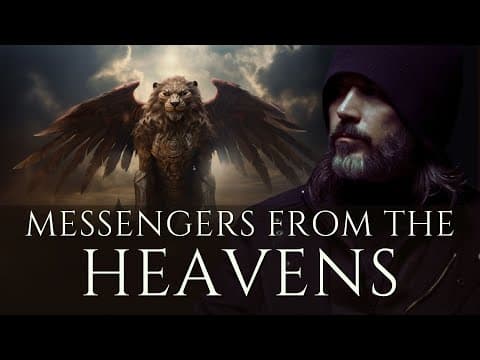
[0:00]Normal human beings also known as the prophets and the messengers, the righteous ones, the saints, become special because they have an encounter. They have an encounter with beings that appear to be human, but they're actually not normal humans. The ones that they are encountering are people that came from above. Wow.
[0:34]Bismillahi Ta'ala, Allahumma salli ala Muhammad wa ali Muhammad. Alhamdulillahi rabbil alameen, my dear sister, Tiffany Oldani. Alhamdulillahi rabbil alameen, thank you so much for having me here today. Good to have you back. So today we're going to talk about the topic of extraterrestrials and UFOs and their connection to the divine religions of Allah subhana wa ta'ala. Okay. It's an interesting topic. Yeah. So, uh, there is this phenomenon that has happened from the very beginning of time. From the very beginning of mankind's history. And that is that there have been these tales, these stories, events that were preserved in the artwork, you know, or the myths of different cultures and civilizations. If you go back to the days of the caveman, you have preserved till this very day the caveman's art. He would draw things on the walls in the caves. You would find in there, um, scenes of people and they're chasing with spears woolly mammoths or they're chasing with spears, uh, buffalo. Right? And so people came to realize that, oh, these were drawn by people of ancient times. They would experience something, you know, or something would take place in their day. What would be important in their day? What would they need to utilize their energy their energy on? What would be the highlight of the year? Maybe the highlight of the year is when the whole community, the town, the family, they went out, you know, and they and they were running chasing these bulls and they captured a bunch of them and it gave them enough food for, you know, a gigantic feast.
[2:45]And they were happy about that, and therefore, after this experience that they had, uh, the children or the elders sought to preserve the story and so they painted it on the walls. Yes. Yeah. And then you have something interesting that would take place. You would find all of a sudden these images of objects that are in the sky.
[3:17]that people have not really been able to tell what are these things. As as well as paintings of beings that do not look like the rest of the the the human beings that were drawn or painted on the cave walls, right?
[3:35]ones that look different. Perhaps they have bigger eyes or they have strange hair or oddly shaped heads or arms. Yeah. The same thing takes place in other cultures and in other civilizations. where they they have natural events that are being depicted in their hieroglyphs or in their artwork that is surrounded by hieroglyphs or in their, um, you know, in their, in their, in their drawings, their murals, depictions of kings that are conquering certain lands. In ancient Egypt you have lots of images that are drawn, murals on walls or in tombs that depict the accomplishments of that king. If he went to war against a nation and he captured the king, they would draw that captured king on the ground being held by his hair or about ready to be slaughtered or at the feet or at the mercy of the Egyptian king. And so once again, even in Egyptian civilization, as things shifted for human beings from the cave to greater, larger civilizations, such as the Babylonians or the Acadians, the Sumerians, the Egyptians, the Phoeniciaans, they depicted their history. And just as the caveman drew oddly shaped human beings or things that were in the sky, including the sun and the moon but also other objects that are unidentified. You have over here in these civilizations, you find them being obsessed with depicting the heavenly bodies up above. Okay. And many of them depicted them to such a high, highly detailed and correct extent. And there are examples of that in South America, where certain cities or towns were constructed to mimic the solar system up above or to reflect the solar system in the very design of the city.
[6:00]Um, and you have other examples which Zachariah Sichen and other people have pointed out, other researchers and authors have pointed out, where the Babylonians and the Sumerians have depicted in their artwork the sun and the moon and the the exact number of planets that are in our solar system that are rotating around the sun. And they found this fascinating. Yeah. And in addition to that, they had depictions of other objects that were in the sky, as well as other human beings that were painted differently than the rest of them. Okay. Some of them come in the form of having a different skin tone or a different color. So you have for example, in the ancient Egyptian civilization, um, paintings where you have the Egyptians painted in different tones of brown and sand, sandy color, right? Or beige. their skin. And you find really in Egyptian society today that the people in Egypt have that type of skin tone. Yes. And you have them depicting the people that, um, you know, came from African nations as as being very dark brown. Yeah. So they would paint the people's skin and depict their faces as they would see them. Yeah. And yet they would also paint images of other beings that their skin tone was either greenish or bluish. Yeah, such as Osiris. Yes, exactly. Yeah. Yeah. And the Egyptologists and the historians have tried to explain this by giving like, okay, like some sort of, uh, you know, allegorical meaning to it or some sort of deep, deep meaning and they shift away from the, the we see therefore we paint to preserve history as we saw it, as it happened, to one of, uh, you know, that giving a deeper meaning, uh, behind things or trying to philosophize on why it is that these people were depicted differently in an attempt to to, uh, you know, normalize the explanation because not only that, but they also come across these half human, half animal hybrid type creatures that are that are painted. Yes. Yeah. Uh, for example, you have Horus, who is one of the ancient Egyptian gods, and he's depicted as having a falcon head, you know, and a human body. You have Anubis, who is the god of the dead, and he is depicted as having kind of like a jackal's head and a human body. Yeah. So, you know, archaeologists, they wondered, what is this? And they contemplated and they dismissed the idea that these creatures that are being depicted could have really existed in real life in that form or that the ancient Egyptians could have saw such a thing. Yeah, because we don't see that thing today.
[9:19]Right? Yeah. So they say, for sure, this is, um, you know, something that has a different type of meaning to it. Yeah. They find the same theme occurring in the statue art, you know, where the statue makers would would make normal statues of human beings such as Ramsay's, he's sitting on his throne, um, you know, as they saw them.
[9:46]statues of Akhenaten, you know, sitting with his with his wife, uh, as we saw them. They don't have like any other skin tones, they don't have, uh, or weird colors, they don't have any sort of animal hybrid aspect to them. It would just be them, the king, sitting on their throne.
[10:08]And then we have all these other statues, which are of the gods that are mixed animal human hybrids, and other entities or creatures such as the Egyptian Sphinx, that is famous and known, and everybody knows that it is a, it's a lion's body, but with a human head. Yeah. And sometimes they would be depicted as being winged, and other times they would not have wings, like the Great Sphinx of, uh, of Giza, of Egypt, the one that's by the pyramids. And this fascinating thing, it carried on, and you found it in other civilizations that were separated from Egypt by large distances, you know, like you, you find in the, the Babylonians, they they have these giant and in the Iran, they have these giant Lamassu type creatures that are half bull, half human, a bull's body, a human's head, with a gigantic beard and a crown on top of it and wings. Yeah. So these animal human hybrids with wings is a recurring theme, uh, that happens. And you have also in the Greek and Roman cultures similar things where you have, for example, whether it's Pan, who's a creature that, uh, is half human, half goat, from his belly above is human, from his legs down, the belly down is is is a goat type creature, you have the Pegasus, which is, um, a horse with wings. So it's you have this this theme again of either animal human hybrid or animals that are not supposed to have wings that have wings. The minotaur, which is half human, half bull. Yes. People wondered, what are these things? And then they kind of dismissed them as being as being like something of a mythological story or a legend, or something which represents like, uh, you know, a guardian or something that's made to ward off or scare off the evil spirits or or people that are coming to kind of like desecrate the tomb or desecrate, uh, the holy area. And then they became associated with being angels, when we shift over then to Judaism. Why? Because in ancient Egypt, so you have now these these beings that would be sitting there. You have Anubis, he would be sitting on top of these tombs that they would build. You have these winged creatures and winged humans that would be drawn on the sides of the different arks or tombs that the ancient Egyptians, uh, used to build like the Ark of Horus and other than that. And when Moses went out then of ancient Egypt and he met God, uh, you know, in the incident of the burning bush, what does God command him to do? God tells him because God knows is is is dwelling, his spirit is dwelling, the Shekina, which he's taking as a, as a wasila or a way to communicate with, um, Moses, is dwelling in this bush. And it requires Moses, it commands Moses to build for it an ark. And he builds for it an ark made out of wood and played it in gold and specific dimensions. The interesting thing about this command is what, Tiffany? Is that he tells them to build something on the top of the ark. What is it that he asks them to build? Uh, two, two winged angels who are guarding the seat of mercy. So, um, yeah, the, I guess wings then become associated with angelic beings, correct? Yes. So now what? So now what the ancient Egyptians were doing, Moses is commanded to do. The ancient Egyptians are using arks, right? To transport, uh, belongings of the king. They're used in funerary processions, uh, they're placed inside of the arks, these jars that contain different organs that belong to the king, right? Exactly. These arks were being used by the ancient Egyptians that were depicting the Sphinxes and these half animal, half human hybrids and they had people painted that had different skin tones and different colors. And that on top of the ark, there would either be the head of Horus guarding it or it would be a statue of Anubis that would be guarding it. God commands Moses to make an ark like they had an ark. And where were they coming out of? They were coming out of Egypt. Yeah. And in the place of the Anubis that's guarding the ark from above, what did they place? They placed two cherubim. The cherubim, these winged beings, humans with wings, were already already being depicted in ancient Egypt on the sides, they were drawn on the side of the arks themselves. And so, uh, it's almost like God was confirming this idea that already existed and that the people in Egypt had, that there is such a thing called an angel, right? And either they literally had physical wings or the wings were used as a symbol in ancient Egypt to depict people that came from the sky, because wings does what? Wings do what? They help a person fly.
[16:07]That's why birds they have wings. And where do wings take you? They take you into the sky. And so where is the heavens? It's up above. Where are the angels from? They're up above. So if you want to depict an angel, a simple way of saying it, you know, you know, to to people that don't necessarily know how to read and write, is to depict a human, but the human is different. What's the difference? He has wings. Why? Because that human that has wings, he came from above.
[27:44]Wow. I mean, I think that's that's that's an amazing question because like as you said, these these events are not happening anymore. People are people are they're critical of religion for this reason. They're saying these these things aren't happening. We're not having these appearances of chariots of fire and and beings appearing as angels or these hybrid creatures or, um, you know, any of these things that we've spoken about.


