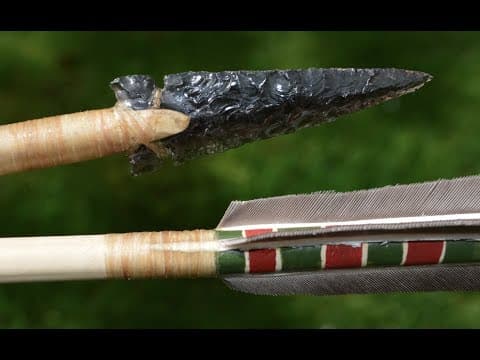
[0:07]On August 29th, 1911 near Oroville, California, the last truly wild Stone Age Native American in North America would emerge from the wilderness.
[0:16]This man later became known as Ishi.
[0:19]Ishi was a master at making his own primitive archery equipment.
[0:24]In this video series, we will show you step by step how he made his arrows.
[0:28]Details on how Ishi made his arrows are recorded in several references including Yanni Archery written by Saxton Pope in 1918.
[0:36]Hunting with the Bow and Arrow, written by Saxton Pope in 1923.
[0:41]And Ishi in two worlds, written by Theodora Kroeber in 1961.
[0:47]Throughout this video series, I will be quoting directly from these three references including the natural materials Ishi collected and the techniques he used to construct his arrows.
[0:58]Ishi called an arrow Sawa. In making arrows, the first thing is to get the shaft.
[1:04]Ishi used many types of wood, but he preferred hazel.
[1:09]A native bamboo like Reed was also a great favorite. In gathering wood for the arrow, he generally selected the tall, straight shoots of hazel where it grew in competition with other shrubs or trees, cutting them to about a yard in length.
[1:25]Their greatest diameter being a little more than 3/8 of an inch.
[1:29]These he stripped off the bark with his thumbnail. He always made arrows in groups of five. Thus, he would select the best of these sticks and collect them in groups and bind them together securely with a leather thong.
[1:43]In these bundles, he would permit them to season lying horizontal position.
[1:48]After any period from a week to a year, these sticks might be used.
[1:57]In general, Ishi made a compound arrow consisting of a main shaft and a removable foreshaft.
[2:03]This allowed him to quickly change from a wooden point used for hunting small games and birds to an obsidian point for hunting deer and bear.
[2:12]The foreshaft was made of heavier wood, frequently dogwood or mountain mahogany.
[2:20]I was able to find some mountain mahogany growing in the desert of Southeastern Oregon in a landscape that is typically dominated by Juniper and sagebrush.
[2:27]The branches of this tree are brittle and not suitable for arrow material, but the heartwood is incredibly dense with tight growth rings, making this ideal material for foreshafts.
[2:39]The tight growth rings in this tree indicate that it takes several decades to grow a few inches.
[2:51]The foreshaft was the same diameter as the arrow, only tapering a trifle towards the front end and usually was about 6 inches long.
[2:59]It was carefully shaped into a spindle at the larger end and set into the recently drilled hole of the shaft using glue or resin.
[3:10]Ishi's hunting shafts were of two kinds, obsidian pointed and blunt.
[3:16]For shooting small games such as birds and rabbits, the latter was used.
[3:19]For killing deer, bear and predatory animals, sharp arrows were used.
[3:24]On arrows with sharp points, a groove had to be cut into the foreshaft to fit the obsidian point.
[3:32]When fletching arrows, Ishi used eagle, buzzard, hawk or flicker feathers.
[3:38]By preference, he took them from the wings, but he did not hesitate to use tail feathers if he was reduced to it.
[3:45]These bird species are all protected and it is not legal to use their feathers for arrows.
[3:50]Suitable substitutes are turkey feathers, which Ishi preferred while with Saxton Pope or goose feathers, which are very similar to buzzard feathers.
[4:03]The feathers were attached to the arrow with long strands of sinew from the back or leg of a deer.
[4:08]These tendons can be pulled away into fine strips and chewed until soft and used to wrap the feathers, the foreshaft and the point onto the arrow.
[4:21]Before attaching the feathers, Ishi painted his arrow shafts.
[4:25]His typical design was a series of red and green alternating rings or a series of red and blue alternating rings with wavy lines.
[4:34]The pigments Ishi used in the wild were red cinnabar, black pigment from the eye of a trout, a green vegetable dye from wild onion, and a blue obtained from what he said was the root of a plant.
[4:49]There is not a lot of detail of how Ishi used these pigments to paint his arrows.
[4:53]And cinnabar contains mercury, which is toxic.
[4:57]So for my arrows, I use the natural red ochre pigment and adopted Ishi's preferred method while living at the museum, which is dry colors mixed with Shellac.
[5:13]Ishi was a master flintnapper and often did demonstrations for visitors at the museum on how he made arrowheads.
[5:21]Saxton Pope records that he began this work by taking one chunk of obsidian and striking it against another.
[5:28]Thus, several small pieces were shattered off.
[5:31]One of these pieces, approximately 3 inches long, 2 inches wide and half an inch thick, was selected as being suitable for making an arrow head.
[5:46]Protecting the palm of his left hand by a piece of thick buckskin, he placed a piece of obsidian flat upon it, holding it firmly with his fingers folded over.
[5:54]In his right hand, he held a sharp piece of deer horn.
[5:59]He pressed the point of the horn against the edge of the obsidian without jar or blow, a flake of glass flew off as large as a fish scale.
[6:07]Repeating this process at various spots on the intended head and turning it from side to side, first reducing one face and then another, he soon had a symmetrical point.
[6:29]In part two, we will take these materials and show you how to finish the Ishi arrow.


