[0:05]So, not too far from the Turkish city of Konya, lies one of the world's oldest known settlements. It's actually a relatively recent discovery. A Neolithic town that in Turkish is known as Çatalhöyük. What the original name of the settlement was is anybody's guess, as it was quite long ago, 10,000 years ago, and no writing that may be able to describe the settlement has to this day been found there. It's just so old, but also quite sophisticated. In fact, many until its discovery didn't think that humans could have lived in such an organized way so many thousands of years ago. So, plus one for our ancestors. Çatalhöyük was excavated over several years, pretty much from its discovery in 1958 to 1964 by a team of archaeologists led by James Mellaart, himself from the UK. Excavation stopped for a while due to some sort of scandal Mellaart was involved in, but resumed again in the early 1990s. Since its excavation, Çatalhöyük has become one of the most famous archaeological sites in the world due to its age, sheer size, and the amazing artwork found there in the form of wall paintings and what are presumed to be religious objects. Now, after the discovery of Çatalhöyük, several similar villages from around the same time period have also been found in other parts of the world, proving that the growth of such communities were not isolated incidents. What these settlements demonstrate is the shift from hunter-gathering to a more sedentary agricultural lifestyle. Think about it, if you were moving around a lot in search of food, then why would you go through all the trouble of making permanent settlements like Çatalhöyük? I mean, that's a lot of work, especially if you're not planning on living in that area for too long. Such settlements all started what we call the Neolithic Revolution, which took place in many parts of the world between the years 10,000 to 7,000 BCE. The Neolithic Revolution is that transitional phase when our ancestors made the move from foraging to farming. Çatalhöyük is just one example of a community that over several hundred years was in the process of making that transition. Archaeologists have been able to see through the ages how the size of the settlement expanded, probably averaging a population of 5,000 people. Although during some generations, this number may have gone up to 10,000 people. In either case, these villages must have spent considerable time and effort in planting and cultivating various crops, as well as storing any surpluses for use during winter or non-harvesting months. So, how did these people live? Well, housing-wise, the people of Çatalhöyük lived in dwellings that were clustered together in a sort of honeycomb maze. They were so tightly packed together that there were few, if any streets. To get inside these houses or dwellings, one would have to enter through holes in the ceiling and then use a ladder to go down. Or up, if you were leaving. These openings were also the main source of ventilation for each house. In a sense, the rooftops of the houses were the streets. Inside the house was a basic kitchen area where a small fire could be built, as well as sleeping quarters and in a few cases, rooms for storage. Now the fire could also have been used during cold weather for heat. The smoke from the fire would exit through the hole in the ceiling, which along with being a point of entry and exit, acted like a chimney. As you can probably imagine, the place was a bit crowded. However, it definitely beat living in a tent, especially when the weather was bad outside. What's also interesting is that the people of Çatalhöyük had their own sanitation system. Apparently, they kept their houses very clean, but outside of town, archaeologists found what they could only determine to be trash heaps for garbage. You know what else is really interesting about the people of Çatalhöyük? They seem to have had a relatively egalitarian culture, meaning that there were no social classes or hierarchies, at least none that can be determined. This conclusion has been made because all of the houses, the hundreds of them that they've unearthed, are more or less the same. Basically, there was no palace for any chieftain or king, no special quarters for any type of priests or those with special status. This doesn't mean that high status people didn't exist, but if they did, then they weren't awarded any special privileges in terms of better housing. As far as we can tell, the daily diet of these people consisted of wheat, barley, lentils, peas, and other legumes. They also herded sheep and goats, and given much of their artwork, cattle as well. Now, one of the really cool things about farming is that it can free up time for many people. When you can't or don't have to constantly be searching for or growing food because you have surpluses stored away, you actually have time to think about the meaning of life or come up with hobbies such as painting or sculpture. Now, without writing, it's hard to really know what the religious beliefs entailed, but from the many female figurines that have been found, it seems that they worshipped some type of goddess, or maybe goddesses. There may have also been male deities and perhaps even spirits of animals whom they worshipped. But statues and figurines of females definitely outnumber the latter two. And it's believed that these statues were used for worship or that they represented divine beings. Many heads of bulls were also mounted on walls, leading some to believe that these could have been objects of worship as well. Either that or they were hunting trophies. We'll probably never know for sure. Anyway, that was a quick look at Çatalhöyük, one of the oldest settlement communities to have been discovered so far. Thanks so much for stopping by the channel. If you found this video useful, please hit that like button because it helps out a lot. Thanks and have a great day.
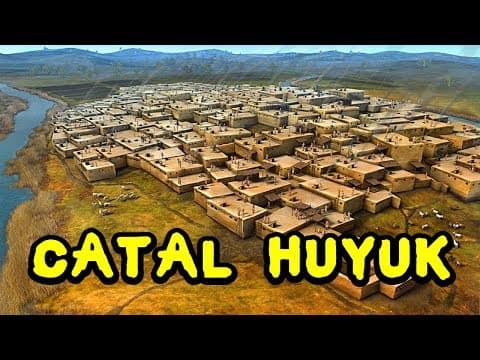
Çatalhöyük (Catal Huyuk) and the Dawn of Civilization
History with Cy
6m 23s1,026 words~6 min read
YouTube auto captions
Transcript source
YouTube auto captions
This transcript was extracted from YouTube's auto-generated caption track. The transcript below is server-rendered so it can be read, searched, cited, and shared without opening the original YouTube player.
Pull quotes
[0:05]So, not too far from the Turkish city of Konya, lies one of the world's oldest known settlements.
[0:05]What the original name of the settlement was is anybody's guess, as it was quite long ago, 10,000 years ago, and no writing that may be able to describe the settlement has to this day been found there.
[0:05]In fact, many until its discovery didn't think that humans could have lived in such an organized way so many thousands of years ago.
[0:05]Çatalhöyük was excavated over several years, pretty much from its discovery in 1958 to 1964 by a team of archaeologists led by James Mellaart, himself from the UK.
Use this transcript
Related transcript hubs
Watch on YouTube
Share
MORE TRANSCRIPTS


