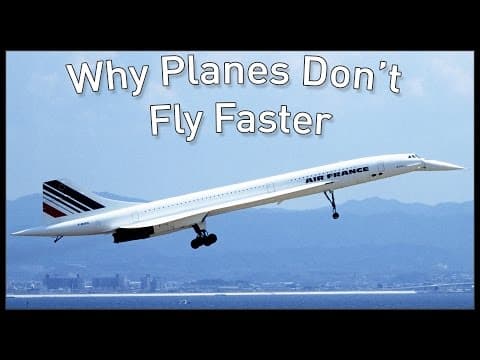
[0:00]This is a Wendover Productions video, made possible by Audible. So I recently went down the rabbit hole of looking at old flight schedules. Airlines used to publish these physical brochures with their fairs and flight times. And when looking at this American Airlines one from 1967, I noticed something interesting. The flight between New York and LA was scheduled as 5 hours and 43 minutes long. That didn't seem right. American Flight 3 was scheduled to leave JFK Airport every day at 12:00 noon and arrive at LAX at 2:43 p.m. There's 3 hours time difference. It turns out that nowadays, American Airlines flight 3 still leaves JFK daily at noon. But the difference is that today, Flight 3 is scheduled to arrive at LAX at 3:27 p.m. 44 minutes later than in 1967. This has happened across the board. Almost every flight today takes longer than it did back in the 60s. In general, the actual flight times, the time in the air, is the same. But with all the congestion and delays at airports, the scheduled times now account for things going wrong. What this means though, is that overall, flying has slowed down. In 1967, we hadn't been to the moon and computers looked like this. But we were flying everywhere just as fast or even faster than we do today. What happened that caused this immense lack of progress in the last 50 years? There are three main types of aircraft engine: the turboprop, turbofan, and turbojet. And each of them has a range of speeds when they're most efficient. The turboprop is the kind of engine that you see on most propeller aircraft. Almost all of the thrust with turboprop engines comes from the propeller. The turbine, which spins the propeller, does intake and speed up some air, but the exhaust air is not at a very high speed, so it only accounts for less than 10% of the overall thrust. These engines are generally inexpensive both to buy and operate, so a lot of smaller commuter planes use turboprop engines. Of course, there's a trade-off. They're not as fast. They're most efficient between about 325 and 375 miles per hour. Any faster than that, and it's better to use a turbofan. Now, these are the engines that you see everywhere. Almost every commercial aircraft is turbofan-driven. With turbofans, the air is initially sped up by a fan. That's what you see when you look at the engine from the front. Then, some of the air goes into the internal combustion chamber where the actual turbine that drives the fan is, and the rest of it goes around the turbine. While air that bypasses the turbine is also sped up, the majority of the thrust comes from the air that passes through the turbine. Turbofans are most efficient at the speeds that you see most aircraft fly today, 400 to 620 miles per hour. If you want to go supersonic, above 767 miles per hour, you need a turbojet. Turbojets are very similar to turbofans, except all the air goes through the turbine. No air is bypassed. This lets them achieve extremely high speeds, but they also require an immense amount of fuel. These engines are only really efficient between about 1,300 and 1,400 miles per hour. What really determines the efficiency of engines is something called the bypass ratio. That's the ratio of the amount of air that passes through the bypass duct to the amount that passes through the engine core. The thing is, it really doesn't take that much more energy to spin a larger fan. What requires a lot more fuel is to put more air through the engine core. That means that engines that accelerate more air through the bypass duct can get more thrust for the same amount of energy. So, as a rule, the higher the bypass ratio, the more efficient the engine. Take a look at this General Electric GenX engine. This is a relatively new, super efficient engine, used on both the 787 Dreamliner and the 747-8I. You can see that the fan is much larger than the turbine itself. That's because this engine has a bypass ratio of 10 to one. 10 times more air goes around the turbine than through it. Compare that to the CFM International CFM 56, an older and less efficient engine. You can see there's much less fan relative to the turbine. So this engine only has a bypass ratio of 5.9 to 1. But that's still considered to be high. The difference is most striking when comparing either of those engines to the Pratt and Whitney JT8D. This engine is a turbojet. As I mentioned, these drive all the air the fan picks up through the turbine, and that means that no air is bypassed. Therefore, it has a bypass ratio of 0 to 1, and is what's known as a Zero Bypass Engine. Since 100% of the air passing through the engine goes through the turbine, the fuel consumption is significantly higher than that of the GenX, CFM56, or even the JT8D. The Concord, using the Zero Bypass Rolls-Royce SNACMA Olympus 593, burned 46.85 pounds of fuel per mile flown. While the 787 Dreamliner, using the 10 to 1 bypass ratio General Electric GenX, uses 18.7 pounds per mile. But the Concord was a tiny airplane. Even compared to the modestly sized 787, it seated only 100 passengers compared to 291 on the Dreamliner. That means that the per person fuel economy on the Concord was just about 14 miles per gallon, compared to 104 miles per gallon on the Dreamliner.
[6:05]In the end, Air France and British Airways, the only two Concord operators, could not afford to keep flying the plane. Less than one-third of the seats were actually occupied by paying customers. Others were filled by those using miles or those upgraded from first class on normal flights. After all, it costs a minimum $7,500 of today's dollars to fly one way from London to New York in those 3 hours. And that was to fly in seats that looked like this. Not all that different than the economy seats of today. When the Concord started flying, first class on other planes looked like this. While nice, these seats were just larger economy class seats and it wasn't incredibly easy to sleep in them. By the time the Concord stopped flying in 2003, first class looked like this, and the seats went fully flat into a bed. Many chose to spend a little less to pass 7 hours in this, rather than spending 3 hours in these cramped seats. British Airways even introduced the first fully flat business class seat in 2000. So for a significantly less money than the Concord, travelers could cross the Atlantic sleeping horizontally. This just wasn't luxury anymore. The whole idea of the Concord was to create the most efficient way to cross the Atlantic for the business traveler. But with fully flat beds, those traveling towards Europe could leave the US in the evening, get their night's sleep on the plane, and wake up in Europe, essentially wasting no time. No longer luxurious or efficient, the Concord flew its final commercial flight on October 24th, 2003, thereby ending the era of commercial supersonic flight. Here's the thing about flying. Speed really doesn't matter to airlines. It really only exists as a selling point for the consumer. The cost of the airplane is a relatively small part of the overall cost of flight. So you'll never see an airline fly faster, so they can use their planes more.
[8:29]Planes lifespans are generally rated in cycles. The number of times the plane takes off and lands. The Dreamliner is rated for 44,000 cycles and has a list price, which is often much higher than the actual sale price, of $224.6 million. That means that the cost of the airplane per flight is barely over $5,000, while the fuel cost for a flight from New York to London is well over $15,000. Therefore, airlines always just fly their airplanes at the most fuel-efficient speed. It turns out that that speed is just about always between 500 and 550 miles per hour. What's weird about this is that it's well below the speed of sound, 767 miles per hour. Why don't planes fly just below the speed of sound? Well, this graph shows the drag on airplanes at different speeds. Between Mach 0.8 and Mach 1.2 is what's known as the transonic range. At these speeds, the airflow around an airplane is not fully subsonic or supersonic. Essentially, some air is subsonic and some is supersonic. So beginning at Mach 0.8, some airflow becomes supersonic, which increases drag exponentially and destabilizes the aircraft. So it's actually quite dangerous to fly right around the speed of sound. You either have to fly well above or below. You can actually see when an airplane is flying transonic. It's hard to see, but there are these lines that look like scratches on the camera lens, but are actually many supersonic shock waves. Because of the disturbances in the airflow, flying between Mach 0.8 and Mach 1.2 actually requires more fuel than flying above Mach 1.2. So that's why we have this number, 613.8 miles per hour. That's the speed limit for commercially viable subsonic jets. While supersonic flight and crossing the Atlantic in 3 hours is flashy and exciting, which truly impressive is hopping the pond for $100 or $200 on an airline that's actually making a profit. And that's becoming more of a reality today. With current speeds, airplanes are able to fly anywhere on Earth in 24 hours, and that's fast enough for almost everyone. The barrier to travel for most people is cost, not speed. So manufacturers and airlines will continue to focus their efforts on driving down the cost of travel, not the time. In the end, time is the enemy of the privileged few. Cost is the enemy of the masses.
[11:42]This video was made possible by Audible. Audible is the leading online audiobook provider, but I'm sure you already know that. What I'll tell you is how I use Audible. I love reading, but there are a lot of times when I just can't read a paper book when working out, doing dishes, even when editing a video. So I download tons of audiobooks through Audible so I can learn no matter what I'm doing. If you listen when doing tasks like me, you're turning what it's normally something boring into something fun. I recently started listening to Skyfaring, a book by 747 pilot Mark Vanhoenacker. It gives a glimpse into the pilot side of flying, but it's written much more like a novel or memoir than a heavy-duty non-fiction book. The great thing is that you can listen to this book for free, thanks to Audible, with a 30-day free trial you get by signing up using the link audible.com/wendover. It's a fantastic book and Audible is a fantastic site, so please do at least give them a look over at audible.com/wendover. Other than that, you can support Wendover Productions at patreon.com/wendoverproductions. Follow me on Twitter at WendoverPro. Watch my last video about how the president travels here. Check out my fan moderated subreddit here, and most of all, subscribe to this channel to receive all my future videos right when they come out. Thanks again for watching and I'll see you in two weeks for another Wendover Productions video.


