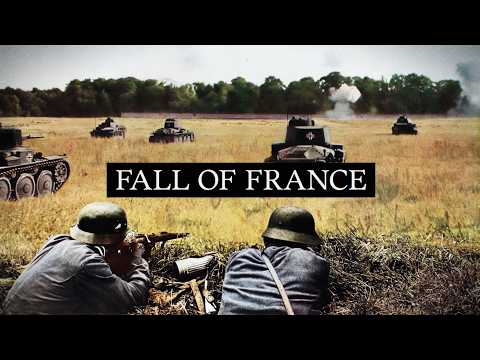
[0:00]In May 1940, Nazi Germany attacks in the West. The Allied armies of France, Britain, Belgium, and the Netherlands have more men, guns, and tanks than the Germans do. And the French army is considered the best in the world. But in just six weeks, German forces shocked the world and smashed the allies. So how did the allies lose so completely so fast?
[0:30]When Germany invaded Poland in 1939, Britain and France declared war. But the Western Allies do little as the German and Soviet armies crush the poles. And German Chancellor Adolf Hitler is already planning his next move. He's in a hurry since his alliance of convenience with the USSR might be short-lived. And the allies aren't yet ready for war. On September 27th, Hitler tells the high command he wants to attack France in a month. Nearly all the German generals, like Wilhelm Ritter von Leeb, are stunned. "The French will not be surprised. They know very well that if the Germans attack they must do so through Belgium. So the French will be vigilant. Our bloody sacrifice will be great. An attack on France cannot be done like the attack on Poland, rather it will be arduous and very costly." Hitler ignores his general's warnings and orders them to start planning an offensive to capture neutral Belgium and the Netherlands, and occupy enough of Northern France to be able to strike at Britain. The start date is moved to November 25th. Chief of the Army General staff, Franz Halder, quickly prepares a cautious plan with the main German advance through Central Belgium. But Hitler is frustrated. This is just the old Schleefen Plan with a strong right wing along the Atlantic coast. One cannot get away with such an operation a second time.
[2:00]The back and forth between army planners and Hitler lasts for months, during which time the offensive is delayed 29 times. Hitler leans ever more towards the idea of concentrating the relatively few German armored and motorized divisions for a strike through the thickly forested Arden region, cutting off Allied forces, if, as expected, they enter Belgium. Army brass thinks it's too risky. Unbeknownst to Hitler, General Erich von Manstein also favors the Arden route for what becomes known as the Sichelschnitt or Sickle Cut plan, but the Army command throttles it. Then, in January 1940, a German Messerschmidt 108 Typhoon carrying the plan crashes in Belgium, forcing the Germans to change it yet again. Finally, on February 24th, 1940, the final plan is approved. One that weakens Manstein's idea of a double pincer from north and south. Army Group B will simply pin the allies in the north, while the Southern Army Group A will lead the attack through the Arden, cross the Murs River at Sedan, and race for the town of Abbeville, where the River Somme meets the sea. This is a risky plan with precious armor moving through dangerous, narrow forest roads, and advancing with long and vulnerable flanks. Army Group B Commander General Fedor von Bock, tells Halder the plan is dangerous. "You will be creeping by 10 miles from the Maginot Line with the flank of your breakthrough and hope the French will watch inertly! You are cramming the mass of the tank units together into the sparse roads of the Ardennes mountain country, as if there were no such thing as air power! And you then hope to be able to lead an operation as far as the coast with an open southern flank 200 miles long, where stands the mass of the French Army?" Meanwhile, the French and British are making plans as well, though international politics makes things difficult. French and British planners are confident in the Maginot line and expect the Germans will attack through neutral Belgium and the Netherlands. The Dutch and Belgians, though, refuse to make detailed plans for Franco-British forces to enter their territory and cooperate with their armies, in the hopes of not provoking the Germans. Nonetheless, this is still the focus of the Allies Plan D. The best French units and the British Expeditionary Force will move into the low countries if the Germans attack, and try to stop them along the Dial River, the Albert Canal, and forts like Eben-Emael. Plan D is also risky. Allied forces won't have the initiative, they'll be advancing into the teeth of an enemy offensive, and a hinge of their line, the Arden, remains thinly defended, since they consider it impassable for large armored forces. French intelligence reports point to the Arden, but the High Command does nothing. There's also no strategic reserve, since the Seventh French army is to advance into the Netherlands. Politically useful, but militarily questionable. On the eve of battle, the Germans have 2.8 million men, 7,500 guns, 4,000 planes, and 2,700 tanks and self-propelled guns on the Western Front. But only 16 of 157 German divisions are motorized. The Allies, including the still neutral Dutch and Belgians, have 3.7 million men, 14,000 guns, 3,000 planes, and 3,700 tanks. So with the Germans hoping for a daring Sickle Cut, the Allies plan an uncertain advance into the low countries. On May 10th, 1940, the Germans launch Case Yellow, a campaign that would shock the world and the Germans themselves. The Germans pour across the border into the low countries. They want to give the impression their main strike is in the Netherlands, and they even use troops in Dutch uniforms to seize bridges by surprise. German paratroops at Dutch airports mostly fail though, thanks to Dutch army resistance. But in general, the Dutch offer little resistance. On May 14th, the Luftwaffe bombs the port city of Rotterdam to terrify the Dutch into surrendering, and it works. The attacks kill 800 civilians, though in the chaos, the Dutch government thinks 30,000 have been killed, and they leave parts of the city in ruins. The Dutch government flees, and the army surrenders on May 15th. Belgian troops also pull back quickly, though a few Belgian units don't receive the retreat order and manage to hold up German tanks for several hours. A lesson allied commanders miss in the confusion. When Franco-British troops belatedly start to move in the evening, their progress is slow on roads choked with fleeing refugees. The Belgians hope that Fort Eben-Emael will hinder the Germans, but despite the Belgians giving the German air and glider-borne troops a tough fight, the attackers prevail on May 11th.
[6:54]Further south in the critical Arden, the Germans advance but encounter problems. The Panzers are held up by blown bridges and roadblocks, and form massive traffic jams up to 250 kilometers behind the front. Only now do the French realize the scale of the attack in the Arden. Local commanders requested reinforcements days ago, but none came. Now French Commander-in-Chief Maurice Gamelin quickly sends three divisions to help. Some Allied Commanders fear their armies might be walking into a trap in Belgium, but Gamelin expects it will take the horse-drawn German artillery nine days to reach the Meuse, and that it's too late to shift major forces south. On May 12th, while a major tank battle rages at Hannut, in which 630 German tanks defeat a French force of 470, the Germans reach the river further south. General Erwin Rommel's Seventh Armored Division and Heinz Guderian's 19th Corps both prepare to cross. In an ominous sign, French units facing Guderian withdraw without a fight. Many German tanks are the relatively weak Panzer I, II, and 38(t)s, but they've arrived en masse with the element of surprise. Oberstleutnant Hermann Balck notes the mindset of some French prisoners. "The French are performing worse than poorly. When asked why they are at war with us, prisoners say: 'Because England and the rich want war. We're not waging war, war is being waged with us.' Their eyes glow with hate when they speak of England. The French were never this bad before." On May 13th, German infantry and recon cavalry cross the Meuse at Dinant and Sedan. The French can't deal with the speed of the German advance, as one captured French general frankly admits. "You are much too fast, much too fast for us. It's everything." Even before the crossing, rumors spread amongst French troops that the Germans are already behind them, causing some units to break and flee. German success is due not only to the armored punch through the Arden, but also air power. The Luftwaffe consistently hits Allied columns, although air losses are very heavy on both sides. Aircraft like the Ju-87 Stuka dive bomber pound French defenses on the Meuse before the ground troops get across. German tanks cross the Meuse on the 14th, but have taken heavy losses. Some units are down to one-quarter strength and lack ammunition and fuel. French forces prepare to counter-attack the still fragile bridgeheads, and if they don't succeed, half of the Allied troops and their best motorized units will be cut off to the north. The crisis at the front is being felt in London and Paris as well. On May 10th, Prime Minister Neville Chamberlain resigns and is replaced by Winston Churchill. A few days later, French Premier Paul Reynaud recalls General Maxime Weygand from Syria to take over command of the army, and appoints Charles de Gaulle Deputy Minister of Defense. But he also asks First World War hero Philippe Pétain to be Deputy Premier, even though Pétain thinks the war is lost and blames Britain for starting it. Reynaud desperately requests 10 more British fighter squadrons to be sent to France. Churchill wants to send them, but the British cabinet is worried about home defense and only agrees to send four. Some in London have lost hope in the French army, especially when Gamelin admits he has no strategic reserve. On the 15th, the Germans break out of their bridgeheads and advance up to 65 kilometers by evening. Gamelin recognizes the danger and orders Allied troops in Belgium to retreat. General von Bock wants to press his Army Group B's advantage in Belgium, but Army High Command worries that might ruin the sickle cut. Both German Army Groups stopped for three days. To keep the northern Allied armies in the developing pocket, and so infantry can catch up to protect the flanks against expected French counter-attacks, a problem that Manstein's version of the plan had foreseen. Allied commanders, though, don't take advantage. When a French general admits that he has no idea what to do against the Panzers, British General Henry Pownall loses his cool. "My God, how awful to be allied to so temperamental a race." On the other hand, an engagement at the village of Stonne shows what French armor is capable of, and why German commanders hesitate. Captain Pierre Billotte's Char B1 bis destroys 11 Panzer IIIs, two Panzer IVs, and two anti-tank guns, one of the most remarkable single-tank actions of the war. Despite Billotte's heroics and the delay, on May 20th, the Second Panzer Division reaches the sea at Abbeville. They catch many French troops unprepared, or in shock from continuous air attack. Lieutenant Alexander Stahlberg marvels at the destruction.
[11:54]"The streets were lined with the wreckage of a defeated French army. Shot up vehicles, pierced and burnt out tanks, abandoned cannon, a never-ending chain of destruction." More than 1 million British and French troops are trapped north of the Somme, and the RAF has lost a quarter of its strength. The Allies desperately organize a double counter-attack to hit the German flanks. But it's not clear who is in command of the cut-off forces, and the Germans are moving fast. Anglo-French forces do manage an effective attack near Arras on May 21st and 22nd, including Matilda tanks, but the hard-pressed Germans hold them off. Allied forces begin a fighting retreat to the port of Dunkirk for evacuation, a British decision that many French resent. The Germans are worried about more counter-attacks from the south, so von Rundstedt asks Hitler to pause the advance on Dunkirk, and on May 24th, Hitler agrees. This is a much debated decision. Later in the war, Hitler will try to cover up his mistake and say that he wanted to avoid humiliating Britain in view of peace talks. After the war, von Rundstedt will say that Hitler gives the order, but this is a lie. In reality, von Rundstedt gives the order to stop, but tells his subordinates that the order came from Hitler so that they will obey. So why does von Rundstedt stop the tanks before Dunkirk? Well, he wants his tanks to prepare for an Allied counter-attack from Dunkirk. He wants his infantry to have time to move up to the Somme line in case the French counter-attack from the south. Panzer Commander von Kleist thinks that the area around Dunkirk isn't even suitable for tanks, and he wants the Fourth Army to secure Arras before attacking Dunkirk. And von Rundstedt, Hitler, and the Navy High Command all think that a speedy evacuation of the BEF is impossible. This means there's no need to waste precious Panzer IIIs or IVs on Dunkirk, when they can be used against the French in the south. And the Germans have already lost 600 tanks. The Germans expect the artillery and Luftwaffe can destroy Allied forces in the pocket and Fourth Army can then mop them up.
[14:11]But the German pause is not the only reason the BEF makes it out. On May 25th, British troops capture a German staff vehicle, carrying documents detailing the location of the next German attacks. Lord Gort promptly sends reinforcements, which prevent the Germans from cutting off most British forces from Dunkirk, a move that may have saved the BEF. Operation Dynamo, the evacuation of the BEF and French forces from Dunkirk, begins May 26th. And the BBC's call for private boats to help follows the next day. On the beaches and in the ships, there is chaos as German aircraft pound the helpless men below. Quartermaster Frank Hurrell is among the wounded. "I got on a boat just after seven that evening, and in the course of loading, an air raid came in. The ship got struck and I found myself blown into the water. There were about 30 of us in the water. I could only doggy paddle because of my wounded leg, but I trod water, and got myself back on the beach to wait for my chance again." Around the town, British and French units fight sacrificial rear-guard actions to keep the Germans at bay. The last men escape on June 4th, and in all, about 700 British and 160 French vessels of all types manage to evacuate 193,000 British and 145,000 French troops. 88,000, mostly French, troops defending the evacuation route are forced to surrender. German aircraft manage to sink 20 Allied warships and damage dozens more. Saving the BEF is an even more remarkable feat, given the sudden surrender of the Belgian army on May 28th, without consulting the British or French. King Leopold controversially decides to give up and become a prisoner of the Germans. Even though the Allies do not plan to evacuate Belgian troops, they're outraged. Reynaud calls King Leopold a pig, and former British Prime Minister David Lloyd George calls his actions quote a sample of perfidy and poltroonery. The collapse of the Allied front also worsens tensions in London and Paris. Weygand and Pétain pressure Reynaud to pursue a separate peace with Germany, but he refuses. British Foreign Minister Halifax suggests peace talks via neutral Italy, but Churchill won't hear of it.
[16:30]"Even if we are defeated, we won't be any worse off than if we stop fighting now. We must avoid being dragged into the abyss with France."
[16:42]With the BEF and the best French units either evacuated without their heavy weapons or captured, the Germans now turn their attention to the rest of the French army. South of the Allied disaster at Dunkirk, the front line runs along the Somme and Ain Rivers, and the Germans already have several bridgeheads. The Abbeville bridgehead threatens the remaining ports which the Second BEF needs for support. Churchill has ordered 300,000 fresh British troops to France, despite the risks, to, as he says, give the French the feeling that they're not alone. General Alan Brooke is not impressed. "It's impossible to give a corpse any kind of feeling, and the French army is in fact dead." But there is some fight in the French yet. On May 27th, the French Seventh Army attacks the Abbeville bridgehead, a battle that includes units of Charles de Gaulle's division and Manstein's corps. The B1 bis tanks cause some German units to panic, but several 88 mm German anti-aircraft batteries used in a ground role stop the piecemeal allied armored attacks and preserve the German bridgehead.
[17:52]The Germans then launch Case Red on June 5th. Their plan is to cross the Somme and the Ain, and quickly drive south to break the French army before it can reorganize. First, Army Group B's three armies will advance to the Seine, Oise, and Ain Rivers near Paris. Then, Army Groups A and B will strike the main blow east of Paris towards Troyes and Saint-Dizier. Army Group C will then start the third phase by breaking the Maginot line at Saarbrücken and continue the fourth phase by crossing the Rhine at Colmar. And the Germans now have twice as many divisions as the Allies. Weygand calls on French troops to defend their positions to the death, since the fate of France depends on the coming battle. He also introduces a new defensive tactic to defeat deep penetrations of German armor. French troops build so-called hérissons or hedgehogs, fortified village and forest positions meant for all-round defense. These are to hold up German infantry, while Allied tanks are to take on German armor when it breaks through. At first, the hedgehogs work, as Luftwaffe General von Richthofen writes in his diary. "What looked this morning like a success, turned out to be nothing. The French are hard and tough. They've fortified all villages. Our tanks drive through, but the French lay low and pop up when our infantry tries to follow the tanks. The infantry can't screen for the tanks, so the tanks just drive on without them. The infantry can't make progress against the all-round defenses of the village. That's how everything bogs down." On June 5th and 6th, there's heavy fighting south of the Somme. Many troops obey Weygand and fight to the death. In some places, the Germans also murder French African colonial soldiers after they've surrendered. In fact, overall in the campaign, SS and Wehrmacht troops kill at least 3,000 French African and nearly 200 British and French prisoners. And several massacres of civilians take place, like at Vinkt and Wyngene. At one of the massacres of African troops, a German officer explains his actions to his French counterpart. "An inferior race does not deserve to fight such a civilizing race as the German race." On June 6th, though, the Germans break through along the Chemin des Dames and cross the Ain and cross the Somme in two places. Allied units along the Somme Estuary retreat to the river Bresle. Again, the German tanks are too fast and they outflank the new Allied position by nightfall. On the 7th, General Hermann Hoth's Panzers reach the crossroads at Forges-les-Eaux, a move that splits the French Tenth Army in two. Hoth wants to press on towards the river Seine and Rouen, but his superiors are nervous about his flanks, since Allied resistance holds up German infantry. Rommel, however, orders his Seventh Division to race to the Seine without waiting for permission. Not the only time German commanders improvise aggressively in this campaign. The French blow the Rouen bridges in time, but Hoth's breakthrough forces a general retreat, which damages Allied morale. The Germans note that even French armored units that could have caused them problems avoid engagements, like at Oudenpin. "The regiment met several lone enemy tanks, which retreated as soon as fired upon. Some crews left their vehicles without defending themselves." On June 9th, the second phase of Case Red begins. Here as well, the Germans find many French fight hard. Army Group A reports mention effective French artillery fire and organized defenses. But other parts of the French army are crumbling, as a French staff officer notes. A stunned and haggard herd, complete mixture of units, regiments, and services. It's not so much a question of morale, these people are disoriented, they don't know what's happening to them. The sight of an airplane terrifies them. Soon the Germans break through everywhere. Guderian's Panzers race south from the Ain into the French rear. Manstein's infantry cross the Seine, and Ninth Army reaches the river Marne, which they cross the next day. The British decide the military situation is hopeless, and withdraw the 200,000 men of the Second BEF. Weygand declares the war is lost, and France must make peace, but Reynaud tells him to fight on. "You are taking Hitler for Wilhelm I, the old gentleman who took Alsace-Lorraine from us, and that was that. But Hitler is Genghis Khan." The Germans enter Paris on June 14th. Same day the third and fourth phases of the German offensive begin. Verdun, symbol of French resistance in the First World War, falls on the 16th. And the Germans reach the river Loire and the Swiss border. The French army is in tatters. Politically the news is all bad for the Allies as well. On June 10th, Italy declares war on them, and Norway surrenders. By the 16th, most French cabinet ministers want an armistice, and Pétain threatens to resign if Reynaud doesn't ask for one, a fatal blow to the government. Reynaud asks President Roosevelt for help, but receives only empathy. London proposes that France and Britain unite as one state to continue the war, but Pétain suspects it's a British plot to take French colonies and calls it a marriage to a corpse. He also wants peace to avoid a potential communist uprising. Reynaud resigns, Pétain becomes Premier and asks for an armistice the next day. Some Frenchmen do want to resist, like Charles de Gaulle, who makes a radio broadcast from England, calling on his countrymen to continue the fight. Few hear him on that day, but that will change. While armistice negotiations begin, Mussolini decides he wants an Italian victory before the war ends. On June 21st, 22 Italian divisions attack in the Alps, but just six French divisions don't let them get far. To preserve Italian feelings, the Germans send air and ground forces to hit the French from behind, and there's heavy fighting in the mountains June 23rd and 24th. Finally, on June 25th, 1940, the armistice takes effect. The Battle of France lasts 46 days, and takes the lives of 2,900 Dutch, 7,500 Belgian, 12,500 British, 59,000 French, 45,000 German, and 1,250 Italian soldiers. Nearly 30,000 French, Dutch, and Belgian civilians die, while 8 million become refugees. Over 2 million French and Belgian soldiers become prisoners of war. The material destruction reflects the scale of the German victory. The Germans lose 1,800 planes and the Allies 3,020. The Germans lose 839 tanks, and the Allies 3,300. Almost immediately, debates raged about why the German victory was so fast and so complete. General Gamelin blames the cowardice of the soldiers. De Gaulle says that the army was used improperly, and Pétain that the country was spiritually weak. Officer, historian, and later resistance fighter Marc Bloch emphasizes the incompetence of the High Command. In the end, the Allies failed in the field because they could not react to the speed and power of the concentrated German armor. They underestimated the effects of tactical air power. They couldn't coordinate their actions to exploit German errors. And they suffered from infighting and partial loss of morale. The German victory shocks Allied governments and publics, including the neutral US, which reconsiders its global security. And comes as a welcome surprise in Germany. German propaganda celebrates the triumph as a Blitzkrieg by the tanks, an image that persists until today, even though it was the infantry that did most of the fighting. German leaders now overestimate their own abilities and military strength, and since Hitler's prestige is at its peak, few will question him from now on. German leaders overlook their mistakes, like exposing their flanks and lacking ammunition supplies, because they got away with them. France is lost, but the war is not over. Britain is determined to fight, as are De Gaulle's Free French. Germany has already begun its next offensive. The skies of England filled with German aircraft, and planners in Berlin turned their attention to the East. Not even five years after the Battle of France, the tide had turned dramatically for Nazi Germany. American, British, and Free French troops were crossing the German border and approaching the Rhine River, while the Red Army was about to cross the Oder and storm the Reich capital Berlin, where Hitler is holding out in his bunker. If you're interested in these last weeks of the Second World War, which don't always get the attention in traditional documentaries that they deserve, we produce two series with a total runtime of over eight hours. Rhineland 45 covers the last set piece battle in the West, the Allied advance into the Lower Rhine region and the eventual crossing of the Rhine. 16 Days in Berlin is a day-by-day retelling of the Battle of Berlin, the dramatic climax of World War II in Europe. Both series use detailed maps and animations, feature expert interviews, and were filmed on original locations. Unfortunately, we can't upload these documentaries to YouTube because of their uncompromising portrayal of the Second World War. So where can you watch 16 Days in Berlin and Rhineland 45 ad-free and in 4K resolution? On Nebula, a streaming service that we're building together with other creators, and where we don't have to worry about YouTube's algorithm or advertising guidelines. Nebula features many more original documentaries, like the Battle of Britain series by Real Engineering. I can highly recommend it if you're curious about the next phase of World War II after the Battle of France. And that's not all. On Nebula, you can also watch all our content ad-free and earlier than on YouTube. And it works in your browser, smartphone, or smart TV. If you sign up at nebula.tv/realtimehistory, you can get 40% off an annual subscription for just $30. As usual, you can find all the sources for this episode in the video description below. If you're watching this video on Nebula or Patreon, thank you so much for the support. We couldn't do it without you. I'm Jesse Alexander, and this is a production of Real Time History. The only history channel that is not a sample of perfidy and poltroonery.


