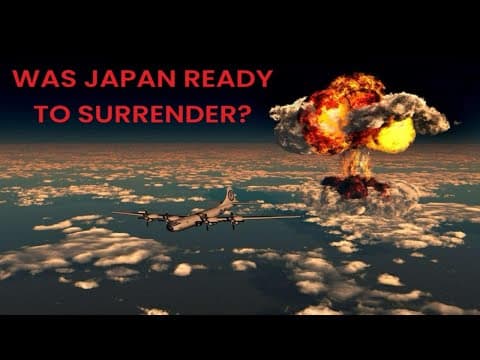
[0:00]Hello everyone. In this video, I want to cover the United States decision to drop the atomic bomb on Hiroshima and Nagasaki. And what I want to do is basically go through the Pacific Theater of War, you know, from Pearl Harbor to Midway, you know, island hopping, you know, finalizing with the Battle of Okinawa and finally the decision of Operation Downfall, right? Should we invade Japan versus should we drop the bomb? I don't think it's a spoiler to tell you that we decided to drop the bomb. So, I want to go over what made the United States take that decision, right? So, let's get started. And so, every time we covered the different theaters of War, the Pacific Theater of War, it is on a league on its own kind of sort of because of this, you know, out of the ordinary circumstances they are not going to see anywhere else, all right? And this is this all stands from the Bushido Code of Honor, right? So, this was the old Samurai honor code and it basically emphasized loyalty, discipline, uh, bravery, but more than anything, honor, all right? So, there was nothing more dishonorable than losing, right? And the only way to repay for that dishonor was to give your life. So, this is why getting near to mainland Japan is going to be extremely difficult, right? Because the Japanese do not care about losing their lives. There's nothing more dishonorable than losing and they are willing to sacrifice their life, right? Go will will now be, how can we get to Japan with all those fortified islands surrounding Japan? And so, this is going to start the new strategy of the US in the Pacific theater of War, which is island hopping. So, the idea of island hopping was basically to hop from island to island and skip the heaviest fortified ones, right? So basically, just go over the most strategic islands as opposed to going through each and every single one, right? So, this would eventually save a lot of time, resources and lives. So some of the biggest examples are Guadalcanal, over here, Iwo Jima, Okinawa, you know, the liberation of the Philippines eventually. You know, all these are grueling, incredibly difficult to dislodge islands, all right? So, this is going to set the tone for the Pacific Theater of War. And so, the success of island hopping is culminated with the Battle of Okinawa. The Battle of Okinawa is the most brutal battle of the Pacific theater of War. It's going to end with about 50,000 casualties for the Americans and about 100,000 casualties for the Japanese, all right? I, I think the best way for me to explain to you is that the closer we get to Japan, the closer we get to mainland Japan, the more desperate and the more radical the Japanese are getting, all right? So, the closer you get, the more Sepukus you're getting, the more Kamikazes you're start seeing, so for example, in the battle of Okinawa, there's over a thousand Kamikaze attacks. If you don't know what these things are, give me one second and let me show them to you. This is a video from the Smithsonian channel and it basically captures the desperation of the Japanese during the Battle of Okinawa, right? So let's watch.
[6:10]Yeah, it is pretty incredible, at least for modern times, and I think even for the 1940s standards. You know, this ideas of the Bushido Code of Honor, you know, the whole sepuku, the whole Harakiri, the whole Banzai attack. This is something that is going to condition the minds of the Americans into being very, I don't want to say necessarily traumatized, but very off-put by the idea of fighting the Japanese that they are going to force you to fight until the very end because they're not going to surrender, right? They're going to rather die in the battleground, right?
[11:41]Pretty incredible stuff, and this is when we get to the decision of we finally took Okinawa, what do we do to invade mainland Japan, right? By that time, the atomic bomb was developed, and I always find it a little unfortunate that Harry Truman has to be the person making the decision. Not because I dislike Harry Truman, but because FDR has been at the head of all this, FDR, you know, has been, you know, on board of all this, but FDR passed away in early 1945, and now the Vice President, Harry Truman, comes to power without any previous knowledge of how close we are to an atomic bomb, or if we're even planning to have an atomic bomb. He was in the shadow about all this, and now he has to be making the decision, you know, because the estimates were staggering, right? Basically, the estimates were the war was going to be prolonged at least two years and it was going to have at least a million casualties, right? At least a million American casualties, plus one or two million Japanese casualties, right? So, uh, Harry Truman is forced with the decision, all right? Do you drop the bomb or do you do the invasion of mainland Japan, all right? So, in preparation for this, I think this statistic is extremely fascinating, right? In preparation for the invasion of mainland Japan, uh, the US commissioned about a million purple hearts. You know, purple hearts is the medals that they give to soldiers if they get injured in battle, right? So, they thought at least a million people are going to be injured in this invasion of Japan, right? So, this purple hearts are still being given out or I think most of them were through the early 2000, they were still giving out the purple heart that were created during the 1940s in preparation for the invasion of Japan, right?
[13:43]That is how much people they thought were going to either die or get injured. Now, I don't think it's a spoiler to tell you that Harry Truman decides for the alternative of dropping the bomb. So, was dropping the bomb necessary or not? The reality is that in my personal opinion, I think the dropping the bomb was possibly the better solution. I know today is not seen with the best of eyes, but once you put everything into context, right? The entire Pacific Theater of War, the Bushido Code of Honor, how the Japanese are getting more desperate as they get near to mainland Japan, the reality was that Japan was already going to arm civilians, women, children, old men. Everyone was going to defend every inch of the island, right? So, this is why they knew or they estimated it's going to be at least a million more casualties, right? So, in order to avoid these casualties, they decided to drop the bomb. I want to dispel a little bit of a myth, I don't know how if I should call it a myth or not, but a lot of people tell me today, for example, Japan was ready to surrender before the dropping of the bomb. This is not a reality, all right? Japan did make some advances to the Soviet Union to try and see if Stalin was willing to negotiate a ceasefire, not necessarily a surrender, right? But a ceasefire, meaning Japan wanted to maintain, you know, the high command. They didn't want to be tried for crimes against humanity, they didn't want to have any sort of disarmament, they wanted to just the war to end, but with no consequences towards the Japanese. Now, the US was not willing to concede on any of this thing, right? The US basically demanded an unconditional surrender, and by the way, it is not going to happen. After two atomic bombs, we're not going to have an unconditional surrender per se. We do get the whole disarmament of the Japanese by the American people. We do get an American occupation for, I think it's seven years of Japan led by General MacArthur. We are going to get uh, some of the Japanese high command to be tried for crimes against humanity, but we are going to keep uh, Emperor Hirohito uh, as a figurehead of Japan for the next years, right? I think Hirohito die is going to die until 1989, but uh, it is not necessarily an unconditional surrender, right? So, the idea that Japan was willing to surrender before the bombs, it is kind of sort of I don't want to call it unfounded. They did reach out to the Soviet Union, but not for surrender, it was for a ceasefire, and all the other conditions that I I mentioned, and just think about it. After two atomic bombs, Japan did not immediately surrender, neither did they unconditionally surrender, right? There were still some attempts by some of the high command to, you know, do a coup, throw over the government and continue fighting, right? Uh, this just tells you about the zeal the Japanese had for fighting and how influential the Bushido Code of Honor. And I don't want to say the US was forced to use the atomic bombs, but it definitely influenced everything that happened in the Pacific to come to this uh, decision. Anyways guys, this will all have for today, let me know what you think, maybe you disagree with me, I would love to hear the opinions of people who disagree with me. Uh, my opinion is the dropping of the bomb, you know, was the decision to make at the time, but let me know what you think, all right? I'll be around and be safe.


