[0:00]Every morning at 9:35 AM the market provides an opportunity, and if you know how to read it, you can become a profitable trader fast. Most traders are drowning in complexity. Multiple timeframes, dozens of indicators, and conflicting signals everywhere. They've been told that THIS is what it takes to win. But here is what all profitable traders discover: All that complexity is just noise, and underneath it all, there is one simple pattern, on one timeframe, at one specific time every single day. I use this strategy to grow an account from $9,000 to $134,000 in less than 90 days, and I'm about to show you exactly how. And to prove this works, I'll walk you through recent trade examples and show you a one-month backtest of the strategy. And by the end of this video, you'll have a complete system for finding winning trades in under 90 minutes a day, that way you can finally become a profitable trader. There are three steps to this system. First, marking your levels. Next, finding your entry. And finally, exiting your trade at the perfect time. That's it. Now, I'm going to break these three steps down, and then go over some live examples, that way you have confidence when you're out there trading this strategy on your own. But first, you need to understand what each step actually is. So let's hop right into step number one, which is marking your levels. At 9:35 AM Eastern Standard Time, something happens that most traders completely miss. The first five-minute candle of the day closes, and when it does, it leaves behind two critical levels. You open your chart, any market works, whether it's futures, stocks, crypto, or forex, this pattern is universal. And then you just mark out two levels: the high of that candle and the low of that candle. That is literally it. Two lines on a chart, nothing else. No indicators cluttering your screen, no multiple timeframes to watch, just two levels that matter more than anything else you'll see all day long. Now, why these two specific levels? What makes them so powerful? I'll show you in the live examples, but for now just know this: These levels are where the real money gets made. Step number two is to find your entry. Now comes the waiting game. The market is going to tell you which direction that it wants to go. You're not guessing, you're not predicting, you're just watching for one specific signal. A five-minute candle that closes completely outside of your range. Not a wick, not a touch, a full-body candle closing beyond your high or below your low. And when that happens, the market has spoken, but you're still not entering yet, because here is what separates the winners from everyone else. You wait for a retest. After that breakout candle, the market almost always comes back. It retests the level that it just broke. Most traders are going to see this and panic because they think this means the trade is failing, or they think they missed it, but you know better. The retest is your entry point. It's the market giving you a second chance at a better price and letting the market prove that this isn't another fake out. And if you could avoid the fake out trades that are causing you to be unprofitable, my guess is your trading career would look a lot different, wouldn't it? So what exactly counts as a valid retest? And this is critical because there are fake retests that will stop you out immediately and there are real retests that lead to winning trades. The difference between the two can make or break your account. Don't worry, I'm going to show you multiple real examples in a moment, that way you can see exactly what a valid retest looks like and how to spot the fake outs before they hurt you. But here's the rule: The candle needs to trade back into your range without closing inside of it. And when you see this, you enter, because this is a valid retest. But entering trades alone doesn't pay you. Exiting at the right time does. And that is where step number three comes in. Now here's the most important part, and everything else that I just told you makes sense in theory, but execution is where most traders fail. So I'm going to take you to a live chart right now and show you exactly how to execute each step over multiple examples. And more importantly, I'm going to show you the three most common mistakes that traders make using the strategy, that way you never make them yourself. And in each one, I'll point out a different mistake traders make using this strategy. Because here's the truth: The reason that you're not consistently profitable yet isn't discipline and it's definitely not psychology. It's that you've been taught to overcomplicate something that should be simple. But by the time we're done here, you will know exactly how to trade with zero emotion, zero guesswork, and zero hesitation. Let's get started with step number one, which is marking our levels. So, as you can see here, we are at 9:30 AM. We're on the five-minute timeframe. To get here, you click this button right here on TradingView. And once this candle that starts at 9:30 and then ends at 9:35, because we're on a five-minute timeframe, once this ends, we are good to go ahead and mark the high and the low. To do this, we're going to go over here to the left on TradingView, and we're going to select the trend line tool, and then you can just mark out the high and mark out the low, and those are your two trading levels. And while everyone else is trying to predict what the market's going to do, we just simply wait and react to it. And this takes less than 30 seconds. You literally just get to your desk right at 9:35 AM and mark the high and the low. You don't need to spend hours trying to figure out what the market might do. So this brings us to step number two, which is our trade entry. So remember, we're just going to wait for a five-minute candle closure outside of the range. And as you can see, we get that pretty much immediately. A lot of times with this strategy, you're going to find the best trades very fast. But still, this is where 90% of struggling traders will fail. They chase this first move and go ahead and fomo into the market. We don't. But instead, we're going to wait for a retest. Now, what constitutes of a valid retest? Well, first off, we want to see the market trade back into our level. And after we see it trade back into the level like you see here, what we want to see is that same candle that hit the level, close back outside of it. This shows that buyers are stepping in and pushing the market back out of this range. This is a signal that the market is likely to go higher. So, I want you to think of this like a slingshot. When the market pushes outside of the range here, it's like we're pulling back the slingshot. And right when we get back here to this retest, this is when the market is fully ready to explode, and as soon as it hits this level and closes above it, that's like letting the slingshot go. And the market's likely to move aggressively to the upside. Notice how we're not using anything complex or trying to interpret 10 different signals. But instead, we're just watching price action. These rules are 100% mechanical. There is literally no room for emotion or hesitation when you have a system like this. So as soon as we've got this retest candle here, we want to enter the trade immediately. Now this brings us to step number three, which is finding our target, which is where we want to take profit on the trade, and our stop loss, which is where we will say the trade is invalid. Since we broke out of the high and retested it, this shows us buyers are in control, which means we want to get into a long position. You go over here to the left on TradingView, click the long position tool, and this is going to help us map out our trade. On this candle closure, that is where you would enter the trade. Now, this tool allows you to place your stop loss point and your target and help you understand what your risk to reward is and map out your trade before you even get started. First, we're going to place our stop loss to make sure we have good risk management, and we're going to do that at the midpoint of the range. In order to find the midpoint, we can go over here to the left on TradingView, click this button, click the fib retracement tool, and we just want to draw this from the high of that first five-minute candle down to the low. Now, to get your fib tool looking like mine, you want to have your settings look like this. The most important part is that you only have one, zero, and 0.5 checked. This puts a line right at the 50% or the midpoint of the range. So, we could go ahead and drag out this box right here, and this shows us that our stop loss will be right under that midpoint of the range. And if the market gets there during our trade, we're happy to get out for a very small and controlled loss. Now, when it comes to our target, we're not trying to hit home runs. We want to get consistent base hits. But here's the thing, for every $1 we risk, we want to make $2. Now, to do this, we're going to go over here to this long position tool, and we're going to drag out the target to two until this risk to reward says two. Once you've got this set, you can enter the trade. To do this, you go on TradingView and you just click the buy button, because remember, we're going in a long. Once you click this, you can just execute, and you drag your stop loss down just like this. And then you drag up your take profit like this. As you can see, we have $625 at risk to make $1,250. And at this time, you just sit back and let the market do the heavy lifting for you. And as you can see, we hit our target pretty quickly. This only took about six candles or 30 minutes to make $1,200. Now, I want to be clear, waiting for this retest is key. Because if you would have just foed in on this candle right here, you would have sacrificed almost half your profits. And you're going to see just how much of a difference this makes when we go over the back test later. So now that we've walked through one live execution and you understand how important it is to avoid FOMO, we're going to hop into the second of our three examples. And this is a perfect example of another common mistake that traders make using this strategy. And understanding this mistake is the difference between a high-probability setup and a coin flip. So we've got the first five-minute candle's high and low marked out. Next, we want to wait for our candle closure, and last we want to wait for our retest. As you can see right here, the market traded outside of the range, but we didn't close outside of it, so that would not be a valid break. And then finally, the market does close outside of the range. So now, we want to just wait for the retest. And as you can see, the market trades back into our level, but we close inside of it. And this is where a lot of traders will go wrong. They'll tell themselves that this still counts or they don't want to miss out on a trade, so they'll just execute, even though we didn't get our valid retest candle. But here's the thing: as long as you wait, you will likely still get a setup on this trade. As you can see here, the market does trade higher up into the range, and then what happens? The market trades back outside of the range, and we end up getting our retest. So if you just wait, a lot of times the market is going to reward you. Now, since this is a bearish example and we're breaking through the low, you'd want to go over here and select the short position tool, and you're good to execute it right here on this candle. To find the midpoint of the range, we're going to select that fib tool, and we're going to drag our stop just above that level, and then we want to target our fixed two to one risk to reward. It's the same thing every single day, boring and repeatable. And as you can see, the market ran pretty much straight to our target. And on this trade, which took about an hour, we netted $4,400 in profit. Now, let's hop right into example number three. And notice down here, you'll see that we're trading gold. In the last examples, we traded Nasdaq and the S&P 500. So as I told you earlier, this strategy works across all markets, and all of these are very recent examples. And the mistake that could have been made in this example is where most traders leave a tremendous amount of money on the table. So we've got our high, low, and midpoint of this first five-minute candle marked out. Next, we want to wait for our candle closure, and last we want to wait for our retest. Since we broke out of the high, we're going to place a long position with our two-to-one risk to reward. And at this time, you're good to enter the trade. Now, something is a little different about this setup. If we watch, the market starts to trade right in your direction, but then what happens? The market starts to chop. Now, for a lot of you, this is probably a painfully memorable experience. And in this chop is where a lot of you guys rob yourselves of being a profitable trader. Do you have the patience to execute your strategy that you trade currently and stick to it? My guess is probably not. But after you see the results of this strategy and you test it for yourself, you'll have no problem letting the system do the heavy lifting for you. As you can see, this trade did take a little bit longer to get to the target, until about 1:00 PM, you entered at around 9:40. So, this is something that a lot of traders make as a mistake is just exiting because they see choppy conditions. But the nice thing about this strategy is you have a clear repeatable system that helps you avoid that. Now, it's time for the back test. But before we get into this, I need you to pause your screen and read this important disclaimer. After testing this on a little over a month's worth of price action, we got 20 trades, 70% of them were winners, and we netted $10,000 using one contract. And during that time, we went to a max drawdown of $1,000. But look at how important it is to wait for the retest. We had a 70% win rate when we waited, but a 33% win rate when we didn't. Now, you have the strategy. But when the market opens and real money is on the line, if you're like most traders, doubt will creep in. That's why I trade live sharing my screen and executions with my students at market open. You see the setups in real-time, get your trades reviewed, and never have to trade on your own. Click the link that's in the top of the description to join. It'll be right next to the word mentorship. If you want a quick cheat sheet for this strategy, you can go ahead and screenshot this. This has all three steps. And if this video is helpful to you, make sure to subscribe to the channel, because I'll be putting out more content on this strategy and other ways you can make it even better next week. Also, there is a beginner's guide that I made and put here on YouTube for free, that you can click somewhere on your screen right now and watch. It goes over all of the basics of trading, the strategy, the psychology, and everything in between. That way you have everything you need to get started on the right foot.
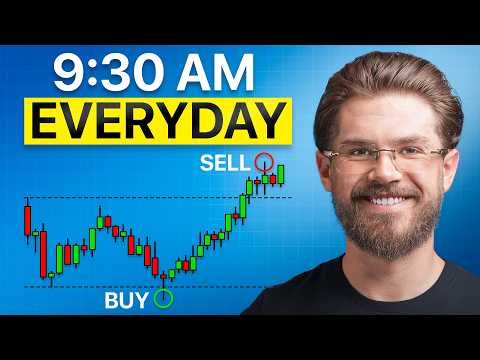
The 5 Minute Scalping Strategy (That Actually Works)
Casper SMC
14m 22s2,861 words~15 min read
YouTube auto captions
Transcript source
YouTube auto captions
This transcript was extracted from YouTube's auto-generated caption track. The transcript below is server-rendered so it can be read, searched, cited, and shared without opening the original YouTube player.
Pull quotes
[0:00]Every morning at 9:35 AM the market provides an opportunity, and if you know how to read it, you can become a profitable trader fast.
[0:00]But here is what all profitable traders discover: All that complexity is just noise, and underneath it all, there is one simple pattern, on one timeframe, at one specific time every single day.
[0:00]I use this strategy to grow an account from $9,000 to $134,000 in less than 90 days, and I'm about to show you exactly how.
[0:00]And to prove this works, I'll walk you through recent trade examples and show you a one-month backtest of the strategy.
Use this transcript
Related transcript hubs
Watch on YouTube
Share
MORE TRANSCRIPTS


