[0:00]Vladimir Lenin. Lenin was the guy who led the Bolshevik Revolution and founded the Soviet Union. Born Vladimir Ilyich Ulyanov in 1870 in Russia, he grew up in a smart, well-educated family. But his life took a radical turn when his older brother Alexander was executed for trying to assassinate Zar Alexander III. That event pushed Lenin toward revolution. He studied law, but got caught up in Marxist politics. Inspired by Karl Marx, he joined the Russian Social Democratic Labor Party, but later split off in 1903, forming the Bolsheviks. Lenin believed in a strict, organized revolutionary party to lead the working class to power. In 1917, with Russia in chaos during World War I, Lenin returned from exile and led the Bolshevik Revolution, overthrowing the government. His slogans, peace, land, and bread, and all power to the Soviets, won massive from the struggling people. After taking power, Lenin nationalized industries, seizing factories, banks, and land from private owners. He later introduced the new economic policy, allowing some small businesses and private trade to boost the economy. Lenin also oversaw the Red terror, a brutal crackdown on political enemies led by the secret police, the Cheka. During the Russian Civil War, Lenin's Red Army crushed the anti-Bolshevik White forces, securing Soviet rule. In 1922, he established the USSR. Lenin's health declined after multiple strokes, leaving him incapacitated by 1923. Before he died in 1924, he warned about Stalin's growing power, but Stalin ended up taking control anyway. Lenin's body was embalmed and placed in a mausoleum in Moscow where it's still on display today. Joseph Stalin. Joseph Stalin was a dictator who ruled the Soviet Union from the mid-1920s until his death in 1953. Stalin rose to power after the death of Vladimir Lenin, the founder of the Soviet Union, and he implemented a series of brutal policies to consolidate his control. Stalin's rule was characterized by totalitarianism, political repression, and the use of propaganda to maintain power. Stalin implemented a series of economic plans that led to rapid industrialization, but also caused widespread famine and hardship, particularly in rural areas. During World War II, Stalin played a key role in defeating Nazi Germany. After Hitler invaded the Soviet Union in 1941, Stalin's Red Army led major victories, like the Battle of Stalingrad, which helped turn the tide of the war. By the end of the conflict, the USSR had become a superpower, setting the stage for the Cold War with the United States. Nikita Khrushchev. Nikita Khrushchev ran the Soviet Union from 1953 to 1964 and was known for shaking things up with de-Stalinization, the space race, and the Cuban Missile Crisis. Born in Ukraine in 1894 to a poor family, he started out as a metal worker before joining the Bolsheviks in 1918. After fighting in the Russian Civil War, he climbed the ranks under Joseph Stalin. When Stalin died in 1953, Khrushchev outmaneuvered his rivals, including Lavrenti Beria to take control. In 1956, he gave the secret speech, calling out Stalin's brutal purges and personality cult. This kicked off de-Stalinization, leading to political reforms and a less repressive Soviet Union. He also tried to fix the economy with projects like the Virgin Lands campaign, which had mixed results. Khrushchev was big on the space race, overseeing the launch of Sputnik and Yuri Gagarin's historic space flight. But his time in charge wasn't all smooth sailing. His Cold War policies led to some tense moments, especially the Cuban Missile Crisis in 1962, which nearly started a nuclear war before the US and USSR struck a deal. At home, his reforms and economic policies didn't go over well with everyone, and by 1964, his rivals led by Leonid Brezhnev pushed him out. Khrushchev spent the rest of his life in quiet retirement until he passed away in 1971. Leonid Brezhnev. Leonid Brezhnev led the Soviet Union from 1964 to 1982, known for military expansion, strict control, and an economy that pretty much stalled. Born in Ukraine in 1906, he studied engineering before joining the Communist Party in the 1930s. He served in World War II, worked his way up the ranks, and became a trusted ally of Khrushchev, until he helped push him out in 1964. After that, Brezhnev took over and focused on keeping things stable and tightly controlled. He built up the Soviet military, cracked down on reforms in Eastern Europe, and in 1968, he sent troops into Czechoslovakia to crush the Prague Spring. He even created the Brezhnev doctrine, basically saying the USSR could intervene in any socialist country to stop change. On the home front, he poured money into heavy industry and kept living standards steady. But the economy started stalling, with corruption and inefficiency making things worse. He tried easing tensions with the West and signed arms control deals like Salt 1, but things got messy again when the USSR invaded Afghanistan in 1979. By the late 1970s, Brezhnev's health was failing, and his leadership became weak and ineffective. He stayed in power until he died in 1982, leaving behind a rigid bloated system that helped push the Soviet Union toward collapse. Yuri Andropov. Yuri Andropov led the Soviet Union for just a couple of years, from 1982 to 1984. Born in Russia in 1914, he started out in the Komsomol before climbing the ranks of the Communist Party. He worked as a diplomat and became ambassador to Hungary, where he played a key role in crushing the Hungarian uprising in 1956. In 1967, he took over the KGB, where he spent years spying on enemies and strengthening Soviet intelligence. After Brezhnev died in 1982, Andropov took over as General Secretary. He tried to shake up the sluggish Soviet economy by cracking down on laziness, enforcing discipline, and cutting down corruption. But his health went downhill fast, and he didn't have enough time to make any major changes. He stayed in power until he died in 1984, leaving behind an unfinished attempt at reform that never really took off. Konstantin Chernenko. Konstantin Chernenko led the Soviet Union for just over a year, from 1984 until his death in 1985. Born in Siberia in 1911, he joined the Communist Party in the 1930s and slowly climbed the ranks. He wasn't known for any big ideas, just for being loyal to Leonid Brezhnev. After Yuri Andropov died in 1984, Chernenko was picked as General Secretary, even though he was already in bad health. As leader, he basically brought back Brezhnev era policies, resisting any reforms. The economy stayed stagnant, Cold War tensions dragged on, and nothing really changed at home. His health quickly got worse, making him largely inactive, and his leadership was more symbolic than anything. He stayed in power until he died in 1985. Mikhail Gorbachev. Mikhail Gorbachev was the last leader of the Soviet Union from 1985 to 1991. Born in 1931 in Russia, he studied law at Moscow State University and worked his way up in the Communist Party, earning a reputation as a reformer. After Konstantin Chernenko died in 1985, Gorbachev took over as General Secretary and launched economic restructuring and openness, hoping to fix the struggling Soviet economy and bring more political transparency. These changes gave people more freedom, but also caused economic chaos and political instability. On the global stage, he worked to ease tensions with the West, signing arms reduction treaties with the US and effectively ending the Cold War. But at home, things were falling apart. Nationalist movements in Soviet Republics gained momentum, pushing for independence. In 1991, a failed coup by hardliners left him weakened, and by December, the Soviet Union dissolved, forcing him to resign. After leaving power, he remained a controversial figure. Some saw him as a hero, while others blamed him for the fall of the USSR.
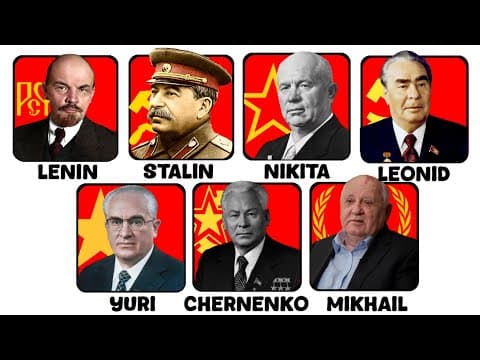
Every Leader of The Soviet Union Explained
Dr. Explained
8m 24s1,304 words~7 min read
YouTube auto captions
Transcript source
YouTube auto captions
This transcript was extracted from YouTube's auto-generated caption track. The transcript below is server-rendered so it can be read, searched, cited, and shared without opening the original YouTube player.
Pull quotes
[0:00]Lenin was the guy who led the Bolshevik Revolution and founded the Soviet Union.
[0:00]Born Vladimir Ilyich Ulyanov in 1870 in Russia, he grew up in a smart, well-educated family.
[0:00]But his life took a radical turn when his older brother Alexander was executed for trying to assassinate Zar Alexander III.
[0:00]Inspired by Karl Marx, he joined the Russian Social Democratic Labor Party, but later split off in 1903, forming the Bolsheviks.
Use this transcript
Related transcript hubs
Watch on YouTube
Share
MORE TRANSCRIPTS


