[0:00]There's a very common experience in the Christian life, but one we rarely talk about. It's the feeling of being spiritually empty. We know in our minds that we have the Holy Spirit, but we don't feel filled with the Holy Spirit. Our life of faith often feels like it's running on empty, marked by constant weakness. A lack of power and an absence of joy. This brings us to the big question. Is being filled with the spirit a mystical, unpredictable bolt from the blue? Something that happens to a lucky few. Or is it the result of cultivating a certain kind of life? How do we go from being an empty vessel? To one that is overflowing. To answer this, let's look to the wisdom of John Wesley, not as a mystic, but as a spiritual pragmatist. He believed that while the filling of the spirit is a gift of God's grace, there are clear and practical means of grace. What we will call holy habits that position us, that prepare our souls to receive this gift more fully. To understand this principle, Jesus himself gave us the perfect analogy. Remember the story, all 10 virgins had lamps which represent the vessel of our faith. And they all waited for the bridegroom. The tragic difference between them was what they did during their time of waiting. The wise virgins cultivated the habit of securing the oil. The habits we will discuss in this investigation are the oil for the lamp of our soul. They are not the light in themselves. The light is Christ, but they are the necessary fuel that allows our light to shine brightly when the time comes. Before we explore the first habit, I want to invite you to declare a blessing over your own life. The pursuit of being filled with the spirit begins with the faith that God has more for you. In the comments, leave this powerful phrase as a declaration of faith and a cry from your heart. Write, God has more for me and by faith I receive. Declare this from your heart. And believe that God will bless you powerfully for your faith. With this truth firmly established, let's move on to the first habit. If our life is a vessel, the first habit of spirit-filled Christians defines the first thing we put into it each day. And it addresses our most common pain, the experience of starting the day already at a spiritual deficit. Immediately consumed by the noise and demands of the world before we even connect with God's presence. John Wesley's legendary habit of waking at 4:00 in the morning wasn't about legalism, it was about a principle. Offering God the first fruits of your time and mental energy, thus consecrating the rest of the day to him. And here lies the counterintuitive revelation. This habit isn't about earning points with God. Or earning his favor for the rest of the day, it's about calibrating the compass of the soul. The first voice you choose to listen to in the morning, the first thought you allow into your mind, determines the direction of your thoughts and reactions for the rest of the day. This radically changes our approach. The practical application is a covenant, the covenant before the screen. Commit this week to spending at least 15 minutes with God in his word and in prayer. Before your hand touches your cell phone or any other screen. Think of this through the most powerful of metaphors. The first hour of your day is the helm of the ship of your life. The rudder is a very small part of the ship. But it is the only part that determines the direction of the entire vessel throughout the day's journey. Give the rudder to God. With our time set aside for God, we come to the second habit. And it defines the nature of our communication. And it addresses our pain of a prayer life that feels dry and repetitive or of Bible reading that feels like nothing more than a history lesson. Devoid of any personal connection. John Wesley didn't separate Bible reading from prayer. For him, they were two parts of the same conversation. He called his time alone with God conferring with the Almighty. He read the word to hear what God had to say to him, which he called inhaling, and then he prayed the word back to God as his response. Which he called exhaling. And herein lies the breaking of expectation. The most powerful prayers are not those born of our own ideas or our own needs. They are those that are simply an echo of God's Word itself. Praying the scriptures is praying in perfect alignment with God's already revealed will. This radically changes our approach. The practical application is to pray a psalm. Take a psalm you love, like Psalm 23. Read the first verse. The Lord is my Shepherd, I shall not want. Then pause and transform that verse into a personal prayer. Father, thank you so much for being my Shepherd today. Thank you that in you I know I shall not want. Please Shepherd me in my decisions today. Think of this through the simplest of analogies, that of conversation. A good relationship is not a monologue. Reading the Bible without praying is like just listening in conversation. Praying without basing yourself on the word is like just talking. John Wesley's habit combined the two into a true dialogue. A conversation that warms the heart. With our prayer becoming a dialogue with God, we come to the third habit. And it sets the temperature of this conversation. And it addresses our pain of a prayer life that is polite, formal, correct. But completely devoid of passion. John Wesley believed based on scripture in earnest or fervent prayer. And for him, this had nothing to do with the volume of our voice, but with the intensity of our desire. It is the engagement of our whole soul, our mind, our will and our emotions in a sincere cry to God. And here lies the breaking of expectation. The Apostle Paul warns us not to quench the spirit. And often, what extinguishes the fire of the spirit within us is our own indifference. A fervent heart, a heart burning with desire for God is the atmosphere the Holy Spirit loves to fill. This radically changes our approach. If you notice that your prayers are cold and mechanical, don't try to warm up them with your own strength. Instead, pray beforehand. Lord, please set my heart on fire, give me your passion for the things that are in your heart. Think of this through the simplest of analogies, that of water. Lukewarm water is useless. It doesn't cook anything, it doesn't purify. Cold water can refresh, but hot water, boiling water has power. It softens what is hard, it purifies. It generates the steam that drives machines. God doesn't look for lukewarm hearts, he looks for hearts that are warm in their devotion. And sometimes to warm the heart, we need to discipline the body. If fervent prayer is the engine of our faith, we come to the fourth habit, which is the supercharger of this engine. And it attacks our most modern blockage, a life dominated by our physical appetites and our love of comfort. Which inevitably leads to a dull and insensitive spirit. John Wesley and the early Methodists practiced fasting regularly every week. And for them, this was not a way to punish the body. It was a way to discipline it, to awaken it, and to express with their whole being the seriousness of their search for God. And here lies the breaking of expectation. Fasting is not a hunger strike, to try to force God's hand to give us what we want. It is a physical declaration of a spiritual reality. It's the act of saying with our bodies. My desire for God right now is greater than my desire for my own comfort and even my food. It's the act of detaching ourselves from the world to cling more fully to God. This radically changes our approach. The practical application is to start small. Try fasting from a single meal this week. And use the time you would otherwise spend eating, not for other activities, but for feasting on God's Word and prayer. Think of this through the most modern of analogies, that of the radio. Our bodily appetites and the distractions of the world are like a local radio station playing too loud, filled with static. Fasting is the act of deliberately turning down the volume of the meat station. So that we can finally hear more clearly the signal from the heavenly station, which is often quieter, but infinitely purer. With the body being disciplined to awaken the spirit, we arrive at the fifth habit. It defines the maintenance of the cleanliness of our hearts. It addresses our ache for a vague feeling of guilt, that feeling of distance from God. Without us understanding the specific blockage. One of the key questions in Methodist class meetings, which were the heart of Wesley's movement, was this: How is your soul? This simple question fostered the habit of regular and honest self-examination, always in the light of scripture. And herein lies the breaking of expectations. The Holy Spirit is holy and he will not fill a vessel. That is knowingly accumulating filth. A clean heart is not a prerequisite for our salvation. Which is by grace, but it is a condition for the fullness of our communion with him. This radically changes our approach. The practical application is what we might call a nightly assessment. Before bed, spend five minutes with the Holy Spirit, reviewing your day, not in a spirit of self-condemnation. But of honesty. Where have I been impatient? Where have I been proud? Where have I been selfish? Confess this quickly and specifically, and receive the cleansing that the blood of Christ has already provided. Think of this through the clearest of analogies, that of a pipe. The Holy Spirit is a river of living water, flowing with infinite pressure. Our hearts are the pipe through which this water must flow. Each unconfessed sin is like a bit of rust, a piece of debris, that begins to accumulate inside the pipe, obstructing the flow. Over time, the powerful flow diminishes to a weak trickle. Daily repentance is the act of flushing the pipe, of keeping it clean and unobstructed. With our hearts cleansed by repentance, we come to the sixth habit. It defines the environment where the vessel is protected, and it attacks the most modern temptation of all. That of an individualistic and isolated faith. That me and Jesus Christianity, which struggles alone to stay warm in an increasingly cold world. The genius of the Methodist movement lay not only in Wesley's personal discipline, but in his radical emphasis on community. He organized new believers into classes, which were small groups for encouragement, accountability and mutual prayer. And herein lies the shattering of expectations. We were not designed to be filled with the Holy Spirit in isolation. The fire of Pentecost, the first time the church was filled with the spirit, fell not on a lone individual. But on a group that was altogether in one place. Worship, prayer and corporate fellowship are channels of God's grace. That we cannot access alone. This radically changes our perspective. Stop seeing church and your small group. As an optional add-on to your spiritual life. Start seeing them as essential environments designed by God to fill you and keep you full. Think of this through the simplest of analogies, that of hot coals. If you take a single coal from a fire and leave it alone on the cold ground, within minutes it will go out. But if you take that same coal and place it next to other coals, something wonderful happens. They begin to warm each other. The heat intensifies, and together they become a powerful fire. We are these coals. With our hearts warmed by community, we come to the seventh habit. One that is often neglected, and it addresses the pain of a spiritual life that is constantly sabotaged. By a lack of physical energy and mental clarity, which stems from neglecting our own bodies. John Wesley was a strong advocate for physical health. He even wrote a popular medicine book, and is famous for saying that cleanliness is next to godliness. He understood the deep and inseparable connection between our body and our soul. And herein lies the shattering of expectations. Our body is not just a shell that carries our soul. The Bible tells us that it is the temple of the Holy Spirit. Therefore, neglecting our physical health through poor diet, lack of sleep or laziness is not just a physical issue. It is a spiritual issue. It is like allowing God's temple to fall into ruin and disarray. This radically changes our perception. The practical application is this. Begin to see your healthy habits, a good night's sleep, a nutritious diet, regular exercise, not as acts of vanity. But as acts of worship and stewardship of the vessel, God gave you to inhabit. Think of this through the most beautiful of analogies, that of an instrument. Your body is the instrument through which your spirit, filled with the Holy Spirit, plays its music to the world. If the instrument is broken, out of tune, or poorly maintained, even the most talented musician cannot produce a beautiful clear sound. Caring for our body is the act of tuning the instrument to the maestro. With our bodies cared for like a temple, we come to the eighth habit. It defines our attitude toward the majority of our time, our work. It attacks our blockage of the false division between the sacred, which is what we do in church. And the secular, which is our work, which leads us to feel that most of our lives are spiritually insignificant. John Wesley inherited the strong Puritan ethic of the Coram Deo, the practice of living one's entire life before the face of God. For him, his work, whatever it may be, was not a diversion from his spiritual life. It was his primary battlefield for glorifying God. And here lies the breaking of expectations. Being filled with the Holy Spirit is not about escaping your daily work to do God's work. It is about bringing God's presence into your daily work. Excellence in your profession, your unwavering honesty in business, your servant's heart toward your colleagues and clients. These are some of the most powerful and rare expressions of a spirit-filled life. This radically changes our mindset. Don't work just for a paycheck. As the Apostle Paul teaches us, whatever you do, work at it with all your heart as working for the Lord, not for men. Think of this through the most beautiful of metaphors. The spirit-filled Christian builds an altar of integrity. Excellence and service in the middle of their office, workshop or kitchen, and they transform their daily work. However mundane, into an offering of worship to God. With our daily work consecrated to God, we arrive at the ninth habit. Which defines the overflow of this consecration, and he attacks our pain with a self-centered spirituality. Focused only on our own experience and our own blessings, with little or no real compassion for those suffering around us. John Wesley's ministry was marked by a relentless and practical focus on the poor and lost of his nation. The fire of the spirit in his heart produced the warmth of compassion for those living in the cold of poverty and spiritual darkness. And herein lies the breach of expectation. You cannot be truly filled with the spirit of Jesus, and at the same time remain indifferent to the things that break the heart of Jesus. A lack of compassion and evangelistic zeal is a clear sign that the vessel is not in fact full. This radically changes our approach. The practical application is the prayer of brokenness. Ask God to break your heart with the things that break his. Ask him to give you his eyes to see the spiritual and physical needs of those around you. Not with judgment, but with compassion. Think of this through the most beautiful of analogies. A vessel that is truly filled to the brim, will inevitably overflow with the slightest movement. A life filled with the spirit cannot contain God's love. It inevitably pours that love out in acts of mercy, justice and witness to the world. With a heart overflowing with love. We come to the 10th habit. It defines the atmosphere of a spirit-filled life. It attacks our most common block. A spiritual life characterized by complaining, negativity and a constant focus on what we lack, rather than what we have already been given. John Wesley's journals, despite recording his immense hardships, persecutions and illnesses, are filled with expressions of gratitude. And deep joy in God. He understood that gratitude is not a feeling, but a discipline. It is the fertile soil in which all the other virtues of the spirit can grow. And here lies the breaking of expectations. A complaining spirit and a spirit filled with the Holy Spirit cannot coexist in the same heart. Gratitude is not just a polite response to God's blessings. It is an act of spiritual warfare. It is our declaration of faith that silences the voice of the accuser. And affirms the goodness of our God, even in the midst of difficult circumstances. This radically changes our approach. The practical application is the gratitude list. End each day before bed by writing in a notebook three specific things you are grateful for that day. This simple habit has the power to train your brain and soul to look for God's Grace everywhere. Think of this through the most beautiful of metaphors. The Bible tells us that a life filled with the spirit. Exudes the fragrance of Christ. If love is the main essence of this perfume. Gratitude is its sweetest and most noticeable note. With a heart that has learned to be grateful. We come to the 11th habit, which is the foundation of all the others, and it attacks our most subtle and most dangerous pain. Spiritual pride, the one born of our knowledge, our experience or our success in ministry. And which secretly blocks the continuous flow of the Holy Spirit. Despite his immense impact, John Wesley maintained throughout his life a deep sense of his own unworthiness. And his constant need for Christ's Grace. He never saw himself as a giant, but always as a sinner saved by Grace. And herein lies the breaking of expectations. The secret to being continually filled with the spirit is to live in a state of continual self-emptying. Humility is the spiritual vacuum that attracts God's presence. This radically changes our mindset. The goal of the Christian life is not to become full of oneself. Of one's own virtues and successes, it is to become so full of him, that you empty yourself of yourself. Think of this through the lens of John the Baptist. The constant prayer of a spirit filled heart is the same as John the Baptist's. As he looked to Jesus, he must increase, but I must decrease. With a humble heart, we come to the 12th and final habit, and it defines our trajectory. And it attacks our most subtle blockage, that of reaching a comfortable plateau in the Christian life. And losing the desire to grow, to go deeper, to press on to perfection, as Wesley would say. The great goal of the Christian life for John Wesley was to be perfected in love. And he saw this as a lifelong pursuit. A spirit filled Christian for him is never satisfied with their current spiritual state. They always yearn for more. And herein lies the breaking of expectation. The Holy Spirit is a spirit of life, of dynamism and of movement. Therefore, to be filled with him, is to be filled with a holy impulse. With a desire to constantly press toward the Mark for the prize of the upward call of God in Christ Jesus, as the Apostle Paul said. This radically changes our approach. The practical application is this. Always have a next step. What is the next area of your character that you are intentionally asking the spirit to transform. What is the next spiritual classic you plan to read? What is the next level of generosity you want to achieve? Keep moving. Think of this through the clearest of analogies. A lake may be full, but if the water doesn't move, it becomes stagnant. A river on the other hand, is always full, but it is also always moving, always flowing toward its destination. The spirit filled life is not a stagnant lake, it is a flowing river. Our journey has shown us the architecture of a God filled life according to the wisdom of John Wesley. We've explored the habits that create space for the Holy Spirit to fill us. Consecrated time, immersion in the word, quick repentance, fervent prayer, communion, stewardship of the body. And a heart marked by humility, love and gratitude, and all of this leads us to the powerful and final truth. These are not 12 separate and independent habits that you must juggle. They form a spiritual ecosystem, an upward spiral of Grace, where each habit feeds and strengthens the next. Your time in the word fuels your prayer, your prayer leads you to repentance, repentance fills you with love and gratitude. Love propels you toward mission, and the journey fills you with humility, which makes you desire to spend more time with God. And the spiral begins again, ever stronger. The final invitation therefore, is not to feel overwhelmed by a list of 12 tasks. The secret is to simply begin. Choose one, just one habit, the one the Holy Spirit has spoken most to your heart during this investigation. And start there, the consistent practice of a single habit will create the hunger and spiritual energy for the next. Let's conclude with a prayer of consecration. Father, forgive us for our half-hearted faith. Forgive us for settling for empty vessels when you offer us a life that overflows. We ask you create in us a holy and desperate desire for a life that is each day more filled with your presence. If you would like a practical guide to implementing these habits into your daily routine. And building a system for a spirit filled life, I've detailed this journey in my ebook, Powerful Prayer. It's an invitation to step outside the box and begin to architect a life of power and intimacy with God. Click the link in the description to get started. If you accept this invitation to a fuller life, declare it, scroll down to the comments and write this petition. Of a vessel opening to the rain from heaven, Lord, fill my vessel. And now receive this blessing. May the God of all Grace who calls you to be a vessel of honor, pour out his spirit upon you without measure. May he give you the discipline to seek and the joy to find. May every habit become a delight, and may your life overflow with the fruit of the spirit, for the glory of the Father. The edification of the church and the salvation of the world. Amen.
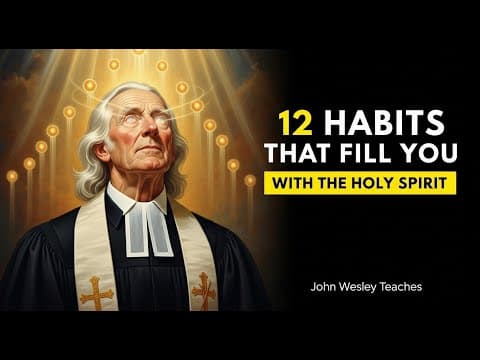
25m 33s3,961 words~20 min read
YouTube auto captions
Transcript source
YouTube auto captions
This transcript was extracted from YouTube's auto-generated caption track. The transcript below is server-rendered so it can be read, searched, cited, and shared without opening the original YouTube player.
Pull quotes
[0:00]There's a very common experience in the Christian life, but one we rarely talk about.
[0:00]We know in our minds that we have the Holy Spirit, but we don't feel filled with the Holy Spirit.
[0:00]Our life of faith often feels like it's running on empty, marked by constant weakness.
[0:00]To answer this, let's look to the wisdom of John Wesley, not as a mystic, but as a spiritual pragmatist.
Use this transcript
Related transcript hubs
Watch on YouTube
Share
MORE TRANSCRIPTS


