[0:00]Hi friends. If you stand in front of a plane mirror, do you know exactly where your image will be formed?
[0:08]That's right. It's going to be behind the mirror. The distance between the image in the mirror will be exactly same as the distance between you and the mirror. We also know the properties of the image. It's going to be virtual and upright and the image will be the same height as you. But now if I replace the plane mirror with a concave mirror. Can we predict where the image will be formed? It's not so easy now. Or if I replace it with a convex mirror, where will the image be formed? What will its properties be? In this video, I'm going to make the topic of image formation for spherical mirrors, that is the concave and convex mirrors really easy for you. And as usual, we'll finish off with our top three questions on this topic. Before we look at spherical mirrors, let's do a quick recap on how to draw the ray diagram for a plane mirror. As we discussed, we know all the properties of the image formed by a plane mirror. Image height equals object height and image distance equals the object distance. So we can cheat here. We first draw the image and then we draw the light rays and produce them backwards to match the image. We take two rays from each point on the object because you need a minimum of two rays to obtain a point on the image. So for a plane mirror, the image is drawn first and then the light rays. But we can't do this for a concave or a convex mirror because we are not sure of the properties of the image. We must use the light rays and the light ray rules for obtaining an image for spherical mirrors. Let's start with the concave mirror. The concave mirror is a converging mirror. For image formation, we need to draw the concave mirror accurately. Let me show you a simple trick for that. Draw a line representing the principal axis. Using a ruler, mark three points. Where C is at 0 cm, F is at 3 cm, and P is at 6 cm. You can take any convenient distance. F should be exactly in the middle. Such that CF equal to FP. C is the center of curvature. F is the focus, and P is the pole of the mirror. Now use your compass to draw an arc for the concave mirror. The compass point should be placed at C, the center of curvature and the radius of the arc will be CP, which is equal to 6 cm in this case. Mark the backside of the mirror with these dashes. Now let's talk about the rules for image formation of a concave mirror. Light is a very visual topic. So I suggest you to keep pausing the video and drawing the ray diagrams for these rules in your notebook. Then you'll get a better feel of what is going on. There are four rules for a concave mirror. So let's take a look at them. Rule 1: ray of light which is parallel to the principal axis, after reflection passes through the focus. Rule 2: ray of light passing through the center of curvature is reflected back along the same path. Do you know why? That's right. The ray of light falls normally. Perpendicular to the mirror. That's why it's reflected back along the same path. Rule 3: ray of light passing through the focus after reflection becomes parallel to the principal axis. Can you see that rule 3 is exactly opposite of rule 1? It's due to reversibility of light. Rule 4: ray of light which is incident at the pole of a concave mirror is reflected back making the same angle with the principal axis.
[4:37]It looks like a plane mirror type of diagram, since the principal axis is like the normal here and the angle of incidence is equal to the angle of reflection. Let's place the four rules that we have learned for concave mirrors on our concept board. Remember, when drawing an image, you need two rays from a point on the object. So for concave mirrors, you need to select two rules that are convenient for the diagram. Now an important note here is, avoid using the fourth rule unless really necessary. Because it's hard to measure angles accurately with your protractor. So it can lead to inaccuracies in the diagram. So basically, you need to use two out of the first three rules for concave mirrors. Now I'm going to be the object and I'll go and stand in front of the concave mirror and you need to find my image. So are you ready? Let's try it out. Here I am on the principal axis. I'm far away from the concave mirror. I'm going to walk towards the mirror and stand on different places on the principal axis. And you'll see that the image will change based on my location. So let's start with case one. I'm beyond C, the center of curvature. You need to consider the rays from the top of the object. So from my head. And remember, we need to take two out of the first three rules. So let's use rule one. For the ray that is parallel to the principal axis after reflection it passes through the focus. And for the second ray, we can use rule two. So the ray passing through the center of curvature gets reflected back along the same path. Now what does the intersection of these two reflected rays represent? That's right. It's the image and it's the image of my head. Because we started with the rays from the top of the object. Now where is the feet in my image? You don't need to draw the rays for that, the feet lie on the principal axis. So we can simply extend the image to the principal axis and find the bottom of the image. So as you can see here, using the ray diagram, we have found the position of my image. What are the properties of the image? There are three points here. Is the image real and inverted or is it virtual and upright? Is the image magnified, diminished, or is it the same size as the object? And what is the position of the image? So let's see what are the properties of the image for case one. As you can see here, the image is real and inverted. It's real because it's formed by the real intersection of light rays. And it's upside down, so it's an inverted image. As you can see, the image is diminished because it's smaller than the size of the object. And the position of the image is, it's located between the center of curvature and the focus. You'll find similar diagrams in your textbook. Of course, I won't be the object there. Usually, we use an up arrow to represent the object and it's marked as AB. And the image is also going to be an arrow and marked as A'B'. Here the arrow of the image is inverted since it's an inverted image. Now let me walk closer to the mirror. I'm going to stand at C, the center of curvature for our case two. Once again, let's draw the rays from the top of the object. We need to use two rules from the first three rules. So for our first ray, let's use rule one. The ray that is parallel to the principal axis after reflection passes through the focus. Now I can't use rule two since I'm standing on the center of curvature. So let's go ahead and use rule three. The ray that is passing through the focus. After reflection is parallel to the principal axis. So this is our second ray here. Where is my image? As you can see here, it's exactly below me. What is the nature or properties of the image? It's real and it's inverted. It's the same size as the object. So the same height as me. And its position is at the center of curvature. If you try drawing the ray diagram for this case two, where the object is at the center of curvature, you might find that you're not getting the image exactly at the center of curvature. Now this can happen if the focus F is not exactly between P and C. Or if the rays are not drawn very accurately. So to avoid such errors, an important exam tip is to use the cheating trick, just like we did in plain mirrors. So you first draw the inverted image at the center of curvature and the image height is equal to the object height and then you draw the rays. So then you'll get the image accurately. Now I'm going to move closer to the mirror. The object, that is me, is between the pole and the focus here.
[11:26]Now let's use rule one and rule two to draw the light rays from the top of the object.
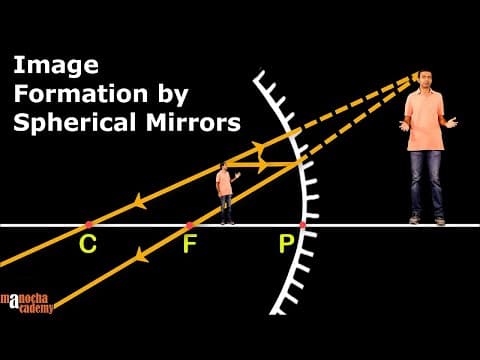
[12:20]And as you can see here, the reflected rays are divergent. So let's produce them backwards to obtain our image. Wow, can you see? I'm magnified here.
[12:37]So what are the properties of the image? The image is virtual and erect. It's magnified and as you can see, it's formed behind the mirror. Do you know how the concave mirror is used in this case? That's right. It's used as a shaving mirror. Since you appear magnified, it's much easier to shave. Now that we are done with the topic of concave mirrors, let's take a look at the other type of spherical mirrors, the convex mirrors. The convex mirror is a diverging mirror. For image formation, we need to draw the convex mirror accurately. Similar to the concave mirror, draw a line representing the principal axis. Using a ruler, mark three points, where P is at 0 cm, F is at 3 cm, and C is at 6 cm. You can take any convenient distance, as long as F is exactly in the middle between P and C. So the distance CF is equal to FP. P is the pole of the mirror, F is the focus, and C is the center of curvature of the mirror here. Note that in a convex mirror, the F and C are on the opposite side compared to a concave mirror. Now use your compass to draw an arc for the convex mirror. The compass point should be placed at C, the center of curvature. The radius of the arc will be CP equal to 6 cm in this case. Mark the back side of the mirror with these dash lines. Now let's talk about the rules for image formation of a convex mirror. Just like concave mirrors, there are four rules for a convex mirror. Rule 1: ray of light which is parallel to the principal axis, after reflection it appears to be coming from the focus. Can you see that the real rays are shown in solid lines? And those behind the mirror are shown with a dashed line. Rule 2: ray of light going towards the centre of curvature of a convex mirror is reflected back along the same path. Rule 3: ray of light going towards the focus after reflection becomes parallel to the principal axis. Can you see that rule 3 is exactly opposite of rule 1? It's due to reversibility of light. Rule 4: ray of light which is incident at the pole of a convex mirror is reflected back making the same angle with the principal axis.
[15:33]Here the angle of incidence is equal to the angle of reflection. Let's place the four rules that we have learned for convex mirrors on our concept board. Similar to concave mirrors, avoid using the fourth rule unless really necessary. Because measuring angles accurately with your protractor is hard and it can lead to inaccuracies in your diagram. So basically, you need to select two out of the first three rules for convex mirrors. Once again, I'm going to be the object and I'll go and stand in front of the convex mirror and you need to find my image. So are you ready? Let's go ahead and try it out. Here I am on the principal axis at a certain distance from the convex mirror. Again, we need to take the light rays from the top of the object, so my head. Remember, we need to use two rules from the first three rules. So for the first ray, let's use rule one. The light ray that is parallel to the principal axis after reflection appears to be coming from the focus. And for the second ray, let's use rule two. The light ray, which is going towards the center of curvature, gets reflected back along the same path. Now where do these two reflected rays meet? The reflected rays are divergent here, so we need to produce them backwards. And the point where they meet is the position of the image of my head. Since we considered the rays from the top of the object. Now where are the feet in my image? That's right. On the principal axis. So we simply need to extend the image down to the principal axis and we get the bottom of the image. So you don't need to draw rays for that. And as you can see from this ray diagram, we have found the position of my image. What are the properties of the image formed here? The image is virtual and upright. It's virtual because it's formed by the reflected rays extended backwards. The image is diminished. And as you can see, it's formed behind the mirror. Now let me walk closer to the convex mirror. Again, we are going to use two out of the three rules to obtain our image. And as you can see, the image formed has similar properties. It's virtual and erect, it's diminished, and the image will be formed behind the mirror. Remember, the concave mirror had so many different cases. But the convex mirror is the easy one in the syllabus. Because it doesn't matter where you stand in front of the mirror, the image properties are always going to be the same. It's going to be virtual and erect, diminished, and the image will be formed behind the mirror. Have you noticed the convex mirrors used at the intersection of roads? What is the nature of the image produced in the convex mirror? That's right. It's always virtual, upright, and diminished. Imagine if that convex mirror given inverted image, then the driver would get all confused and an accident may happen. So the convex mirror always produces a virtual, upright, and diminished image. I hope the image formation for concave and convex mirrors is super clear to you now. Light is a very visual chapter, so I would suggest you to practice by drawing ray diagrams and trying to predict where the image is formed. Then you'll feel more confident about these light ray rules. And do remember to subscribe to my YouTube channel and follow my Facebook page. And do check out my website manochaacademy.com. And do remember to try the quiz and the top three questions on this topic. Links are given below the video. Thanks for watching.


