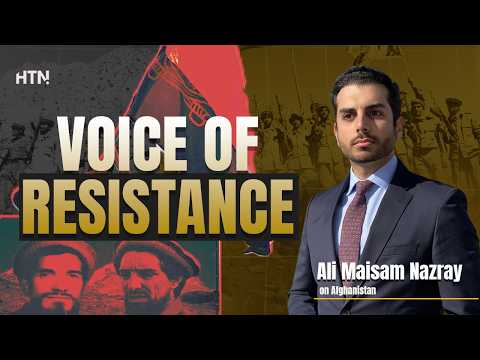
[0:00]The National Resistance Front of Afghanistan is a popular movement. The natural resistance front of Afghanistan is fighting for the liberation of Afghanistan's people.
[0:13]NRF is the true representative of the people of Afghanistan. Do you think that it possesses some kind of potential political power inside Afghanistan or is it just there in the virtual world?
[0:36]We are a political and military movement. The National Resistance Front has been fighting a multi-front war and struggle, not only for our interests, but for the security interests of our region and the international community. Not only facing one terrorist group, we're facing a myriad of terrorist groups. 21 regional and international terrorist networks. Taliban are obviously denying the presence of their footprint over there in Afghanistan, but do you think that these are illegitimate concerns?
[1:22]We don't have any foreign backing or sponsor, and we're facing a group that's armed to the teeth with NATO weapons and munitions and equipment. Just last year, more than what 70 of our operations were verified by the United Nations security General.
[1:45]The Taliban is a paper tiger and with time and the right resources, we will be able to overthrow them. Thank you so much, Mr. Ali, for being here and for joining us on this special episode.
[2:04]It's been long that we were trying to reach you out and I'm sure you're very busy and you're, you know, traveling around the world trying to lobby for Afghanistan, for the people of Afghanistan and especially for NRF. Because in your perspective, in your view, NRF is the true representative of the people of Afghanistan. So I'll start from there. NRF, do you think that it possesses some kind of potential political power inside Afghanistan or is it just there in the virtual world? Well, first and foremost, uh, thank you very much for having me on your program. Um, it is always great to speak with, um, our brothers, um, and, um, to bring the clarifications and to resolve many of the misconceptions and misunderstandings that have existed on both sides of the border for almost 80 years now. Yeah. When it comes to the National Resistance Front, um, we are a political and military movement that was formed in August of 2021 when NATO left Afghanistan and Afghanistan's Republic collapsed. And a vacuum was created and unfortunately, that vacuum and void was filled by the Taliban terrorist group and their other terrorist allies, regional and global terrorist networks. And since then, the National Resistance Front has been fighting a multi-front war and struggle, um, not only for our interests, but for the security interests of our region and the international community, and we've been highly successful. Politically, we've shown legitimacy, the people of Afghanistan support our struggle, support our resistance, and one way of demonstrating that is in August of 2021. The National Resistance Front of Afghanistan, also known as the NRF, we were only present in two provinces of Afghanistan, two provinces out of 34 provinces. Today, we're present in 22 provinces out of 34 provinces, meaning the majority of the country. And the reason isn't because we're supported by foreign capitals or we have external support, the reason we've been able to expand is because the people support us. The people encourage us, and the people provide assistance to us to activate ourselves in these new provinces. And so politically, we are the ones who enjoy legitimacy. Territorial holding territory never translates into legitimacy. But this takes the question that if, you know, like you are claiming that now you are present in 22 provinces of Afghanistan, uh, why did it take so long? Like it's been almost now five years. And if if you if you think that you're you're expanding from the scratch, uh, do you think that this actually contradicts the, uh, the very statement that NRF was, uh, or is the true representative of Afghanistan and people of Afghanistan are, you know, waking up to this reality now? Well, the NRF basically, um, has been in the forefront of this resistance from day one inside and outside of Afghanistan. Uh, we are in survival mode. We've been able to expand our uh resistance. We are pursuing an asymmetric war, of course. But we've had a lot of limitations and difficulties too, since we're not only facing one terrorist group, we're facing a myriad of terrorist groups. 21 regional and international terrorist networks who are all backing the Taliban, or all of these groups are receiving protection from the Taliban terrorists in order to fight us. All of this is verified. The United Nations Security Council reports for the past three years has been verifying that the NRF is not only fighting the Taliban, we're fighting the TTP, we're fighting Ansar Allah, we're fighting Al-Qaeda, Daesh, and all the other terrorists. But what what are we fighting with? We're fighting with empty hands. As I mentioned, we're not receiving external support. We don't have any foreign backing or sponsor, and we're facing a group that's armed to the teeth with NATO weapons and munitions and equipment.
[6:54]More than seven billion dollars worth of them left behind inside Afghanistan. And so, of course, uh, we haven't been able to move on to the second phase of our resistance, basically meaning liberating areas and sustaining control over them. But what we've able to demonstrate what we've been able to demonstrate and achieve in the past five years has been incredible. With empty hands, we've been able to expand our resistance. We've been able to survive, we've been able to organize, we've been able to successfully penetrate. Um, uh, into the Taliban. So intelligence penetration, expand local networks, um, pursue selective operations, inside cities and rural areas. And to show that we're the Taliban is a paper tiger and with time and the right resources, we will be able to overthrow them. So this this claim, this claim that you that you're making right now that you're you've penetrated in their internal circles, you are getting the intelligence from their, you know, ranks and files. You are carrying out attacks on them day in, day out, and, you know, claiming them, but these attacks that you are carrying out on them, uh, can they be verified from the independent sources? Because the claim that has been made by one party can be contested by the other party. And Taliban, of course, they they they do not accept, uh, that they're they're been attacked by the NRF. So how do you verify, verify those claims?
[8:52]And Afghanistan today, independent verification is difficult for almost everything, not just for resistance claims because the Taliban restrict media, of course, censor public space, and make open reporting dangerous. So observers should apply the same standard to everyone. Not accept Taliban's denials as neutral fact or not accept our, and and to give you just a bit of, um, evidence, uh, how the Taliban's claims have been contradictory. The Taliban claimed that there is no resistance inside Afghanistan, but they're throwing thousands of people within Afghanistan's prison system, as political prisoners, because they claim they're affiliated with the resistance. The United Nations, whether it's the Security Council or the Secretary General's own reports, have verified our attacks and operations. Just last year, more than what 70 of our operations were verified by the United Nations security security General. And these reports are not written by the NRF. The UN has eyes on the ground, UNAMA is still functioning, and they see the truth. And there has been a lot, reporting, the problem is, you don't have free press inside Afghanistan. You don't have the international press anymore inside the country. No mass media to report on this. The local media have been restricted. They're only allowed to report on the Taliban terrorists propaganda, and that's it. Uh, so, um, when it comes to verification, independent verification, that is a problem. But as I mentioned, there is numerous credible sources like the United Nations that has verified the National Resistance Front of Afghanistan's operations in the past few years. So how do you see this? You just talked about the political prisoners and you you said that thousands of people or probably hundreds of them have been thrown into the jails by Taliban on daily basis. Uh, do you have a kind of data with you that you can present to the world that these people are, you know, being incarcerated, uh, under the Taliban regime? And you can project them through your social media, your media, uh, domains and you can present that, you know, factual fact book to the other media domains who are independently working around the world and in the region. Of course, we've been recording this for years and we've been continuously reporting this to the Human Rights Council, to Amnesty International and to many, um, other international organizations and institutions. Um, and it's something that others have verified independent independently too, ICRC, um, ICC and the Human Rights Council and even the special repertoire for Afghanistan and the UN. um, have reported on this, so it's not something that's only been claimed by the National Resistance Front of Afghanistan. Afghanistan's prisons are now full of criminals today. The criminals were released and they're receiving protection. It's actually civilians and innocent people who are being condemned for being against the current situation. Political descent isn't being tolerated. Uh, and they're mostly youth. They're rounded up and, yes, we can we can see that. Yeah, we can we can see that the verdict is coming from Kandahar day in and day out. Uh, so my question, there is the obstacle of, of course, I'm curious about it and you also just talked about it briefly that NRF is not getting any kind of support from the regional or, you know, any other country around the world. Also, you are trying to lobby for the support. You're right now, you know, traveling, uh, somewhere in Europe, I think, uh, trying to, you know, present the picture of Afghanistan to the people of Europe, and of course, uh, trying to get some some kind of support from there. But these claims by Taliban, uh, especially by their media, by their, you know, GDI linked accounts on social media and of course, their mainstream media, which is under their control right now, that Pakistan is supporting NRF, Pakistan is meeting the heads of NRF in different countries. Pakistan is trying to, you know, switch the gears and, you know, trying to support and back NRF. How do you see this, these claims from the Taliban first, and number two, is there any interest to it? You can, you can put the record straight over here. To make it clear, the National Resistance Front of Afghanistan is a popular movement. It's a mass grassroots movement inside Afghanistan that was formed by the people. We started our efforts to form the NRF back in 2018, and the leader of the NRF and I was part of his team. We went from village to village, going to mosques, schools, community centers, so forth, gathering the people, from whatever segment of the population it was, from the most rural areas of Afghanistan to the cities and so forth. And so we formed this movement from that from from the population. It's a grassroots movement. I don't see any other movement that can make such a claim, one. Two is the National Resistance Front of Afghanistan is fighting for the liberation of Afghanistan's people. Our fight is for the best interest of our population, of our people, from whatever background they come from. It's to guarantee a legitimate and democratic government for Afghanistan's future, uh, where every single citizen, regardless of their ethnic identity, their religious belief, or their gender, or any other identification to enjoy equal rights. And they deserve this in the 21st century. Uh, we're against oppression. We're against oppression what everyone the vast majority are facing today. And so, whatever we're doing inside and outside of Afghanistan is purely based on the best interest of our people, and at the same time, we have the interest of our region and the international community to consideration too. We want an Afghanistan where the people live in peace, where our neighbors live in peace, and the international community lives in peace. No one fears anything within Afghanistan, whether it's its people, fearing oppression, repression, and a totalitarian regime, or group, or genocidal group, whatever. Or our neighbors, feeling any sense of threats coming from Afghanistan, or the international community, feeling that some element inside Afghanistan is threatening global stability and global security. So we are going around the globe, advocating for this type of Afghanistan, for our vision, for our objectives because it makes sense to everyone.
[16:03]And what we are asking from the international community and from our neighbors is look, intervening in Afghanistan directly isn't the solution. What is the solution is to partner up with the Afghanistan's people, to enable Afghanistan's people to strengthen Afghanistan's people's struggle and resistance against this genocidal terrorist criminal group. That is not only against the people of Afghanistan, but is a force of destruction against the region and the international order. And we see a mutual interest in this, we see common values, one. And secondly, just our our, uh objectives beyond our domestic objectives. The Afghanistan that we want to build in the day after in a post-Taliban era, isn't an Afghanistan that we've seen in the past. We truly want an Afghanistan that is neutral. We want an Afghanistan that can serve as a neutral country just how Switzerland serves as a neutral government, our country in Europe or on the international stage. We want to work with all our neighbors. We want Afghanistan to be become the strength, the point of strength for all our neighbors. We want Afghanistan to become the crossroads for economic prosperity, for cultural integration, for political cooperation. We don't want Afghanistan to become a hub and haven and sanctuary for groups that threaten the stability and security and the survival of any country in our neighborhood. So this this brings us to to the to the next question and it is, I mean, it is connected to what you were just saying. Uh, the concerns of Pakistan, in particular, in this region, right now, and there are some other countries as well, like Pakistan, some some other central Asian countries as well. Uh, they claim that the presence of these groups that you're also talking about, the ones that United Nation is also talking about, or other, uh, countries are also talking about. Taliban are obviously denying the presence of their their footprint over there in Afghanistan, but do you think that these are illegitimate concerns? These are unfounded concerns from these countries, especially from Pakistan, and second, as a representative, like you are claiming that you are represented representing the aspiration of people of Afghanistan in true sense. So what kind of data and what kind of pulse that you are gathering from Afghanistan, when these concerns are been raised by the neighboring countries? Do they see it as as as an unfounded concern or do they see that that's, yes, this is a legitimate concern, but people of Afghanistan need to, you know, deal it by themselves? We believe what you claimed is all legitimate because we've been saying this even before August 2021, to all our neighbors, to the international community, and it's all on on the record. It's not something that I'm claiming now, which didn't exist back then.
[19:15]Uh, whether it was with, um, Pakistani officials before August 2021 that we met on numerous occasions with the people of with the government of Tajikistan, with the government of Uzbekistan, with many other regional governments and including the international community.
[19:56]For months before the collapse of the Islamic Republic of Afghanistan, we made trips internationally. I was with the leader of the National Resistance Front, Mr. Ahmad Massoud, when we met President Emmanuel Macron of France in March of, uh, 2021, exactly five years ago. And we've kept stated this that look, and to the Americans, I made numerous trips to Washington, D.C. from Kabul, uh, in early 2021, warning them that this vacuum that you guys are creating will create a mess that will cause a catastrophe in the future. Not for us, the people of Afghanistan, but for our regional stability, and for the wider international order and stability, of course, because it will enable those terrorists that you came into Afghanistan to fight against in 2001. And these terrorist groups are much stronger today than they were in 2001 or 2002 when they were defeated. And so we were warning everyone that this whole idea of the Taliban 2.0, this new narrative that this Taliban are reformed, that they're basically good terrorists now, or they've abandoned terrorism and extremism, is a facade. And behind this facade is a force of destruction against everyone. Number one, against the people of Afghanistan, for whatever background they're from, and two, against our neighbors, immediate neighbors, including Pakistan, Tajikistan, Uzbekistan, and everyone else. And thirdly, against the international community, and that's what we're seeing today. All of our predictions and forecasting have come true, and as every day passes, it's escalating, it's intensifying, it's exacerbating. And what are we doing in the in the past five years is, especially in for the first four years or three and a half years, is appeasing the Taliban. is pursuing diplomatic laundering, and thinking that, of course, if we politically engage with them, they will change, but we've seen that they've actually emboldened. Yeah. They've they've become much worse. What we're saying is enable the people of Afghanistan to defeat them, to liberate their country. And the forces that want a prosperous Afghanistan and a neutral Afghanistan, a democratic Afghanistan, where it can live in peace with itself and its neighbors, and don't want Afghanistan to become a threat to any of its neighbors in the future, that respects the the national sovereignty, that respects the idea of, of, um, uh, of, of, uh, stability and peace and security for every single country, whether it in its neighborhood or beyond that, can be established. An Afghanistan that is truly neutral, that can cooperate and collaborate with all its neighbors, that can be a crossroads for prosperity, stability and security. And this is something that I've been writing about, speaking about, even before August 2021. And when it comes to your audience, which is a Pakistani audience, and this is again on the record. I wrote a whole chapter for a book published by the University of Karachi in 2021, which I stated that look, we have to, um, adopt a new trajectory and approach to our relations. Pakistan is our permanent neighbor, and Afghanistan is Pakistan's permanent neighbor. Our histories are intertwined.
[23:51]We claimed to be inheritors of the same civilizational imperial past. Um, both of us derive, uh not most people in Afghanistan, but the most individuals, uh, within Afghanistan, and the majority.
[24:23]Connect themselves with the Mughal Empire in that was based both in Kabul and and Delhi and Lahore. Even when it comes to the 18th and 19th century, uh, Kabul, Kandahar were, of course, uh, capitals of the Durani Empire. But you had Punjab and and Peshawar serving as capitals of of the Durani Empire.
[27:50]Belongs equally to both Afghanistan has no monopoly over that history. And Pakistan has no monopoly over that history. It's our shared history, it's our shared legacy, and so forth. For example, let me, uh, ask you another thing. How many descendants of Ahmad Shah Durani and his Saduza Dynasty live in Afghanistan today? Direct descendants of Ahmad Shah Durani and his progeny who live in Afghanistan today. I think, I think there is, there are none. I don't think so. Most of them are in Pakistan. It's interesting. It's interesting. People who claim to be direct descendants of Ahmad Shah Durani and his son Tamer Shah and his grandsons, Shah Shuja, Shah Mahmoud and Shah Zaman, and the other descendants of him, today, most of them, or all of them were in Pakistan. They're not in Afghanistan. Yes. And so, it's very difficult to claim that who has a legitimate claim over who. It's our shared legacy, it's our shared past, it's our shared history, and we should create bridges based on this, not gaps. As I mentioned, yes, of course, from the beginning, uh, the policy and approach was wrong, uh, and that mentality not only hurt relations with Pakistan, it hurt Afghanistan's internal and domestic cohesion as well. Because it wasn't inclusive within Afghanistan. I have to remind you, uh, and this is something that most Pakistanis might not even know about. Afghanistan doesn't have a majority. There isn't one majority and the rest are minorities. Every single ethnic group in Afghanistan is a minority. No one constitutes 50% plus within the country. So Afghanistan is a country made up of minorities, and this is why one one group comes and tries to force its will on the others, which has been happening in Afghanistan for the past one century. It has been disastrous for Afghanistan's stability. Now, imagine that, when it comes to, uh, such pursuits, uh, regarding foreign affairs and and regional policy, uh, policies that have been pursued for almost 80 years now. Not only regarding Pakistan but many of our other neighbors. So we believe that that policy has reached a dead end. And basically, uh, the Taliban is its most extreme form today. And this is again, I, I have to acknowledge it. A a policy mistake and a strategic mistake on the part of the Pakistanis for the past 40, 50 years. Um, thinking that a group like the Taliban terrorists can come and neutralize that threat, neutralize that policy and thinking and mindset in Afghanistan. But today it has basically morphed into something more dangerous, that is threatening Afghanistan's existence, Pakistan's existence and the existence of many other countries. So of course we have to learn from our past, but what we're proposing is a different Afghanistan based on the realities. That Pakistan is here to stay. Pakistan is our most important neighbor. It's our strongest neighbor. It's the only Muslim country with a nuclear weapon, and it's a guarantor for the security of many countries today within our neighborhood and even beyond our neighborhood. And we have to accept this reality. Two is there is no historical animosity between us. We were one people for thousands of years. No border between us.
[31:53]And in in an era of nation states, of course, we can't remove border boundaries and national boundary or international borders. We have to uh, approach this with a different uh, lens and a different way of thinking. Uh, there was a lot of conflict within Europe over territory, for example, Alzas Lorraine is a, uh, an area between France and Germany. The Germans claimed that the people within Alzas Lorraine are German speakers and ethnically German. But historically, Alzas Lorraine has always been within France. In in the era of nationalism in the 19th century, and, uh, up to the mid-20th century, there are many battles and wars fought. Tens of millions of people were killed because of Alzas Lorraine. The issue of Alzas Lorraine. Yet, today, they've adopted a policy where they've where Alzas Lorraine is part of France.
[32:58]But the boundaries exist, but there's free movement between the countries. There might be co-ethnics within Germany, Switzerland, France, and so forth, but there's free movement. Why can't we emulate something similar in our region? The free flow of information, the free flow of trade, the free flow of people. So if there are co-ethnics on the other side of the border, it doesn't become problematic where people pursue claims or nationalistic claims or whatever, and whatever country it is. Right now, because of the borders drawn in the 19th and 20th century, many other ethnic groups have been divided in the north, in the west, until a hundred and something years ago. Did we have any border between Herat and Mashhad? No, they were always part of the same geography. Did we have two Badakhshans? Badakhshan, for example, a large region, has been divided between four countries. Afghanistan, Tajikistan, Pakistan and China. And so these these claims, of course, uh, it's it's used as political tools at times to mobilize a specific mass of people, um, but it's destructive. Uh, and opening that can of worms is is not in anyone's interest. So my last question to you, uh, since you, uh, you, you seem to be very positive and optimistic about the future of NRF, of course, uh, which may translate into, uh, a kind of future where where prosperity and progress, uh, will be seen by the people of not only Afghanistan, but also, uh, other regional countries as well. How soon do you see, uh, this dream may come, you know, into the real world. You know, it may realize for the people of Afghanistan and and the rest of the region. There's a timeline are you you see that this resistance will go on for like next 5, 10 years more? Well, we definitely don't think that the Taliban is a permanent group that will stay in power. The Taliban are weakening as every day passes. Uh, they're a group that haven't shown any legitimacy inside Afghanistan. They're a group that are oppressing the vast majority of the people. They are exploiting Afghanistan as much as possible because they themselves know they're not here permanently.
[35:31]And we see their weaknesses today within the Taliban terrorist organization. There's fractors, they're fighting over power and resources, and that's exacerbating as every day passes. So we don't see this situation, uh, as a prolonged situation. Um, we see that change is coming. Of course, it might be difficult. We might have a short period of difficult days coming, and, uh, unfortunately, um, more bloodshed and and, uh, and and instability, but after that, we see a new era. We see a new window of opportunity, not only for the people of Afghanistan, but the whole region.
[36:21]And we are, and our vision is very much aligned with that. And so we as a, as every day that we work, that we struggle, and we resist, we're working for that vision. Now, I can't really promise anyone if that's going to be achieved within a day, within a month, within a year, or a few years, but it is coming. Thank you. Thank you so much, brother Ali, and I hope that, uh, the people of Afghanistan, first and foremost, and then the people of this region, particularly Pakistan and then some other regional countries as well, may see, uh, this bright future that you're talking about, uh, come into realization and we may see a progressive and, you know, a kind of developed region, which we all dream of. Thank you so much once again for giving us time and for being here and, uh, surely we'll contact you once again if you will be available and, uh, you may, you know, bring some time out out of your busy schedule. Thank you. Thank you very much, brother. Have a good day.


