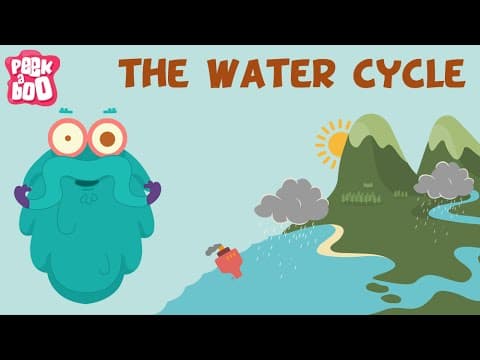
[0:06]Ha, it's raining. Hey, have you ever wondered where the rain comes from?
[0:18]Or how the clouds are formed? Well, this is what the water cycle is all about.
[0:24]Come, let's explore. Zoom in.
[0:28]When the sun heats up the rivers and oceans, water becomes water vapor.
[0:35]And it rises up in the air. This process is called evaporation.
[0:40]It is the first step of the water cycle.
[0:44]You too can see water vapor at home. Just tell your mommy to heat some water.
[0:51]And as the water gets heated, you'll be able to see the water vapor rising up in the air.
[0:59]When the water vapor reaches up in the sky, it turns into tiny droplets of water.
[1:06]These water droplets along with various gases and dust particles, come together to form clouds.
[1:14]This is known as condensation.
[1:18]Now, hold a cold lid over the vessel in which you heated water.
[1:23]When you open the lid after some time, you'll be able to see water droplets on the lid.
[1:31]That's exactly what condensation is.
[1:34]When the cloud becomes too heavy and it cannot hold any more water inside, it bursts open to give out rain.
[1:44]Hail or snow. This is known as precipitation.
[1:50]As it rains, water gets collected in oceans, lakes, and rivers.
[1:59]It even seeps through the soil and becomes ground water.
[2:04]Thus, water cycle is a continuous process of evaporation, condensation and precipitation.
[2:14]Trivia time. Did you know that even plants sweat? That's called transpiration.
[2:21]That's why it rains more in places with more trees like hill stations and forests.
[2:29]Sometimes snow directly turns into water vapor without melting into water. That's called sublimation.
[2:37]This happens a lot in cold countries.
[2:42]Oh, I need to run now. It's raining again.
[2:46]So, this is me zooming out.
[2:49]Till me next time for some more fun facts.


