[0:08]Greetings, everybody, and welcome to my continued series on themes of the 20th century. This is the first part of a three-part lecture I do on the Second World War. If you missed my prior lecture, which deals with the rise of dictatorships, the rise of Nazism, you're more than welcome to watch that one. That's kind of a good place to start, because for our purposes, we're going to be jumping directly into the Second World War. One of the wonderful things about this war and studying World War II is the fact that we have access to so many photographs, so much film footage, so much audio that all the countries, the Soviets, the Japanese, the Germans, the Americans, the Canadians, were actively filming and photographing aspects of this war. So from a historical perspective, there's just a plethora of wonderful primary resources that we can use to put this event together. Certainly there have been no lack of films made across the world, Japanese films, Chinese films, American, German, Russian films that deal with the Second World War, each of which of course interpreting the war through their own lens, through their own cultural experience, and certainly through their own historical experience. So we're going to launch right into Poland and like I say, if you're interested in the causes of the war, please do have a look at my lecture on the rise of the dictators of the 20s and 30s. It's remarkable to think that when this war started just 20 years after the end of the Great War. The Great War was supposed to be, when I say the Great War, I should mention, I mean World War I, 1914 to 1918. That was supposed to be the war to end all wars, and here we are 20 years later, poised to fight an even more brutal war than the First World War itself. Now, before we begin, it's important I think that we get an understanding of exactly what Blitzkrieg meant and what it was. Now, Blitzkrieg in German means lightning war, and that's pretty much precisely what it was. The question is, where did the concept of Blitzkrieg come from? And I know there's been quite a few historical studies done of course on Blitzkrieg, but I would argue that there are certain elements of it that seem to be derived from the creeping barrage tactics used by the French and the Canadians so brilliantly at Vimy Ridge from World War I. In a very basic sense, in the in the creeping barrage of the Great War, we dealt with a coordination between artillery and infantry. And sort of any study of the creeping barrage demands a close look at the Battle of Vimy Ridge, Canada's Great Battle in April of 1917 that really seemed to perfect all these coordinations of troops. They had maps, they had very clear guidelines of where they were going, how many steps they were moving forward, when the artillery was going to be sent over to the enemy, and so on and so forth. So in many ways, I would see Blitzkrieg as a manifestation of the creeping barrage with much more modern technology. And certainly where the tank and the airplane are concerned, they had made leaps and bounds in technology by this time. So, I think as we look at Blitzkrieg, you'll kind of get a sense of of and for those of you that have looked at the creeping barrage from the First World War, you'll be able to make those connections in those links. So, as we said, it means lightning war and was the defining reason for early Nazi success in the war. Blitzkrieg was based on the two main weapons, the airplane and the tank, and I would argue that they were the two weapons that were really revolutionized since the end of the Great War. We had airplanes, we had tanks in World War I, but they had really perfected these technologies by 1939. The airplane of course, now we have the introduction of the jet plane, they're much more maneuverable, much quicker, and certainly the tank is is stronger, more reliable, and quicker as well. Bombers would first attack any enemy airfields or communications sites. That is stage one: destroy the ability of the enemy to respond to your attack. So if you destroy their ability to communicate with each other, that's a huge part of this. In addition, if you can destroy their air force on the ground before they even get going, of course, that's going to be a huge asset as well. So that would be stage one, attacking airfields and communication sites. Parachutists were dropped behind enemy lines to capture bridges and disrupt communications.
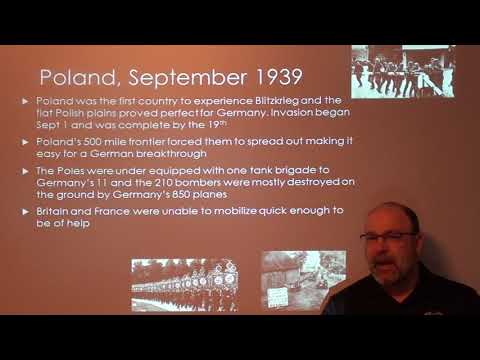
[5:16]Dive bombers moved ahead of tanks and attacked enemy strong points. So now you have the dive bombers coming in, so there's two sort of stages in which the airplane is used in this Blitzkrieg tactic. Tanks would then speed through weak spots and motorized infantry would mop up resistance. The motorized infantry would be sort of trucks filled with troops in the back, and they would go in locations, they would all scatter about, of course, well, they wouldn't scatter. It would be well coordinated, but they would basically clean up resistance. And you have to consider that by the time the motorized infantry gets into this battle, the enemy is thoroughly confused and disconnected and dislocated. So, we see this, of course, work brilliantly for the Germans in Poland, and certainly in in the Netherlands, and Belgium, and other places in Western Europe. Now, the trick with innovative tactics of this nature is they're only as effective for as long as it takes the enemy to figure out what you're doing. You know, we could go back to Napoleon, and for that matter, we could go back to Alexander the Great. Let's use Napoleon as an example, you know, his tactics were to flank the enemy, curl around the sides, encircle the enemy. I mean, the armies of the French Revolutionary wars didn't have a clue what was going on, and certainly during the Napoleonic wars, rather, I should say, they were completely confused. And, you know, so you look at Napoleon's tactics, you look at the creeping barrage, and then you look at Blitzkrieg, you see this evolution of military strategy that continues to get better and better and better. Because the tactics were new and unexpected, they worked very well, and I would argue that they worked very well throughout the campaign in Europe. When they began to stall, was in North Africa because the landscape, of course, was just flat and dry and stretched out. Uh, so you can't really hide behind things, you can't, uh, there's no hills, there's no forests. Uh, and it also stalled in Russia because of the climate and the landscape was the length or the the the size of the of the land in which they were invading was just overwhelming to try to maintain this type of. This is going to work in really well, quickly, in small areas, but once again, by '42 and '43, the Allies began to kind of figure out also, uh, what exactly the Nazis were doing. So, in the early stages of the war, Blitzkrieg works very well. Poland was the first country to experience Blitzkrieg, and the flat Polish plains proved perfect for Germany. Invasion began September 1st and was complete by the 19th.
[8:14]The invasion of Poland lasted 18 days. That's how long it took for Germany to to, uh, defeat Poland. In fact, even though Britain and France would declare war and later Canada as well and and others, um, they the defeat of Poland was so quick that Britain and France were completely unable to contribute to the defense of Poland in any way, because they themselves had to begin to mobilize, they themselves had to ship troops and get them to the front, and so on and so forth. And there's a lot of logistics involved from taking an army and then preparing them for a battle. Uh, so, you know, the Allies were not in any great position at this point. Here you can see German soldiers opening up the border gates to Poland.
[9:03]Uh, motorized infantry, I guess you call it, uh, on on the motorcycles, and here's of course, one of the many daunting images of the Nazi regime in general that we've seen so often. Poland's 500 mile frontier forced them to spread out making it easy for a German breakthrough. So, you know, um, it was difficult for Poland to maintain their lines of communication over such a long distance. You know, we look at 500 miles, we think, my gosh, that is a heck of a stretch, and then you look at the invasion of the Soviet Union in 1941 when the Nazis invaded there, they invaded over a 3,000 kilometer, um, you know, distance, so, pretty remarkable stuff. Uh, the Poles were under equipped, unfortunately, with one tank brigade to Germany's 11, and the 210 bombers were mostly destroyed on the ground by Germany's 850 planes.
[10:00]So, once again, stage one of of Blitzkrieg to destroy communications and airfields and in this case, hopefully destroy the air force on the ground, which Germany was able to do in Poland, so, catching them completely off guard. Britain and France were unable to mobilize quick enough to help, or rather to be of help. One of the tragic stories of the defeat of Poland was the idea that, um, there were cavalry units in Poland that were engaging the Nazi Blitzkrieg on horseback, and you can only imagine the result of that. The other piece of the invasion of Poland that we shouldn't remember, uh, and is very important, was the fact that the Soviets had an agreement with the Nazis that they would take the eastern half of Poland and Germany, the western, and they actually divided, um, Poland between them. So really Poland, uh, rather Germany only had to defeat, uh, half of Poland and, um, when those two armies met, they kind of waved each other. Okay, you stay on your side, we'll stay on ours. And what's interesting is that the German, uh, soldiers told their commanders, hey, you know, we acknowledge the Soviets and waved at them, but man, they are very, very ill-equipped and looked like ragamuffins over there. Why do we hit those guys now? Um, and the decision, of course, Hitler's decision at that time was not to because, uh, he had other fish to fry in the west which he wanted to take care of first. Many military historians argue that had the Nazis made that quick knee-jerk decision to keep moving toward the Soviet Union, they very well, rather, may have overwhelmed them. Um, because Stalin's purges had decimated his military and they were rebuilding in '39, so, uh, but that wasn't what happened, and the Soviets have two more years to get their military house in order to prepare for what I'm sure Stalin was well aware was going to be an eventual attack by the Nazis sometime down the road. As agreed, as we said, in the Nazi-Soviet Pact, Russia invaded from the East and Poland was divided.
[12:14]All right, so from September to April, 1939 to 1940, there was very little occur, very little occurred, and this period was referred to as Sitzkrieg, or sitting war in Germany. In other words, you had a what, a six-month period when nothing was happening. And in that six months, um, of course, we had situations where civilians in Great Britain were preparing, people were being issued masks, children were being evacuated into the northern parts of the country, in the countryside. Uh, whenever I think about the removal of the children out of the main centers and during this Phony War period, I often think of the novel, The Lion, the Witch, and the Wardrobe, which is part of the C.S. Lewis Narnia series. Those children who were the main characters are sent up to the north to flee the potential invasion or bombings by the Nazis, so, uh, yeah. Britain and France prepared for war and the British Expeditionary Force would be sent to France. So during the, during the Phony War period, uh, significant component of the BEF was sent to Britain in the defense of France, right. So there they were, waiting. Uh, preparations by the French were half-hearted because they felt secure behind the Maginot Line, and, boy, what a tragedy that was. The Maginot Line was built at the end of the Great War to defend France from any future war with Germany. And, uh, you know, it was this long, stretched out barricades of concrete and and steel. Uh, and when war does come, the Germans just go around it, and in fact, the Germans also came through the Ardennes Forest, which the French did not, uh, send, set up the Maginot Line through, because it was so forested and so mountainous, they thought, oh, there's no way they're going to come through there. And of course, the Blitzkrieg works its way, uh, right through the Ardennes Forest, so. During this time, Britain dropped 18 million leaflets over Germany to say they would lose the war. This is interesting, but they did not bomb at this time because it would have meant the destruction of private property. Isn't that an interesting thing? So the British were still apprehensive to actually drop any bombs, um, because at this point, there hadn't been any, uh, sort of warfare between Britain and in Germany. And I think neither one of them wanted to be the first to to send that message because once you've sent that message, dropping bombs or whatever it may be, you basically given your enemy the right to say, well, you attacked first, off we go. So the idea was that trying to convince German civilians that going to war is a bad idea because at the end of the day, you are going to lose, so the leaflets, I don't think, were very effective, unfortunately. During this time, tension eased in Britain as evacuated children returned home and people left their gas masks at home. So by the spring, early spring of 1940, people began to think, well, maybe, maybe that's it. Maybe the Nazis just wanted, um, Poland, and their appetite has now been satiated, and the appeasers, you know, continue to hold out for, um, uh, a situation where there would not be any warfare in the west. So Neville Chamberlain would remain in power, of course, until we get to Norway, and I think Norway is really the turning point, uh, for Great Britain in understanding what they were really dealing with. One of the things I should mention too before we move on to the next slide is the idea that, um, Adolf Hitler had a great admiration for the, uh, uh, for Great Britain for their history. Uh, there was that racial connection with the Anglos and the Saxons. Um, there was a Nazi, uh, appreciation of the great, uh, British Empire. They loved and were fascinated with the idea that Great Britain controlled so many countries all over the globe, you know, the story, the sun doesn't set on the British Empire. Um, more importantly, their control of India, which was a huge gold mine, the crown jewel, they called it, of the Empire. So, you know, Adolf Hitler had this grudging respect and admiration for Great Britain, and I think in many ways, had he had things his way, he would have much preferred to have had some kind of non-aggression pact with Great Britain in the same way that he did with the Soviet Union from '39 to 1941. So, here we are, Norway.
[17:09]You can see the landscape is quite rugged, lots of fjords and inlets. Right.
[17:15]So, Norway is basically the end of the Phony War. This is where we resume an active phase of warfare in Europe. As first Lord of the Admiralty, Churchill drew up a plan to invade neutral Norway at the port of Narvik where 80% of Germany's iron ore arrived by train through Sweden.
[18:13]Chamberlain hesitated, fearing the implication of invading a neutral nation.
[18:24]Hitler caught wind of this and invaded both Norway and Denmark as a result.
[18:37]So this is a preemptive strike. The Nazis say, hey, well, while Neville Chamberlain waffles on what to do with Norway, we're just going to get in there because we need to ensure that we maintain our supply of access to iron ore, so they invade. British and French troops were sent, but they were forced to withdraw by May. Uh, you know, this was a very, very difficult landscape to fight. It's a vast country, there were hundreds of thousands of inlets and fjords throughout the nation. I mean, it's a great place for you to hide your U-boats and of course, the Germans would eventually use, um, Norway as a place to, uh, you know, be in a position to be very threatening of course to Great Britain as well, so. The Germans secured their iron in addition to the Norwegian fjords, which would provide excellent bases for attacks on British shipping. So the fact that Chamberlain hesitates really, uh, is the end of the line for Chamberlain. I think people in Britain were had had enough of trying to appease Hitler, and it was time to take direct action. So, as a result, uh, Neville Chamberlain would be pressured to resign on May 10th and replaced by Winston Churchill. The same day Germany invaded Holland, Belgium, and France. How's that for a first day to be leader of Great Britain?
[20:01]All of a sudden, um, you are dealing with a tremendous amount of pressure, you know. And at the end of the day, I think Winston Churchill was the right man for the right job, obviously, history has proven that to be the case. If you have the time or you have the interest, I would strongly recommend listening to, um, many of, um, Winston Churchill's speeches throughout the war period. The finest hour speech is one of the best. Um, just to really get a sense of how important leadership can be in times of war. I mean, what exactly could one person do? Well, I tell you, his speeches were able to really solidify the resolve of the British people, and you know, he never faltered. He always had the right words, you know, he was a remarkable speaker, even though he struggled with a speech impediment when he was younger. He had a really good grasp of rhetoric and oration, you know, his favorite works were, uh, the Rise and Fall, Edward given the Rise and Fall of the Roman Empire and the Holy Bible. And he said between these two great pieces of of of art, of literature, of history, whatever term you want to use, he was able to combine the great use of the English language in in in constructing incredibly powerful, meaningful, and inspirational speeches throughout the war. All right, the Fall of France. Uh, Britain and France were certain Hitler would invade through Belgium, which is where the British Expeditionary Force and France's few mobile units were sent. France was overconfident that the Maginot Line would stop Germany and they would invade through the heavily forested Ardennes with their tanks and quickly broke through. So here they go. The French didn't anticipate this, the Ardennes, not a chance, too forested, too hilly, and here they come, right through, uh, with their motorized infantry and their tanks and boom. They make their way through. French resistance crumbled as tanks headed toward the coast to cut off the retreat of 150,000 British Expeditionary Force troops. After 10 days, Germany reached the coast to seize the ports where 380,000 French and British troops were waiting to evacuate. Okay, so I wanted you to have a quick look up here, because basically what happens, you might recall that during the Phony War period, which I mentioned, the British had sent over elements of the British Expeditionary Forces, who were basically here on the coastal areas. Once the Germans come up through Belgium and they swoop around under the Maginot Line, they come this way, they have basically encircled the British. The British have nowhere to go. Um, so they are essentially sitting ducks on the beaches of Dunkirk, and at that point, certainly the Nazis could have carpet bombed those beaches and and destroyed the British Army, but that that didn't happen. It did, but not nearly as much as it could have.
[23:01]And some believe that one of the major reasons the Nazis didn't try to completely destroy the British Army on the beaches of Dunkirk was this sense that Hitler still held out in hope that he could have some kind of agreement. Um, you know, the jury's still out on this and there's a lot of debate and not a lot of real clear documentation as to precisely why there was that tentativeness, that apprehension. And it was that very apprehension that allowed those forces to get evacuated off the beaches and sent back home. Between May 27th and June 4th, Operation Dynamo would see the evacuation of almost the entire British and French forces from Dunkirk. Huge amounts were left behind, like 475 tanks, 1000 heavy guns, and 400 anti-tank guns, which of course, the Nazis would be able to use against the Allies later on.
[24:02]Um, to what extent they could use the guns would be limited by how many cartridges they had for the rifles, because, and I'm not really sure if they began to construct or build rifles that could accommodate the allied weaponry, but they certainly had enough that would be of use to them in any campaign. Uh, under Luftwaffe bombing, hundreds of small privately owned ships managed this feat and many German bombs did not explode in the soft sand. So, soon after, France would fall. So this is the other thing. When Great Britain sends over every ship you have, fishing trawlers, pleasure craft, cruise ship, everything that could float was sent over to to collect these men. Um, when the Germans did bomb the beaches from time to time, the sand was so soft that it would almost cushion and absorb the impact of these bombs. And you'd see these bombs sticking out of the sand. You sure as heck wouldn't want to go anywhere near them, but, uh, it was the soft sand that prevented many of these bombs from exploding, so. And here you can see later, Hitler makes his way into Paris, and he so arrogantly was and smugly quite proud to get a picture of himself next to the Eiffel Tower. All right, Battle of Britain 1940-41. So for the following year, Britain faced Germany alone but survived due to Churchill's leadership, which we talked about earlier. Uh, the superiority of their RAF and American aid with Lend Lease in March 1941. Franklin Roosevelt managed to negotiate through Congress, uh, the idea of loaning America, loaning Great Britain equipment. There was still a very strong isolationist, uh, mentality in the US, and as much as church, or or Franklin Roosevelt, rather, wanted to help the British, um, he was basically held prisoner by the isolationist camp. So, he was able to negotiate lend-lease, which basically, as I said, means loaning Britain equipment until the war is over, and they would return it. You know, uh, Roosevelt used this remarkable metaphor to the American people where he said, you know, we're going to, uh, it's like loaning your neighbor, loaning your neighbor your garden hose, so they can water their lawn. When they water their lawn, they give you the hose back, and the American people went, ah, okay, I get that. The grim reality, of course, is that, uh, you loan somebody tanks and planes, and helmets, and guns, uh, chances are you're not going to get them back, but they're going to be destroyed. But nonetheless, lend-lease was some semblance of a lifeline to Britain. Uh, the Royal Air Force, those of you that are interested in technology, certainly know that the Spitfire was a superior aircraft. Um, it had a Rolls-Royce jet engine, it was maneuverable, it was more fuel-efficient than the Messerschmitt and other German planes. So, um, you know, I think that those first, uh, battles in the air between the RAF and the German Luftwaffe caught Herman Goering off guard. Britain was fighting over their territory, and their radar system could spot German aircraft 100 miles away. The fact that the British could detect these planes when they were coming, gave the British people enough time to be warned, get into the basement, get into the subway systems, get underground, whatever way, by any, by every and any means necessary. And uh, so radar was a huge advantage. As we said, Herman Goering, the commander of the Luftwaffe, underestimated the RAF fighter planes and the low fuel efficiency of the Messerschmitt limited their time over England. Something so simple as a lack of fuel efficiency is huge because it prevented the German air force from spending any significant amount of time doing coordinated precision bombing. You had to fly over, drop your load, and get out of there. So, we must be thankful that their airplanes were lacking fuel efficiency at this time. Here you can see, I don't know how clearly you can see this picture here, but there are people, you know, underneath what looks like the subway system. Uh, here you have a man whose job it was to keep an eye out for the RAF or the Luftwaffe coming. And then down here, the tragic results of many of the Nazi bombing campaigns, you know, when people came out of their bunkers, or their basements, what they saw was the tragic consequence of, uh, of the dropping of these bombs. Between September 7th and November 2nd, Germany bombed Britain for 57 consecutive nights in hopes of destroying their morale. This was the thinking. Pound them, pound them, pound them. That is two months of consecutive bombing. And as I said, the thinking was that we will destroy their morale, they will sue for peace. Well, Winston Churchill, between his tenacity, between his speeches, between the dogged determination of the British people not to succumb, it actually strengthened their morale, because now the British people knew what on earth they were dealing with. We are dealing with something and someone extremely menacing. This regime has to be defeated. It's either win this war or lose this war. There's no in between, so, uh, you know, the Battle of Britain was a huge turning point for Great Britain. Uh, but it was also from the German perspective, they realized very quickly that they couldn't tackle the RAF as well as they'd hoped, and they realized that the fact that it was an island nation was going to make things very difficult for the Germans when it came to conquest of Great Britain. London, Hull, Plymouth, Bristol, Liverpool, Manchester, Birmingham, and Coventry were all attacked. These are all the major industrial centers in Great Britain. All right, so in North Africa, with France defeated and Britain struggling, Mussolini declares war and invades North Africa with no anti-aircraft guns, fuel for only 7 months, and 800,000 poorly led and equipped soldiers. Oh, boy, oh, boy, were the Allies ever lucky that Mussolini was so out to lunch when it came to his military preparation. These are not the kind of numbers you want to have when you want to invade a landscape like this. Now, not sure how clearly you can see this map on the screen, but here you have Morocco. Uh, we have, um, Algeria, sorry, Tunisia, and the Suez Canal over here. So, um, you know, this was a huge, hot, flat desert, sand-filled landscape, so. Uh, their performance is so poor, this is the Italians we're talking about, that Hitler decided to bail him out and brings in Erwin Rommel who drives Britain out of Libya, leaving only Tobruk in British hands where a back and forth battle continued. Erwin Rommel, the Desert Fox, now keep in mind that the Nazis did not initially have an, an, a conquest of North Africa on their radar. This was simply a means of bailing Mussolini, his ally, out of the mess that he got himself in. So in many ways, the Nazi invasion of North Africa really delays Operation Barbarossa by several months, the invasion of the Soviet Union, and we're going to come back and talk about that as well. At El Alamein from October 23rd to November 4th, Montgomery deploys artillery and tanks in large numbers outnumbering the Afrika Korps 2-1. This battle prevented Egypt and the Suez Canal, and beyond that, the Middle East oil fields, from falling into German hands. So right over, whoops, over here, of course, on this map again. The Suez Canal is probably somewhere around here. Now, why on earth was the Suez Canal important? It was the lifeline of Great Britain's links and connections to, um, to, uh, India. And India was important because that's where they had so many resources, there was so much manpower there. And if Great, if the Nazis could cut off those connections to, um, India, then you're cutting off quite a significant lifeline of Great Britain. So that becomes a huge concern, the other piece to consider too, is that just beyond the Suez Canal is a significant amount of oil of the Middle East, and that's what the Germans were interested in as well. They were coming at it from the Caucasus, and they hoped to come across through North Africa to get access to the oil. From this point forward, Rommel was in retreat, and on November 8th, both British and US troops invaded. Hitler underestimated both the strategic importance of the Middle East and the Allied desire to hold onto it. Mussolini, or rather Hitler, completely underestimated the tenacity with which the Allies would fight and try to defend their interests in North Africa, so. All right, and of all the battles that occurred during 1939 to 1945, this was a unique battle because it was a continuous battle that starts when the war starts and ends when the war ends. It is a six-year battle. And it is, of course, the campaign in the Atlantic that Winston Churchill feared more than any other, because he recognized that if Germany was able to limit and reduce and even halt supplies coming into Great Britain from Canada and the United States, you could actually bring Britain to her knees by literally starving her out, and that terrified, um, Churchill. And so, the recognition was that the war at sea needed to be won as well. Churchill feared this battle, as we said, more than any other because of Britain's dependency on supplies from North America. From 1939-1945, 2,700 allied merchant ships and 100 warships were torpedoed during this time. Just think about those numbers. 2700 allied merchant ships and 100 warships. What a monumental waste of supplies and human life, of course, too. You know, I often wondered why the Nazis were not more interested in apprehending these ships, taking the supplies, um, and then sinking the vessel. Maybe logistically it was too complicated, uh, but, you know, all the medicine, all the canned foods, the blankets, the, everything that could have been used by the enemy. And I'm, you know, I, I, I, I marvel at the, the, the tremendous, not only waste in human life but waste in in supplies in this campaign. Uh, Germany's General Doenitz sought to shoot every ship going in and out of the British Isles, squeeze them out, bring them to their knees. The convoy system was created to protect supply ships from the Nazi U-boat wolf packs and Canada was central to this system. You know, this is where Canada really shines is that connection between Halifax and Great Britain. Uh, you know, the lifeline, the convoy system and the Corvettes, the smaller, more maneuverable ships, because what ends up happening is you need more than just battleships to head over with supplies. You needed ships to protect those ships. Because what the Royal Navy was facing, not only the Canadian Navy, but the British Navy and later the Americans, were a new phenomenon in, uh, German, uh, U-boat tactics and something called the wolf packs. Wolf packs were like a string, a triangle-shaped string of of U-boats that would cover, you know, so many kilometers. And, you know, if you found yourself in the middle of a wolf, a wolf pack, um, chances were very slim that you would survive. So, uh, the wolf packs were incredibly threatening to all shipping in the North Atlantic. 1942 was the worst year where in the first 6 months, 586 ships were sunk by U-boats. And neutralized were vital supplies of war material, food, and merchant seamen on which the survival of Britain depended. And this circles back to what I was saying at the beginning of this slide that Great Britain recognized that, um, if Germany is successful in in demobilizing all these supplies, Britain would have no choice but to sue for peace, either that or starve, so. Pretty terrifying stuff. All right. Well, what is this, what is this the turnaround? What, what sees Great Britain and the Allies begin to get an upper hand in the war in the North Pacific? Pretty obvious, I think, uh, the introduction of the Americans. And once the Americans are brought into this war by the invasion of Pearl Harbor on December 7th, 1941 by the Japanese Imperial Armies, um, that was a huge game changer. The introduction of of both the Americans entering the war and the Soviet Union entering the war is what really kind of tips things over, uh, for not only the war in the Pacific but for the war in Europe as well. By this time, the USA was launching far more tonnage of supplies than the U-boats could sink. So, the Americans were able to produce more than the Germans were capable of sinking. Quite something. The Allies were building four times as many ships as were sunk. The convoy system included hunter-killer groups of ships that would break from the convoy to actively seek and destroy U-boats. Allied aircraft was crucial, sinking 273 U-boats in 1943. The ASDIC system which used sound waves to bounce off U-boat underwater could identify the location and distance of U-boats.
[38:51]So sonar. Think about this, you send a signal, it goes through the water, it hits a U-boat, bounces back, and the amount of time that it takes to come back to you will help you determine the actual distance between yourself, the ship on the water and the U-boat underneath. Once the ASDIC system identified the location, depth chargers were then dropped. These are big bombs that are rolled over, and their time to go, you can set them to explode at 30 feet, 50 feet, whatever it may be. And once sonar had identified how deep under the water it was, the hope was that when you send the depth charger over, it would explode right next to the, uh, the U-boat and hopefully destroy it. The development of Ultra could decode Enigma codes which helped decoding messages between wolf packs. So, the Enigma was the complex codes of communication that Germans had between, uh, U-boats, between, you know, uh, and the Allies had a heck of a time cracking it, but once they cracked their codes, then they could determine exactly where the Germans were going, how many were their coordination or their coordination, rather. Uh, so, once we see these advancements in British technology, uh, the war begins to make a dramatic change, so. And that being said, this concludes our first part of, uh, the first of the Second World War. Um, please by all means have a look at, uh, my World War II Part 2 lecture, and then the third lecture will will deal specifically with the war in the Pacific. So, thank you very much again for viewing, and, uh, we'll see you next time. Cheers.