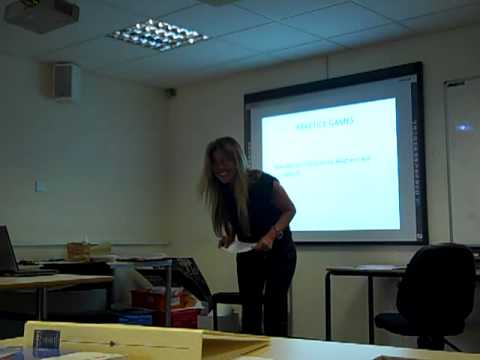
[0:03]Yeah. Okay, good afternoon, everyone. My name is Maria Floriano. And today, we're going to actually be introduced in to basic Spanish numbers. So I know you have prior knowledge or you don't. So I regroup the groups to actually balance, you know, the exercises that you're going to do. So, the aims of today is to develop an understanding of basic Spanish numbers. The objective is by the end of today's session, you will be learning how to pronounce and recognize numbers from 1 to 10 in Spanish. And you also will be able to use them in simple applications. Okay? So that will be the thing. So very basic 1 to 10 numbers. Imagine that you are going to to Spanish restaurant and you want to order chicken and chips and you you want to order three. But instead to order chicken and chips, you will order elephant with wheels. The right thing that you will do by the end of today is to actually order the right quantity of food, meaning the number three in Spanish. So, that is the whole purpose of learning the basic one. I'm going to do it myself first for the ones that are not familiar with the sound and then one by one, you will repeat it. Okay, that kind of there is the one that you have in front of you. In black is the way that Spanish number is being, it's being written, and in red is the phonetical way to aid you on the way that you should pronounce it. Okay?
[2:02]So, here we go. Uno. Dos. Tres. Cuatro. Cinco. Seis. Siete. Ocho. Nueve. Diez. Did anyone find any of the number that I say difficult to pronounce? So far, on my sound? I just thought five was different to, I think I was thinking more of a French. French? Okay, well, let's going to actually practice one by one. We all together? Uno. Dos. Tres. Cuatro. Cinco. Seis. Siete. Ocho. Nueve. Diez. Very good. She will actually do it again. Okay, come on guys. Uno. Dos. Tres. Cuatro. Cinco. Seis. Siete. Ocho. Nueve. Diez. Right. Now, all together. But let's going to do it very quickly because we're going to wrap the numbers in after that. So, let's going to wrap the numbers in threes. Uno, dos, tres. Cuatro, cinco, seis. Siete, ocho, nueve, diez. Uno, dos, tres. Cuatro, cinco, seis. Siete, ocho, nueve, diez. Okay, should I put the song on? Yes. Yeah. We ready for the song? Come on. Let's have that one.
[4:16]Uno, dos, tres. Cuatro, cinco, seis. Siete, ocho, nueve, diez. Uno, dos, tres. Cuatro, cinco, seis. Siete, ocho, nueve, diez. Right, I'm going to play again because you all enjoy it that much. I think you should wrap it tonight. Uno, dos, tres. Cuatro, cinco, seis. Siete, ocho, nueve, diez.
[5:01]That's it. Yes. I think I will. You're going to have nightmares with this song tonight. Okay, now we're going to do some games. You already practiced the visualize and the sound with the numbers, so we're going to test that with some games. Now, first of all, do you all know how to play Dominos? Yes. Okay. Here are some cards to actually aid you with the visual numbers and how it's been pronounced. And here as well, two team in group. This is a competition. You need to actually match the written number with the number, either in a line or in a square. So, the thing, okay, you can prepare it. Well, because I know you're quite prepared. When I actually say go, the team that actually finished first get the first point. Okay? Are we all ready? Go. Quick, quick, quick, quick, quick, quick. Five. Okay, let's start with one.
[6:17]Uno. Uno. Uno. Two, two, two, two, three. Where's four? Where's four? Where's four? Cuatro, one. Cuatro. No, that's wrong. Nine, nine is nine. Five. What's five? No, because five is, that's right. Five, five. No, sorry, sorry, sorry. Yeah! Yes! Very good. You can finish. You can finish that work. You can finish that work. Yeah. Excellent.
[6:58]And how many? Five points. So how many? Ten. Yeah. And how many did I give you? Five. Well done. So, we have test, you know, how to recognize numbers, you know, and then be able to match them as well. So we're going to do now is a game where you're testing your pronunciation and the sound and see if you can actually comprehend the number, no by visual of the number, but about listening to the number. Okay? So far so good? Are you having fun? Yeah, I like it. I'm very sorry. I thought, you know, you will not have any knowledge but you're actually being really good with your numbers. So, I'm taking one of the Dominos out. You can actually aid you with this again, it's the same. All of you will actually have one card. We do not know where we are going to.
[7:58]Where you actually have the number, uh, numerical and then on the world one. I have two. Okay. So what I'm going to do is I'm going to shout the number in the in the work one. And whoever has that number in the numerical one has to stand up and say their number in the world one. Okay? Yeah? Okay, Uno.
[8:29]I have uno.
[8:33]Right, okay. Seis.
[8:39]Now you need to actually say the, the, the one, the number on your, on your, I have got six here. Six. Oh, I thought you meant that the right one. Sorry. If I, if I say that word, the number is the one that's actually stand up. That's not what you meant. Okay. Diez. Who has Diez? Ocho. Tres. Cinco. Nine.
[9:15]Who has nueve? Oh. Oh no, he's got nine. Oh, sorry. You're up and down like a yoyo. Siete. Siete. Muy bien. Tengo. That's me. What do we say? Dos. Dos. Oh sorry. Four. I'm sorry. Cuatro. Cuatro. I have the Cuatro. Number Uno. But they're not working. Which one do you have, Alan? He did some. He did, he did. You said that you said Dos.
[9:52]Okay, do you actually found that by sounding, by, you know, making a sound, you recognize them numbers more than by seeing them in the cards? You need to practice your lyrics. Okay, yeah. I did have, but we will not have time today. I did have a telephone game with cards and numbers. And that will be on your next lesson because I'm going to see you all for the next lesson. Okay. I will explain to you how the game will actually be for you to practice at home. Okay, you will have cards like this. The red one is your telephone number. And when you hear that number, you need to stand up and say ring, ring, and you need to call that number. And that number belongs to another of you, that has to say ring, ring. Okay? And we carry on like that. But because we don't have time today, this is a game that we are going to. We've only done 10 minutes. I only done 10 minutes. So we can actually do this game. Yes. Oh, we have. Oh, we have. That's a challenge. Thanks. Yeah, because otherwise, you know. Oh, this is hard. Okay. Either, either we can actually do it in pairs. Oh, no, no. I'm just thinking. Is the phone number that she's had to call out the next one on the card, like the chronological? Okay, this is your number. Someone will actually call up that number. And that is a wing, wing. Your telephone ring, you need to call that number. But they're they're not together. Oh, no. Oh no. You are such a spoilsport. It's like a chain. Oh no, this is the one. Oh my God. Well, that's fun, because I know you're competitive.
[11:47]I can't believe you did that. Oh, no. This is going to be good. This is going to be good. I'm going to the make them right. I'm just very sorry. I thought. You will not have any knowledge but you're actually been really good with your numbers.
[12:03]Okay. And I'm not looking at your. Okay, do we understand the rules of the exercise? Could you just explain it again, please? Yeah, sure. Okay, this is the number that I'm going to call. Whoever has that number has to call the green number. Okay? Okay. No, sorry, this is a number that I'm going to call and that is the number of the owner. Okay, I will actually say the number out loud. See, I'm going to say in English. Yeah, that's fine. That's fine. Six, nine, five, three, one, seven. And I don't understand why I'm calling myself. Ring, ring, ring, ring. What? It's good demonstration. Brilliant. Ring, ring, ring, ring. Okay. Do you hear us? No, it's not going to be like that. Nine, six, five, three, one, seven. Ring, ring. That's one of my numbers. Okay.
[13:42]I got my little sheet here. Nine, two, six, eight, four, seven. Ring, ring, ring, ring, ring, ring. I'm sorry. Carol. What did you say? Ring, ring, ring, ring, ring, ring, ring, ring. I'm sorry. Dos, cinco, siete, cuatro, tres, ocho. Ring, ring. That's me. I got one of mine.
[14:17]Eight, four, nine, five, one, two. Ring, ring. Oh, no. Right, where are we? Six, three, four, nine, six, eight. Ring, ring. Seven, three, one, four, five, nine.
[15:08]Ring, ring. Six, nine, five, three, one, seven.
[15:22]Ring, ring. You're back to you again. I'm back again with me. So, well done, everyone.
[15:30]Okay, guys. So to summarize, what we tried to actually do today is the same that when we learn any new thing is to learn the basics in order to actually build on top of that basis. We actually have learned today how to say the numbers from 1 to 10. That will actually allow us to go to the supermarket and ask for a small quantity, 1 to 10. Once that we actually mastered that, the next objective is to actually learn the numbers from 11 till 20. Okay? In order to be able to tell the time. So we apply the knowledge, we build into the knowledge and apply that knowledge into more activities and more complex situation. And after that, the number become very easy to learn because they follow the same pattern that the English one. Meaning, after 20 is 21. After 20, which is 20 in Spanish, is 21. So, it follows the same pattern than the English one. So, that will be our objective for our next lesson. So, thank you, everyone. Thank you. Thank you. Very good.


