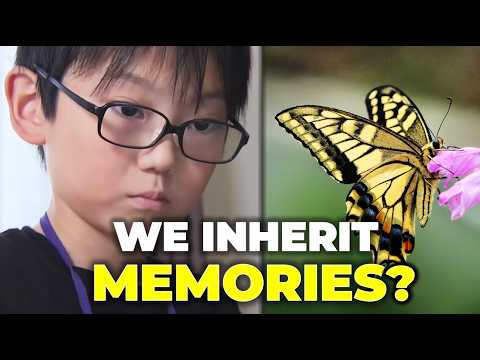
[0:00]At the 2024 International Congress of Entomology, a group of researchers were gathered around the booth of a young elementary school student. They were listening closely as he presented his latest research on butterflies, and as his presentation came to a close, what followed was a long applause. Some rushed to take photos with him, and others were seriously considering what he had presented. His name is Jo Nagai, and he was 10 years old when he first presented his groundbreaking research on Swallowtail butterflies. Now, you might think, how groundbreaking could this really be? He's 10. But he's the first person in the world to show that butterfly memories can persist through metamorphosis. And his research showed that butterflies not only retain memories of when they are in larval form, but that these memories may be passed on to their offspring. To put that into perspective, this would be like saying that if your parents were bitten by a snake and had a very painful experience, their memory of that event would have a direct influence on how you feel towards snakes. Now, this certainly sounds very exciting, but at this point, you're probably a little bit skeptical, because how scientifically accurate could his research really be? Well, let's take a step back and look at how all of this started in the first place.
[1:19]From a young age, Jo has always been fascinated by insects. Whether it was the rhinoceros beetles that would battle each other with their horns, or dragonflies that he would find near a pond. And his favorite, was the butterfly. But unlike most children, he didn't just go around collecting them; instead, he would take the time to really observe their behavior and document patterns and odd behaviors that most people would overlook. In kindergarten, he tested how long butterflies could survive if they got stuck inside their own chrysalis. In first grade, he would document his findings about a species of caterpillar that he found would molt more often than usual. He would come to win awards for both of these projects, and by the time he was in second grade, he had already accumulated hundreds of pages of handwritten observations about his butterflies. But somewhere along the way, he began to notice something unusual. He noticed the butterflies he raised seemed to behave differently around him even after metamorphosis. Compared to those he caught in the wild, they would flutter toward him when he tried to release them. And it made him wonder, is it possible that they could remember something from their time as caterpillars? So Jo did what any serious researcher would do. He went online and started looking for research papers on this very subject. That's when he came across a study by an entomologist called Martha Weiss. In her experiment, Martha had shown that moths could retain memories from during their caterpillar stage, even after undergoing complete metamorphosis. It was a surprising and controversial finding, because for a long time, many researchers believed that metamorphosis effectively reset the insect brain. When Jo read this paper, he was really excited, as he thought to himself that maybe there was a chance it could apply to his butterflies too. And so, in the spring of 2022, Martha received a large envelope in her mailbox. Inside was a handwritten letter four pages long. To Martha Weiss, Hello! My name is Jo Nagai. I live in Kobe, Japan. I'm in second grade... Along with the letter, he had attached pages upon pages of data he had collected over the years. He told her that he was very impressed by her research and that he wanted to replicate her work with his butterflies. Now, Martha was very flattered by this, but probably like most people, she didn't actually think Jo would be able to replicate this at all. And so she wrote back thanking him and instead recommended that he go with a more simple experiment. But Jo insisted, because he wrote back telling her that he'd already started adapting her protocols for his own lab at home and even questioned parts of her methodology, like why certain chemicals were used. actually in in one of our uh correspondence is he he called me on the carpet for using ethyl acetate he said, I have no idea why you would have used that that chemical. Don't you know that that's what people used to kill insects? Don't you think that the insects would would hate that odor? And I admit to having felt a little bit defensive. Um, and I I sort of said out loud, we did our controls. We know that it was okay. But um, he wanted to choose an odor that was uh natural that they wouldn't have had experience with and This time, Martha realized he was serious, and she agreed to help him with his experimental design. Over the next few months, the two would regularly exchange ideas, like how to adapt her methods for his home setup and potential improvements to the original study. And by the fall of 2022, Jo wrote to say the study was finished, and this time, he sent 33 pages. So next, let's take a look together at what this experiment involved.
[5:00]Jo's experiment was built around a very simple question. If a caterpillar learns to associate a specific smell with something unpleasant, will it still know to avoid that smell after it becomes a butterfly? To test this, he followed a method similar to the original moth experiment. But not only did he adapt this for swallowtail butterflies, he also made several improvements to the methodology that we will take a look as we go through the experiment itself. First, Jo would expose the caterpillars he raised to a specific smell, and immediately, here is where his first improvement comes in. In the original experiment, the smell used was ethyl acetate, which smells a little bit like nail polish. But Jo knew that this solution is very lethal and often used as a killing agent for insects. Jo felt it was possible that the caterpillars may be naturally sensitive to this and could potentially impact the accuracy of the study. So he decided to substitute this with lavender oil, which still produced a stronger and nicer smell. When the caterpillars were exposed to clean air, nothing happened, but when they were exposed to the lavender smell, they received a mild electric shock. And here is where Jo makes his second improvement to the method. See, in the original experiment and most insect experiments in general, delivering shocks is very common, and very little care is given to the insects themselves. But Jo really saw these caterpillars as his friends, and he didn't want to hurt them more than necessary. So, rather than selecting an intensely level at random, of which there were 15, he started at the lowest level and gradually increased it while watching carefully for any signs of distress. By level four, he noticed a clear reaction. The caterpillars would pop out their osmeterium, which is a clear indication that they could feel the shock. And he decided that this was enough. In the original moth study, the shock intensity was much higher, and the caterpillars were showed much more intense distress responses to put it lightly. He would then administer the shock by putting both the pad and the caterpillar on his arm, meaning he could feel the shock himself. Over repeated trials, the caterpillars eventually learned to avoid the smell, and he also had a control group of caterpillars that didn't undergo any training. While both groups were busy turning into butterflies, he would spend that time building a wide tube maze out of materials that he could find at home. And then came the most important part of the experiment. He would first place sugar water on both arms of the tube, but one of the arms would also have a small cotton pad with lavender oil. After completing metamorphosis, the butterflies were placed into the maze, and he paid close attention to their behavior. When he first tested the control group, the ones that weren't trained as caterpillars, they split evenly, so about 50/50. Then came the trained butterflies. If metamorphosis had erased their memory, they should show the same behavior as the control group. But when the trained butterflies were placed into the tube, around 70% avoided the arm with lavender, which is statistically significant. And with this, Jo was the first person in the world to show that the memories of swallowtail butterflies could persist through metamorphosis, and he now had experimental evidence that his butterflies could, in fact, remember him. I was really happy they remembered me, and although they are small and their brains are small, they are still able to remember me. And I'm really glad they didn't forget that when they became adults.
[8:31]Now, most people, even most researchers would have stopped here. In fact, that's where Martha stopped, but we haven't even got into the most critical part of Jo's experiment. Because what he did next was shock scientists around the world.
[8:51]In the weeks that followed, Jo repeated the experiment again and again, watching carefully to make sure that the result was consistent, and it very much was. But one day, as Jo was spending time together with his family, he noticed that him, his mother, and his grandmother all had hay fever. And soon, a question began to surface in his mind. Well, my mother has hayfever and I have it too. And when I was in school the teacher said that if your parents have hayfever, you're more likely to have hayfever. And my grandmother also has hayfever. So it got me thinking if it was possible for memories to also be inherited.
[9:37]So he decided to try and test this. And so, through the summer of the following year, Jo began raising a new generation of caterpillars. These were the offspring to the group that he had already trained. While other kids were playing outside, Jo was busy replacing leaves and taking care of his new caterpillars. Unlike the previous generation, these new caterpillars didn't need to go through any training. And he mentioned that he felt like he was a little parent to the caterpillars again. By late summer, the caterpillars finally emerged as butterflies, and they were placed into the same Y maze. They were now faced with the same decision as the generation before them had months ago, but this time, they had no training. And yet, as they went through the maze, most of them chose to avoid the lavender. But more than that, it was in almost the exact same ratio as the first generation. This suggests that learning doesn't just alter behavior, but it may fundamentally alter the biology of the butterflies in a way that may be carried into future generations. Now, this is pretty amazing, right? But we aren't done just yet, because when Jo saw this, he thought to himself that if memories could be inherited to the next generation, how far does this really go? And so, he decided to breed his butterflies one more time. And again, the result seemed to support what he had already seen, with the majority of butterflies avoiding the side with the lavender pad, even in the grandchild generation. He later also finds that this behavior seems to be more prevalent in the male offspring compared to the females. But perhaps the most impressive thing out of all this is Jo's ability to show restraint. He knows that the sex-linked behaviors from the third generation data set is still small, as it was never something he intended to test initially. So, as exciting as it is, he plans to do more trials and more rigorous testing before any strong conclusions can be made. By the end of the summer break, Jo finished collecting all his data across his experiments. And with this, he had gathered a strong body of evidence to show that memory and learning may, in fact, persist beyond a single generation. I thought it was amazing that memories can be inherited, because they're so small. And I thought the caterpillars are so cute when they're young, and they're so cute even when they become adults. So when I found out these memories can be inherited, I fell in love with them even more.
[12:12]Whether the sex-linked effect ultimately holds across larger data sets is something Jo is still trying to figure out. But what he had achieved is already remarkable. And as news of his work spread, something unusual began to happen. As science fairs and conferences, people began lining up to speak with him. Researchers who had spent decades in the field were suddenly listening carefully as a 10-year-old explained transgenerational memory in butterflies. He was even invited to present his work privately to the Crown Prince of Japan. And eventually, in December 2024, he finally met Martha Weiss, the scientist whose paper had started all of this. Two years earlier, the four-page letter he mailed across the world had not only earned him a mentor, it had set him on a path that would come to shape the researcher he is today. Jo's research on butterflies suggests that our experiences may leave deeper biological traces than we once assumed. That learning may not just shape behavior in our own lifetimes, but potentially influence physiology in ways we're only beginning to understand. To truly figure out how far this really goes, it will require more rigorous testing, replication across different species, but perhaps most importantly, the courage to ask questions no one has asked before. Because in Jo's world, there are no stupid questions. There's no hesitation to ask something even if it may turn out to be wrong. And as I was making this video, I couldn't help but feel a little bit emotional. There was something about Jo's work and his approach that made me feel something I haven't felt in a long time. Because this whole thing wasn't born out of ambition or the pursuit of a scientific breakthrough, it was simply a 10-year-old trying to figure out whether his butterflies could actually remember him.


