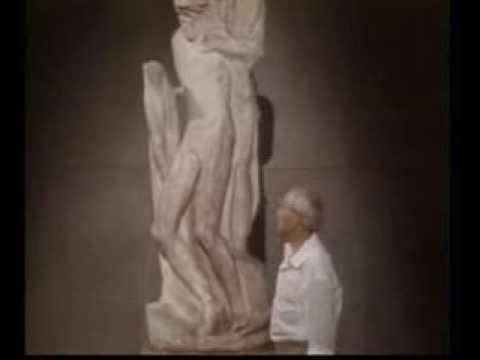
[0:35]La Pietà Rondanini è opera della tarda maturità di Michelangelo ed è ultima in ordine di tempo, dopo la Pietà della Basilica di San Pietro in Vaticano, commissionata nel 1498 dall'ambasciatore di Carlo VIII presso Papa Alessandro VI. La Pietà del Duomo di Firenze, terminata nel 1553, e la Pietà di Palestrina della Galleria dell'Accademia. Michelangelo, ultra novantenne, lavorò a quest'opera fino alla vigilia della sua morte, che avvenne il 18 febbraio 1564. Nell'inventario della casa romana di Michelangelo Buonarroti, la Pietà Rondanini viene descritta come opera sbozzata e non finita. Donata ad Antonio del Francese, mentre era ancora in lavorazione da Michelangelo stesso, la scultura fu poi venduta a Firenze ed è rimasta per alcuni secoli nel cortile del Palazzo Rondanini, da cui deriva il nome. Acquistata dal Comune di Milano nel 1952, la Pietà è conservata nel Museo del Castello Sforzesco. L'opera, rimasta incompiuta, nella sua commovente composizione, ha chiaramente i segni dei mutamenti e dei rifacimenti effettuati dall'artista. In un documento dell'archivio cinematografico della Rai del 1964, lo scultore inglese Henry Moore davanti alla Pietà Rondanini. I think the first thing that's necessary to explain to people who are not sculptors about this masterpiece, which can be puzzling. For instance, the arm of the Christ here, on the left, seems to have no connection with the rest of the sculpture. (Italian voice-over: Penso che per prima cosa sia necessario spiegare a chi non è scultore, alcuni punti riguardo a questo capolavoro che può lasciare perplessi. Per esempio il braccio del Cristo, qui a sinistra, sembra non abbia rapporto con il resto della scultura.) This disconnection according to me can be explained perfectly because this part of the work, for example, the arms, the legs, it's modeled in the style of 15, 20 years before Michelangelo died, when he hadn't yet reached the climax of his art. (Italian voice-over: Secondo me questo fatto si spiega perfettamente perché questa parte dell'opera, ad esempio, le braccia, le gambe, è modellata nello stile di 15, 20 anni prima che Michelangelo morisse, quando non era ancora arrivato al culmine della sua arte.) And, in my opinion, he, uh, I think he changed his conception of life. He began as a young man in Florence with all the enthusiasm of a Renaissance man, discovering Greek art. He was a complete Renaissance man. (Italian voice-over: Mi pare anche di poter dire che Michelangelo ben sapeva che avrebbe mutato il suo modo di concepire la vita. Giovanissimo a Firenze, incominciò ad accostarsi all'arte con tutto l'entusiasmo di un uomo del Rinascimento, scoprendo l'arte greca. In effetti Michelangelo fu in tutto e per tutto uomo del Rinascimento.) Then, as he got older, he became more religious, also under the influence of the poetess Vittoria Colonna and his Roman friends. He approached deeper and deeper the religion and the Christian ethics. (Italian voice-over: Poi, invecchiando, cominciò a diventare più religioso, anche sotto l'influenza della poetessa Vittoria Colonna e dei suoi amici romani. Si accostò sempre più profondamente alla religione e all'etica cristiana.)
[3:23]And, uh, I believe that maturing with the years his way of considering existence, and having continuously under his eyes the work, Michelangelo came in the determination to modify it. (Italian voice-over: Credo che maturando con gli anni il suo modo di considerare l'esistenza, e avendo continuamente sotto gli occhi l'opera, Michelangelo venne nella determinazione di modificarla.) Probably the artist arrived to destroy, and not only to modify, the upper part of the sculpture. Michelangelo, therefore, in the last years of his life, began to remodel his own idea of the Pietà, of the Madonna and of the dead Christ. So today we are in front of two styles. The last, the most recent, in Gothic expressionistic style, and the originally older part, in an anatomical realistic style. (Italian voice-over: Probabilmente l'artista arrivò a distruggere e non solo a modificare la parte superiore della scultura. Michelangelo, quindi, negli ultimi anni della sua vita, incominciò a rimodellare la propria idea della Pietà, della Madonna e del Cristo morto. Così oggi ci troviamo di fronte a due stili. L'ultimo, il più recente, in stile espressionistico gotico, e la parte originariamente più antica, in uno stile realistico anatomico.) I think these legs are marvelous, I think it's just that beautiful. The whole composition would perhaps have been, from an aesthetic point of view, perfect. If it had been carved all in the same style as the legs, which appear to us beautiful. But as it is now, this is for me the most moving sculpture that has ever been created by an artist. I feel profoundly moved and touched by the tenderness, by the extraordinary dramaticism and spirituality of the Madonna, of the faces, of the hands. (Italian voice-over: Tutta la composizione sarebbe forse stata, dal punto di vista estetico, perfetta se fosse stata scolpita tutta nello stesso stile delle gambe, che ci appaiono bellissime. Ma così come ora, questa è per me la scultura più commovente che sia mai stata creata da un artista. Mi sento profondamente commosso e toccato dalla tenerezza, dalla straordinaria drammaticità e spiritualità della Madonna, dei volti, delle mani.) I think we should perhaps first go around the Pietà and show you this arm, the right arm of Christ detached from the body. If he had continued it, if he had also made the shoulder, Michelangelo would have reached the height of Christ's head. This confirms that the first part of the sculpture, the primitive one, was sculpted about 20 years or more before the head and shoulders. (Italian voice-over: Ritengo che innanzitutto dovremmo girare attorno alla Pietà e mostrarvi questo braccio, il braccio destro del Cristo distaccato dal corpo. Se l'avesse continuato, se avesse fatto anche la spalla, Michelangelo sarebbe arrivato all'altezza della testa del Cristo. Questo conferma che la prima parte della scultura, quella primitiva, fu scolpita circa 20 anni o più prima della testa e delle spalle.) It's opportune to explain the way of working of Michelangelo the sculptor. The artist began to sculpt by chiseling the frontal part. For example, in the statues of the so-called 'Prigioni', which are now in the Galleria dell'Accademia in Florence, it can be noted that often the block of marble, for example, the Atlas Slave, it is finished only in the anterior part. (Italian voice-over: È opportuno spiegare il modo di lavorare di Michelangelo scultore. L'artista cominciava a scolpire scalpellando la parte frontale. Per esempio, nelle statue dei cosiddetti Prigioni, che sono oggi nella Galleria dell'Accademia di Firenze, si può notare che spesso il blocco di marmo, ad esempio lo schiavo Atlante, è rifinito solo nella parte anteriore.) But behind, it's left almost in the rough state. And I think that sometimes, that is, the posterior part of the sculpture is less important for the artist than the frontal part. It is a pictorial technique that can be justified or have a meaning in a genius like Michelangelo. It would not be accepted in a younger sculptor, or a more modest one, who should have a complete, overall vision of what he is doing. (Italian voice-over: Ma dietro, è lasciato quasi nello stato grezzo. E talvolta, cioè, la parte posteriore della scultura è meno importante per l'artista della parte frontale. Si tratta di una tecnica pittorica che può essere giustificata o avere un significato in un genio come Michelangelo. Non sarebbe accettata in uno scultore più giovane o più modesto, che dovrebbe avere una visione completa, d'insieme, di quello che sta facendo.) I myself don't work in that way. For my sculptures, I sketch the block of marble. I turn around it, and I refine the main forms in the material, and then I pass to the details. It's extraordinarily exciting for a sculptor to hear how Michelangelo worked, to see the graphics, the sign of the chisel, of the point. (Italian voice-over: Io stesso non lavoro in questo modo. Per le mie sculture sbozzo il blocco di marmo, gli giro attorno, e rifinite le forme principali nella materia, passo ai dettagli. È straordinariamente eccitante per uno scultore sentire come lavorava Michelangelo, vedere la grafia, il segno dello scalpello, della punta.) Michelangelo was so extraordinarily gifted, so wonderfully able, that he could travel a much longer and more arduous path than anyone else. So that again, observe this Pietà from the front and in its details. In the features of the Virgin and the Son. Here again, an example of how the experts, the theoreticians of art, can be wrong. (Italian voice-over: Michelangelo era così straordinariamente dotato, così meravigliosamente abile, che poteva percorrere un cammino molto più lungo e più arduo di chiunque altro. Osserviamo questa Pietà di fronte e nei suoi particolari. Nei lineamenti della Vergine e del Figlio. Ecco ancora una volta, un esempio di come gli esperti, i teorici dell'arte, possano sbagliare.) I mean to speak of those critics who maintain that in the work of art a unity is necessary, that there must be no disparity between the various parts of the composition. Here we have in front of us a sculpture that is completely disunited. The lower part is completely different from the upper one. However, this contrast, and the fact that we can see, imagine the primitive, anatomically realistic part, and together a sentimental improvisation of the upper part, re-elaborated after so many years, which is therefore in contrast with the realistic perfection of the lower part of the legs. (Italian voice-over: Intendo parlare di quei critici che sostengono che nell'opera d'arte è necessaria una unità, che non deve esserci disparità fra le varie parti della composizione. Ecco qui di fronte a noi una scultura che è completamente disunita. La parte inferiore è del tutto diversa da quella superiore. Tuttavia, questo contrasto, e il fatto che possiamo vedere, immaginare la parte primitiva, anatomico-realistica, e insieme un'improvvisazione sentimentale della parte superiore, rielaborata dopo tanti anni, che è quindi in contrasto con la perfezione realistica della parte inferiore delle gambe.) It makes the sculpture much sweeter, and full of feeling, and emotional. One must always keep in mind how the artist looked at his sculpture. There must have been a moment when Michelangelo looked at his work as I look at it now, from bottom to top. (Italian voice-over: Rendono la scultura molto più dolce e piena di sentimento ed emozionante. Bisogna sempre tenere presente come l'artista guardava la sua scultura. Ci deve essere stato un momento in cui Michelangelo guardava la sua opera così come la guardo io ora, dal basso verso l'alto.) If we look, for example, at the hand of the Madonna on the chest of the Son, it appears to us thin, light as a sheet of paper. It seems that there is not enough material. Not enough marble. Michelangelo did not have enough to carve it, and so he had to chisel the hand into the very body of the Son. (Italian voice-over: Se noi guardiamo, ad esempio, la mano della Madonna sul petto del figlio, essa ci appare sottile, leggera come un foglio di carta. Sembra che non ci sia abbastanza materia. Non abbastanza marmo. Michelangelo non ne aveva abbastanza per scolpirla, e così dovette scalpellare la mano nel corpo stesso del figlio.) But in this case it doesn't matter at all, on the contrary. The fingers of this hand give us a sense of tenderness, of sweetest contact, and are even more spiritual. The later part of the composition, the head, the shoulders of Christ and that of the Madonna, are impressive. I would almost say that Christ is an agonizing figure. I am sure that Michelangelo, while working on this Pietà, was thinking about life and death, about his own death, about the unhappiness of existence, about human tragedy. (Italian voice-over: Ma in questo caso non ha nessuna importanza, anzi. Le dita di questa mano ci danno un senso di tenerezza, di dolcissimo contatto, e sono ancora più spirituali. La parte più tarda della composizione, la testa, le spalle del Cristo e quella della Madonna, sono impressionanti. Direi quasi che il Cristo è una figura agonizzante. Io sono sicuro che Michelangelo, mentre lavorava a questa Pietà, stava pensando alla vita e alla morte, alla propria morte, all'infelicità dell'esistenza, alla tragedia umana.) And all this, he represented it in the part he wanted to make before he died. I think what this great masterpiece demonstrates is how it is not the skill, nor the excellence of the technique, nor even a particular ability in this art that matters most. What is most important is the quality of the thought that inspired the work. It is felt in this sculpture the most profound understanding of humanity. This, for me, is the true meter of judgment of every work of art. (Italian voice-over: E tutto questo l'ha rappresentato nella parte che ha voluto fare prima di morire. Credo che questo capolavoro dimostri come non sia la bravura né l'eccellenza della tecnica e neppure una particolare abilità in questa arte ciò che più conta. Quello che è più importante è la qualità del pensiero che ha ispirato l'opera. Si sente in questa scultura la più profonda comprensione dell'umanità. Questo, per me, è il vero metro di giudizio di ogni opera d'arte.)
[10:06]Assistente musicale Walter Frazzi, lettura testi Ermana Mandelli. (Italian voice-over: Assistente musicale Walter Frazzi, lettura testi Ermana Mandelli.)