[0:00]A lot has been happening. First, we had that threat from President Trump that the United States would bomb Iranian power generation infrastructure if Iran did not reopen, fully reopen the Strait of Hormuz in 48 hours.
[0:16]Then early on Monday morning, Washington time, the president said that he delayed those attacks because there had been what he called constructive talks with Iran.
[0:25]But the Iranians say, well, that's news to us. There have been no talks taking place. So, it's confusing. It's confounding.
[0:33]What is your reading and understanding of what is going on right now?
[0:39]It's not really confusing or confounding. Trump said this an hour before markets opened.
[0:46]He was expected that the price of energy would go up, and he made the price go down. There have been no talks, and no negotiations.
[1:01]The Iranians have no plans to negotiate with the Americans. And also, I think he was very worried that Iran would indeed carry out his threat.
[1:14]Striking critical infrastructure such as electrical power plants, these are crimes against humanity. It's to target ordinary people, and of course, Western media is completely indifferent about it.
[1:28]So, and so are Western politicians. So, we have to create a deterrence.
[1:35]And Iran said if they strike our electrical power plants, we will strike much harder on the other side of the Persian Gulf, because those Arab family dictatorships are complicit.
[1:46]They host US bases. They allow their air space to be used to bomb Iran. They allow their territory to be used to fire missiles.
[1:55]And so, they will be punished severely. And Trump took that seriously.
[2:00]We saw a few days ago, when the Israeli regime with full American coordination, bombed Iran's gas industry, which is also critical infrastructure.
[2:15]Iran struck back very hard at Qatar, and Saudi Arabia and the Emirates, and Trump went and said that it won't happen again.
[2:26]So, I think this is where things stand at the moment. The Iranians continue to fire missiles and drones at US targets, and US assets in the Persian Gulf.
[2:37]And against the Israeli regime.
[2:40]Now, on the question of the status of the Strait of Hormuz, there's also been a statement from the Iranian Foreign Minister Abbas Aragchi and he said in his statement, part of that post was on X, he said, Strait of Hormuz is not closed.
[2:54]Ships hesitate because insurers fear the war of choice you initiated, not Iran. No insurer and no Iranian will be swayed by more threats. Try respect.
[2:59]Freedom of Navigation cannot exist without Freedom of Trade. Respect both, or expect neither. So, how should we see this? Can you clarify this for us?
[3:04]Well, I think the Strait is not going to be used like it used to be before without any doubt.
[3:15]Until Iran's satisfied that its demands have been met. Iran did not start this war.
[3:24]Iran did not begin murdering the war by murdering 168 little girls in an elementary school, where the Western media collectively turned its attention elsewhere, and ignored it for a week, until finally, one Western media outlet began to raise some questions.
[3:47]So, it wasn't Iran that brought about this situation. And of course, the oil and energy that leaves the Persian Gulf comes from those countries that were complicit in the war.
[3:59]So, no one should expect the situation in the Strait of Hormuz to be normal. Some ships have been allowed to get through, as a result of coordination between countries and Iran.
[4:13]But as things stand, I think there will be very little traffic in the Strait of Hormuz for the time being.
[4:24]President Trump has also repeated his claim that Iran has been defeated. He uses the word obliterated. He uses it very often. So does other people in the US government.
[4:36]And there's also widespread speculation that's been fueled by the movement of large numbers of US troops and military hardware to the region that there could be a land invasion of Iran.
[4:48]I mean, given how Trump has backed down so quickly on this threat to bomb Iranian power plants, you think there will be a land invasion?
[4:57]Everything's possible, but it should be very easy for them. I mean, if Iran is obliterated, then they should just walk in.
[5:07]But obviously, Iran's capabilities have not been obliterated. After the first two, three days, the Trump regime claimed that Iran was running out of missiles and drones.
[5:19]Well, over the last week, we've seen intensified strikes across the board coming from Iran. And there is no shortage of missiles and drones because they're deep underground, well protected.
[5:33]And so are the factories that produce them. In fact, Iran's air defense capabilities are largely also kept in underground bases for when the time comes.
[5:46]I think that the United States and Trump say this, basically for propaganda purposes. The bulk of Iran's navy, they are speedboats with missiles.
[5:58]And they're all also in underground tunnels, tunnels alongside the coast of the Persian Gulf, and the Gulf of Oman.
[6:07]And when the time comes, I think we will witness the Iranian navy, the Iranian air defenses, Iranian drone and missile capabilities, intensify their battle against the aggressor.
[6:21]The Americans have miscalculated. So of this, so as the Israeli regime. They've miscalculated against Hezbollah.
[6:29]They've miscalculated against the axis of resistance and they're destined to be defeated.
[6:36]There is a view in Washington, and this view comes especially from the President, President Trump, that it is the United States that will decide when this conflict ends.
[6:44]It's the United States that will decide when the Strait of Hormuz is going to be reopened, and it's the US that will decide under what terms all of this will take place.
[6:56]But the Iranians, of course, see it very differently. What are the conditions that must be met for the Iranians to say that there will be a cessation of hostilities?
[7:05]Well, if it is the Trump regime that determines how things move forward and when the Strait of Hormuz should be opened, then I assume it is they who've kept it closed.
[7:18]So, they should not be complaining about Iran because based on that claim, they're in charge.
[7:27]But obviously, they aren't. And they've failed on all accounts. Iran will continue to resist aggression.
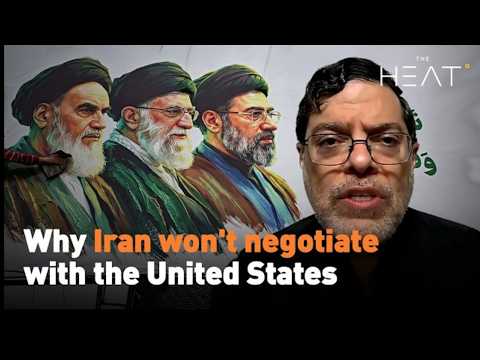
[7:38]Until the facts on the ground change. We are not going to negotiate with the United States because Trump's signature is worthless.
[7:45]It's a, it means nothing to anyone. He changes his position every day. He negotiates and then secretly launches wars. This is not the first time that he's done it.
[7:57]So, he's torn up the JCPOA nuclear deal, was signed in 2015. So what is there to negotiate with him?
[8:06]The facts on the ground have to change. Our neighbors will no longer be allowed to be a platform for aggression against Iran.
[8:17]They are complicit in this war. They have blood on their hands. And in future, Iran will not allow them to have such capabilities.
[8:29]In addition to that, reparations will have to be given to the Iranians for all the damage done, for all the murders carried out.
[8:37]And I assume these family dictatorships in the Persian Gulf will be copping up a lot of money. Otherwise, I doubt that the Strait of Hormuz will be of much use for them.
[8:47]And of course, Iran's allies across the region, they will have to benefit from this change on with regards to the facts on the ground.
[8:58]Now, Iran dealt an enormous blow to Israeli defenses when it sent its missiles into an area that was close to the Israeli nuclear plant at Dimona.
[9:10]The Iranian missiles didn't hit the plant itself, but it hit areas around the plant. What was the goal behind that attack?
[9:18]I mean, what kind of message did that send?
[9:22]Well, the Iranians have been striking targets across the land of Palestine. And the Israeli regime is increasingly incapable of doing anything about it.
[9:37]The first week of the conflict, Iran was using very old drones and missiles across the board, both to force the Americans and the Israelis and their and their proxies to use all the air defense capabilities.
[10:02]And then gradually from week two, they begin to mix newer technology with older technology. And now we're seeing in general new technology being used. The latest technologies have not been tested yet or used on the battlefield.
[10:14]But the Israelis are in serious trouble. They no longer have the defense capabilities that are very expensive, much more expensive than Iran's missiles and drones.
[10:29]And they are highly vulnerable. Iran basically controls the skies over Palestine.
[10:35]Israel and the United States have hit many civilian targets in Tehran and in other parts of Iran, as well, including civilian apartment buildings.
[10:44]Can you tell us about conditions in Tehran, in the city there, and how people are coping?
[10:51]Well, since this Epstein coalition, as I would call it, has failed on the battlefield, they have failed to destroy any of Iran's underground missile bases, any of their underground drone bases, and any of their underground factories.
[11:06]They're taking it out on ordinary Iranians. They're frustrated. So they bomb hospitals, they bomb schools.
[11:15]They just today in a couple of school children and a teacher were murdered. They they bombed the Red Crescent Society central building.
[11:29]They bombed the central building for emergency services for first responders. And they carried out many, many double tap attacks.
[11:40]And one of them I put up on my Twitter account because they've shut down my Instagram and Facebook account. But on my Twitter account I put footage of a woman who survived an initial strike.
[11:55]And then she was murdered in the second strike. That happens quite a lot. And it just shows that the immorality of this genocidal regime in Palestine.
[12:10]Is the same as all the immorality of US pilots. They have they have won they have one, they have similar characteristics.
[12:23]Dr. Marandi, before I let you go, just one final question on Iran's nuclear program. President Trump and the Israeli Prime Minister Benjamin Netanyahu continue to make the case that Iran was on the verge of producing a nuclear weapon.
[12:35]I mean, that timeline has changed so many times. We've heard it's going to be within two weeks, it's going to be within a month, it's going to be within a few days.
[12:46]The Iranian President has talked about this, uh, and this is what he had to say. Let's listen.
[12:54]We have never sought nuclear weapons. Whenever we met with the supreme leader, in the presence of the Defense Council or commanders, he would state with full decisiveness that nuclear weapons are religiously forbidden.
[13:06]No official in the Islamic Republic is permitted to pursue the development of nuclear weapons or any weapons of mass destruction, or even to move in that direction.
[13:17]Given what the United States and Israel continue to say about Iran's nuclear program, I mean, do you see any scenario under which there would be a restoration of the nuclear talks or other stakes now much bigger?
[13:32]The nuclear program was always an excuse, just like human rights, just like terrorism. Their problem with Iran is it being an independent country.
[13:42]And the country that supports liberation movements, whether it's in Cuba, where they're starving them, the people right now, or, of course, in Palestine.
[13:50]And Palestine in particular angers them. They do not want Iran and the axis of resistance to block their ongoing genocide.
[14:02]That angers the United States and the Israeli regime. And of course, Western media will repeat anything that Western regimes say, because they're both controlled by the Epstein class and the oligarchy and the Zionists.
[14:12]So, they will always say that Iran's nuclear program is a threat, even though they've been saying this for decades, even though the International Atomic Energy Agency has never provided any evidence whatsoever, that Iran at any point in its history was pursuing a nuclear weapon.
[14:30]But regardless of all that, aggression against the country, murdering the country's leader, this is, of course, what they're doing today, murdering school children.
[14:42]These are crimes against humanity, these are war crimes. But the Western media collectively blames the victim.
[14:51]And that just shows how dangerous the collective West is to humanity. It shows how how far apart it shows the gap between their claims for human rights and international law, the gap between those claims and reality.
[15:09]And it simply shows that they've imposed the law of the jungle.
[15:15]We have to leave it there, sir. Thanks for joining us.
[15:18]Thank you.


