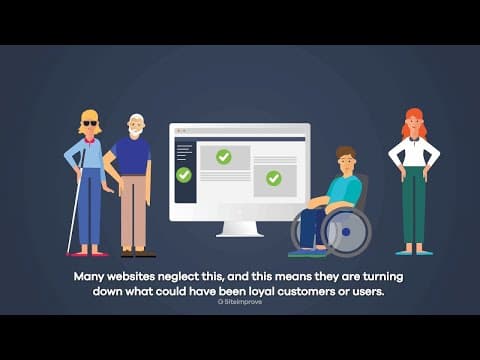
[0:03]Did you know that 15% of the world's population according to the World Health Organization live with some kind of disability? That's over 1 billion people, and they are potentially not able to use your website unless you have made it easily accessible to them. Digital accessibility is about providing equal access and opportunity to people of all abilities and disabilities. That includes visual, hearing, and physical impairments, but also cognitively challenged people, the elderly, and other less obvious groups. Simply put, it's making websites simple and usable for everyone across all devices. This simple idea is recognized by the United Nations as a basic human right. It's not difficult to build accessible websites, and doing so is a great way to take social responsibility and improve your business at the same time. When sites are "accessibility optimized," they are easier to navigate and simpler to understand for all users. Accessible websites are also found easier by search engines. All in all, it's positive for everyone. Accessible websites work like a magnet on people with disabilities simply because they can be accessed. Many websites neglect this, and this means they are turning down what could have been loyal customers or users. Also, making your website accessible doesn't strictly mean catering to the disabled. It also means catering to an increasing number of senior citizens. By 2020, the share of people over 65 will reach nearly 30% in Japan, 20% in Europe, and 16% in the U.S. This is definitely something worth paying attention to, because seniors are a segment with strong purchasing power. Accessibility is increasingly also a necessity from a regulatory point of view. In fact, many countries around the world are introducing or tightening existing laws that make accessibility a mandatory focus. Some even enforce this with fines. At Siteimprove, we can help you make sure everyone experiences your website the way they were meant to. Let's build a better web for all. Siteimprove. A better web for all.
Why Accessibility Matters
Siteimprove
2m 12s331 words~2 min read
YouTube auto captions
Transcript source
YouTube auto captions
This transcript was extracted from YouTube's auto-generated caption track. The transcript below is server-rendered so it can be read, searched, cited, and shared without opening the original YouTube player.
Pull quotes
[0:03]Did you know that 15% of the world's population according to the World Health Organization live with some kind of disability?
[0:03]That's over 1 billion people, and they are potentially not able to use your website unless you have made it easily accessible to them.
[0:03]Digital accessibility is about providing equal access and opportunity to people of all abilities and disabilities.
[0:03]That includes visual, hearing, and physical impairments, but also cognitively challenged people, the elderly, and other less obvious groups.
Use this transcript
Related transcript hubs
Watch on YouTube
Share
MORE TRANSCRIPTS


