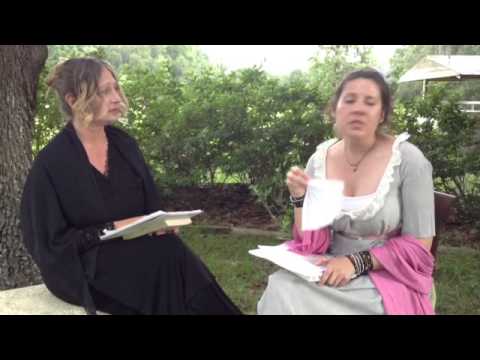
[0:00]An interview with Literary Legends. Starring Nancy Harmon and Stephanie Hauser.
[0:16]HUM 1230 Midterm Presentation. Welcome to today's show, Interview with Literary Legends. My name is Elizabeth Bennett. Today we will have authors Mary Shelley and Jane Austen. We have a series of questions for our authors to ask each other, so please give our guests a big round of applause.
[0:44]Jane Austen, charmed, pleasure to make your acquaintance, darling. So, um, apparently we have a series of questions to ask each other, Miss Mary. So I guess I'll start, is that okay with you? Oh, yes. All right, so, um, tell me about your childhood and your family, Mary. Well, it would have been a happier childhood, had my mother not passed after uh, she gave birth to me. Within 11 days, she died. Oh, how very sad. Yes. Very. It was quite tragic. But I was born August 30th, 1797 and she passed 11 days later, like I said. Tragic. So tell me about your childhood, Mary? So I was the only daughter born to my father, who was a philosopher, William, and a feminist, my mother, who I'm named after, Mary.
[1:51]So then after that, my mother died, my father and I spent quite a bit of time together. The next three years we were inseparable. But then he became so lonely after our housekeeper and nanny left. I'm not sure if the two of them were together or not but. Oh, scandalous. Quite upset. Yes. So he then married our neighbor, who was a widow herself. Oh, my. Really? She brought two children with her. Oh, and how did you feel about them? Them or her?
[2:30]However, you tell me, Mary. The children, they were nice, but her, not so much. She was really a stepmonster. Oh, how terrible. Yes. Was she very cruel? She was jealous of me and my father's relationship. So my father sent me to go stay with the Baxters in Switzerland for a couple of summers. How awful. Yes. And I became best friends with the sisters. Oh, wonderful. How very nice. Yes. But I, I never went to formal school. I learned how to read through my father. He just imposed on me on all of his books in the library and my mother's writings, and I learned to read and write that way. Astounding. Although my stepsister, she was able to go to school. Oh. Really? Not you. Yes. The stepmonster. Terrible. Yes. So that was my childhood. Tell me about yours. Yes. Well, um, happily, mine is a little bit more upbeat, Mary. How fortunate for you. Yes. Um, I was born December 16th, 1775. I was born in Steventon, Hampshire in England. My father's name is George, and he was an Oxford student, he was educated there, and he ran the parish, the rectory, the Anglican Church near our house in Steventon. And, uh, very intelligent man. My mother was named Cassandra, and, uh, she was just rather delightful, very, um, upbeat woman, uh, very intelligent, uh, part of the upper class aristocracy. So that was quite nice. Uh, she taught us much of what we needed to know to be proper ladies. Um, I only went to school for about one year formal school, actually. Financial constraints and all of that. So quite not so upper class then. Hm. Hm. Thank you for pointing that out, Mary. Thank you. Yes. You're welcome. Quite welcome, Jane. My family did deal with some financial issues, uh, as we were growing up. Um, you know, as most of us do at some point in life, I'm sure you did as well. Um, but I was rather close with my sister Cassandra. Uh, we had six brothers, and it was just us two sisters, so we were like two peas in a pod, you know. Just the two sisters, of course. Uh, we did when I was eight years old, end up going to school together, and I got to learn French and piano and reading and writing and painting and sewing and some delightful things, but, um, me and Cassandra actually took quite ill, um, not long before we had to come home with typhus. It was a rather bad outbreak of typhus, uh, that year at school. So it cut our education quite short. So we did come home after that, but beloved Daddy, he was always for us girls getting a proper education, even when it wasn't a very popular at the time for ladies of our class to do so. Uh, but he had hundreds of books in his library, so we got to indulge ourselves every evening in them.
[6:03]So it was quite nice. Sometimes I would read to the whole family and open a book or a novel of my own writing and, uh, pleasure the, the whole family with my, my reading and writing skills. So it was lovely, very lovely. At least we have one thing in common. Yes. I, I have to say it's much happier than your upbringing, Mary. I do feel terribly sad for you about that. Yes. Yes. I'm sure she does. Uh, so, uh, next question, Mary. Yes, tell me you, so you already said about your hobbies. Would you like to hear about mine? Uh, why, yes, I would love that, thank you. Reading and writing. Okay, and, yes. And reading and writing. Oh, it's so nice that you're so focused on your work. Yes, I was quite.
[7:00]Doesn't seem like that would, uh, very much amuse you growing up. Well, I was in the library all the time. Oh, so and I loved to read and write. Well, did I tell you that I played pianoforte? I'm sure. Oh, yes. I do love a nice tune. I also rather like to dance the cotillion, have you ever? No, I haven't had the pleasure. Well, I do love a nice ball every now and then, especially when the militia's in town. Oh, that's where my, my, uh, mother met, uh, the soldier friend and she had my half sister. Oh, enthralling. You have such a sordid history, Mary. Oh, yes. Lovely. So shall we move to the next question? Absolutely. Um, so what influences have affected your writing the most? Like, what made you want to be a writer, Mary? Well, since I only did read and write, um, all the death in my family, oh, yes. Lots of death in my family. After my mother passed and my father went through such a tumultuous time, so heartbroken. And then my husband, well, not quite my husband, my lover, we had children together. Three of them died out of the four. Oh, how sad. And then his wife jumped from a bridge, committed suicide. Oh, my gosh. Yes, and then my half sister also died, maybe it was my half brother.
[8:47]So much death, it's hard to keep track. Yes, quite. I do suppose it would give fuel for the creative mind, all of that emotion pent up inside of you. Yes, I had quite, um, lots of nightmares and dreams. I was quite the dreamer. So with all that death and my husband's being, uh, well, again, not my husband, my lover, we were unable to marry until his wife jumped to her death, then we were able to marry. Oh, scandalous, Mary. Oh, your poor family. Yes. Prior to that, my lover, Percy, he being such a smart man, scientist himself, read about sciences, had these talks with Lord Byron about creativity and electricity.
[9:52]Made me think about on all the death, just maybe think about how life is created. Yes, I do suppose. That's what got me started thinking about the monster. Oh, from Frankenstein. Yes, from Frankenstein. Although the monster wasn't Frankenstein, it was actually Victor Frankenstein was the scientist. Yes, dear. My reading comprehension is quite well, I did notice that. Oh, shall we go on then or do you know too much already? Did you know that my writing style is actually somewhat of a satire of the gothic style, such as you write in, Mary? Is that so? No, I'm not quite knowledgeable about yours, as you are mine. Oh, well, I began writing at a very young age, actually. I was about 15 and my family, me and my brothers and my sister, we love to write plays and perform them for my mom and dad. Very much encouraged us to be creative and to learn and to read all of my daddy's books and, uh, to become educated and creative and so writing and writing poems and epistolaries and things of that nature, they really were my second nature.
[11:18]And it was at a time when women really didn't, uh, they weren't published authors at all, so nobody ever would have guessed, not even my family, that I was actually going to become a published authoress. So, uh, but really, I drew from my life and my circumstances and, um, I just thought it was so silly, you know, being overly romantic and overly sensible. Like, there has to be some kind of middle ground for goodness sakes, so that's really, uh, where my writing began. And I was 15 when I started writing my own novels. Isn't that wonderful? I was nine when I became mine. Oh, well, we were both young, so I'm sure I was younger than 15 when I was writing, Mary. Please. This isn't a competition. Oh, I see. So, so shall we move on to the next interesting topic they have planned for us? Absolutely, darling. Yes, please do. Uh, so, Mary, tell me about your love life. My love life, very interesting question. Yes, very interesting, quite an interesting question. Well, let's see, when I was 16, I met, uh, Percy, and, uh, Percy Shelley. And he was already married and had a bun in the oven with his wife Harriet, but. Oh, my Lord. I was so much more intellectually stimulating than her, so we eloped. We eloped and ran off together. Had to move away after that. Yes, his father pretty much cut him off financially and my father, well, he needed the money, but told us not to come around. Just asked for the money. I can't imagine, yes. Yes, so, um, so we stayed together. Really? Until his death. Never getting married. Well, we, no, we got married, um, after his wife jumped to her death, she, uh, was pregnant with his third child. Oh, my Lord. Oh, my gosh. Yes. It's shocking. Couldn't handle, I guess, being alone and jumped from a bridge to her death, and then we were able to get married. It was quite wonderful, really. Oh. Happy day for you and him. God bless the deceased. Yes, Claire, my, uh, my, uh, stepsister was able to run and elope away with us. So, um, but that started a, uh. So you were close with your sister, Claire, as I was with my sister, Cassandra. Yes, we were closer than I like to be. How, okay, fascinating. Yes, wonderful. So that, that, you know, we were together all the way up until his death when he drowned. Oh, my. But then I never married or was with anybody again. How old were you when you met Percy? 16. Oh, my, so young. My goodness. Actually, we were 14 when I met. We ran away when I was 16. Oh, it's very young to come out into society, don't you think, Mary? He was older than me, five years. Not not interesting. So, would you like to know about my love life? Oh, I'm sure I would. Sorry to say, it's not quite as intriguing and sordid as yours, but, um. You actually had one. Yes, I did. Thank you so much. Um, well, I never married, so I suppose I was a bit of an old spinster to some people, but I decided that I wouldn't get married simply for sensible reasons. If there wasn't affection, then I absolutely was not going to marry the fellow, which was a very hard decision sometimes, since my sister and my family, they were in financially dire straits and. I could have married in order to save them, but fortunately, I absolutely could not be a hypocrite and do such a thing, so. How selfish.
[15:39]Thank you for your candidness, Mary. Thank you so much. I did find real love when I was 20 years old. My neighbors, they had a nephew and his name was Tom LeFroy. He was a delightful young man, just delightful. And we did have somewhat of a romance, um, to let you know about that. So I did find love, but unfortunately, it wasn't a very good match in his family's eyes, considering I had no estates whatsoever, no fortune to inherit, no dowry, so. So love didn't find you. I know, it did not. So sadly. Yes, dear Tom was sent away by his family and we never really talked very much after that. Six years later, I did get a marriage proposal from a gentleman named Harris Bigwither. Uh, he was not much to speak of as far as looks and intelligence, unfortunately. But the fact that he did have, uh, quite nice fortune, he was set to inherit, did make him some sort of amiable bachelor to be had, I do suppose, in some people's eyes. So I decided to accept in order to save my family, but unfortunately, the next day, I realized I had made an error as I could never marry such a man with no affection whatsoever. So I called off the engagement and never again had another proposal. What a shame. Yes, quite sad. I was 26 when that happened, so, yes, so, yes, you were quite old. Thank you for pointing that out. So, next question, on a happier note, wouldn't you say? Yes. Uh, so, what's your most favorite and famous work of literature that you ever composed, Mary? That would have to be Frankenstein. Oh, yes, of course. Wasn't it called something else in the beginning? Frankenstein or the Prometheus. Oh, very interesting.
[18:00]Yes, yes. So, can you tell me a little about it? Well, Frankenstein, this is my book. It is quite lovely. Oh, my. It's, uh, quite interesting, yes looking. Published in 1818, I see. Yes, I started writing in 1816. Although I, this was my most famous work, I've produced others, but this one has, has set the tone for science fiction today because this was the very first of its kind. How interesting. Yes, it was written in the gothic style, was it not? Yes, gothic style and horror, because that was my life, death.
[18:55]And, um, it just, it was about Victor, who was the scientist and he had, uh, had so much death in his life. It pretty much mirrors my life. It was my life story in text. That, um, he recreated this, this, this monster being who he then realizes that, um, could never fit in and it really is comes down to selfishness. Oh, interesting. It sounds horrid. Absolutely horrid. They all die in the end. Delightfully horrid. My goodness. Yes, so, very interesting. So I also brought my most famous work of literature. Would you like to hear about it, Mary? No, but I'm sure they would. You would, not? Okay. Um, this is it right here, Pride and Prejudice. I like to call it my darling child. Very near and dear and close to my heart, you know. But I wrote it really after that whole sordid affair with Tom LeFroy, to be perfectly honest, I was absolutely beside myself. And really Pride and Prejudice, it was actually originally called First Impressions. Did I tell you that, Mary? No. Well, because it's really about, you know, outward appearances and first impressions of people and that fine balance between reality and romanticism and things of that nature, and I just felt so inspired after everything that happened with dear Tom, that I put my feelings out on paper and my darling child was born. It was published in 1813, you know. So not long before yours was published. How interesting that yours was come out of inspiration and mine out of a nightmare. True. Yes, very interesting. I guess we both pulled from places of our life and places from our hearts for writing. Wouldn't you say, Mary? I would have to agree. So, Mary, I do believe I forgot to tell you what an incredible impact and influence my literature has had on modern 21st century, uh, literature and media and humanities. Did I tell you about this? No. Oh, well, I think you'll be pleased to know, uh, and very happy for me that hundreds, maybe even thousands of movies and works of literature, literature have been based upon adaptations of my very own writings from 200 years ago. Isn't that amazing? Quite. Have you ever heard of the movie Clueless? No, I haven't. It's not of my genre. Yes, clearly, it's mine.
[21:54]Well, it was made in the late 90s and it's actually an adaptation of my book called Emma. And it's interesting to note that when I was writing in my day, they called my genre social comedy. Uh, I wrote a lot of satire and irony, but, of course, there was so much romance in it. But nowadays, they call it the romantic comedy. Perhaps you can think of some romantic comedies that you like, Mary? No. Well, I'm sure our listeners and our viewers have many favorite romantic comedies. And you're welcome. You're very welcome. My contributions other than that would have to be, uh, I always wrote very strong female characters who would make decisions, uh, not just based on what society dictated and had decided for them to do and how to act and how to live, but making decisions from their hearts and from what they felt was right. I have to say that I live that way and I also wrote my female characters in that way, and obviously, we can see many of our characters that are female today, having, uh, that sort of an attitude as well, so that is, uh, part of my contribution. How lovely. Yes. Thank you. And how about you, Mary?
[23:28]Anything at all that you influenced? Gothic, horror, science fiction, and infinite number. Oh, my word. I do put a number to yours, mine was infinite. Such as you've, I'm sure our listeners have heard of movie The Crow and Frankenstein's Bride and Interview with a Vampire. Oh, how very sinister. Very modern works. Big box office hits.
[24:00]Yes, that's very true. Very dark, dark box office hits. Lovely. Well, I would say we're running short on time. Shall we get on with it then? Please. Uh, so, Mary, tell me about the last years of your life. I've heard you had a very tragic death. What were you doing the last couple years before that tragic end? Well, after my husband, because we did marry after his wife's jump. Thank God. Yes. He drowned. Percy was going across the sea and. So terrible. Shipwrecked and, and drowned and died. God rest his soul. So we came into some money. Oh, my word. Yes. And your son, my son Percy named after his father, like I was named after my mother. Yes. And we inherited everybody's estates because they were all dead. My word. Yes. So I was able to send him to formal schooling. Oh, nice for him. We traveled a little bit. And then I died. Oh, my. How did you die? Brain cancer. Oh, how tragic, Mary. How very tragic. Yes, yes, and you were rather young. Yes, I died February 1851. I was only 53 years old. My word. Yes, that is quite young. How sad, how very sad and what a tragic end, brain cancer. Sounds rather painful. I don't remember. Oh, thank God. I died. Yes. Yes, that seems to be a theme of your life, Mary. Lots of death and sorrow. Well, for me personally, I was in the middle, or actually finishing writing two of my, uh, very famous novels. Sanditon and Persuasion, they were later sold after my death, so posthumously. Um, but I was working on those novels, but I just kept on getting very sick. I was living with my sister, Cassandra, and we actually ended up moving closer, uh, to my doctor's office so that I could be nearer to him because my health was deteriorating at such a rapid rate. And they didn't actually find out what was the cause of my death until after I had died, uh, and it was Addison's disease. Yes, it was. How horrible. Yes, it was. I was only 41 years old. So it was quite sad. Quite. Yes, so sorry.
[26:37]Quite all right. But I suppose we have the wonderful knowledge that we made a mark on history, and as literary legends, we have something to be very proud of, affecting literature and humanities from the time of our death and before and till much later, who knows how long our stories will be read. That's true. Well, that's all the questions I have, so, um, it was very nice to make your acquaintance, Mary. The pleasure was all mine, pleasure. Well, since that's all the time we have today, that concludes our interview. That was quite lovely, girls. Can we give them a round of applause? Thank you, and we'll see you next time.


