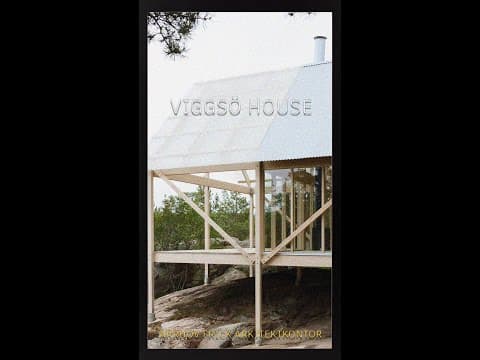
[0:00]By using wood, people can find a friend in the building because wood and humanity have a long history. As humanity was living in the forest, the memory of wood is very long and deep. Swedish studio Arhov Frick Architect Contour is designed a house that fits this description. Vigso House has used slender stilts to elevate this timber-framed cabin into the tree tops on an island in the Stockholm archipelago. The house is located on the island of Vigso and functions as a summer house for a family of five. Architects created an unassuming space within the landscape in a rugged, rocky environment that is dotted with wind-battered pine trees. Island of Vigso's modest and minimalist house that is very abstract of Vigso house. I am founder of BEA+ and I am gonna talk about my personal thoughts about Vigso House.
[1:03]In the beginning, the brief was very simple for Vigso house, free and all about program, Arhov told. A tight budget is an important part of the design of the house. A landscape of stone cliffs, windbent pine trees, heather, and a forest floor of lichen and wild berries. This sparse yet rich site couples with a minimal budget establishes the principles for this private residence at its origin. The design process largely focuses on the development of a simple and economic structure in wood. The materiality of the house had to be efficiently transported and assembled on the island, yet able to withstand relatively large spans. The foundation, a series of posts, minimizes the house's touch on the ground condition, while elevating it to sit amongst the trees and vegetation. From any vantage point in the vicinity, the building is visible, situated as it is to the north of the island and affording views of the sea. Simple planks connect the residence with the surrounding cliffs, following the aim to create an unassuming space within the landscape. The house is mostly ordered in three equal parts. Firstly, the entrance volume at the rear of the house containing the bathroom, bedroom, and kitchen. Above, a loft for children and guests. Secondly, an airy double-height living room providing unobstructed views in three directions. Lastly, an open terrace facing the water, covered by a semi-transparent roof concludes the house.
[2:35]This modest building consists of pine wood as a load-bearing structure and finish. The structural pine wooden frame is infilled with abundant glazing and a generous sheltered terrace extends from one end of the sitting room. Even in this project, wood remains the classic choice because of its versatility, timelessness and warm nature inspired look. This versatility allows it to blend harmoniously with its natural surroundings or evoke a rustic atmosphere. Also, glass helps fostering a lighter architecture and become a stable material in contemporary design. Characterized by its transparency and versatility, it enables the creation of open spaces with seamless transitions between the interior and exterior. The main body of the house is sheltered by a pitched white corrugated metal roof, while a short section of translucent corrugated plastic extends over the deck. The wood, glass wall and roof provides a natural sunlight and a panoramic view for the sky and the forest. Moreover, materials were selected based on their ability to withstand transport to the island and to achieve large spans. Considering all its features, the biggest feature that attracted me to this project was, I always think that architecture should not be the protagonist of the environment. Architecture should work with the environment and should not be separated from the environment. The most important part of architectural design is the interface between the environment and architecture, and this building is strongly achieved that. The minimalist and unassuming structure serves to camouflage the building in its surroundings. Furthermore, the secondary elements such as the metal roof, introduced diversity and prevent the architecture from becoming monotonous.


