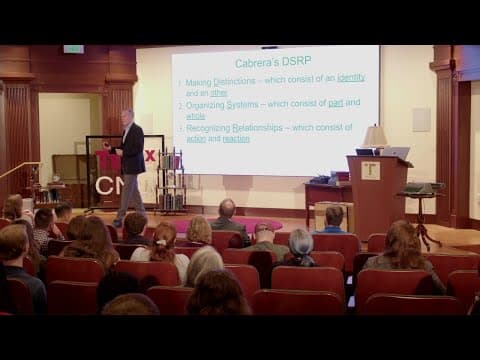
[0:03]Thank you. As human beings, we live in a collective infinite number of systems all day, every day. They collide with us, we collide with them, they interact in in miraculous ways, and yet it's not a very well-known skill. Um, system thinking tells us to look at the world that way. It gives us a language and a set of tools and a set of lenses with which to look at these systems that we're in. And it's a critical skill. In fact, the World Economic Forum has identified it as one of the most important skills we're going to have to come together as humankind if we're going to deal with the complex challenges that we deal with every day and that we all see in the news. And yet again, it's not a very well-known skill. So I want to give you a definition, and I use Dana Meadows' simple elegant definition from her book Thinking in Systems. A set of elements coherently organized in a pattern or structure that yields a characteristic set of behaviors. And if you think about that definition, elements interacting and generating a characteristic set of behaviors, that describes just about everything we do or interact with. Right? This is a system. Elements, speakers, and audience interacting with technology and ourselves with a characteristic behavior of learning about a new topic. And this is going on all around campus in hundreds of classrooms as we go through our day. This university is a system by that definition. Students, faculty, staff, interacting with a characteristic behavior of learning and training the next generation students. Right? So hopefully what you're starting to see is the importance of followership and leadership to systems thinking and vice versa. Now, in as system thinkers, we talk about bounded systems and unbounded systems. And a bounded system is one which we have a governance structure. We choose as humans to make that system. So our university is a bounded system. We have a board of directors that chooses a president and steers it in a particular direction. Our our governance systems, voters, elements, electing leaders who then go and govern a nation, a state, et cetera. We also have unbounded systems or natural systems, and we refer to those as unbounded because we can't wrap our arms around, we can't bind them. All we can hope to do is to respond and create our own human responses to those systems. So let's talk about some of the natural systems we're dealing with. So, again, using that definition elements, let's take our tectonic plates, if we pick just one of the elements here, constantly moving. We know they're moving at some rate and they come together in a characteristic set of behaviors, volcanoes, earthquakes. Now, we may not like those consequences, but nothing we can do about them. And system thinking gives us a set of lenses that we can switch out and look at those systems from different scales. So let's step back and let's look at the Earth. It's just one element in our solar system. Right? Our sun, the planets, interacting in characteristic set of behaviors, which gives us daytime, nighttime, our tides, our seasons. And if we scale up even further, our sun, our solar system is only one sun of billions and billions of stars interacting throughout. And if we take out a different set of lenses and start looking down and what we call it system thinking, in scoping, come to a human and low and behold, we're just a bunch of systems. A skeletal system, a respiratory system, a circulatory system. If we scale even further down with another lens, the lung is a system with a particular purpose in a characteristic set of behaviors. If we go even further, a long cell, strands of DNA and proteins interacting, we may not like the characteristic set of behaviors, but it's going to find a host, it's going to infect that host. It's going to mutate and it's going to replicate.
[4:34]That's what systems do, and yet a lot of humans, we try to wish those things away and system thinking causes us to say, no, you've got to look at it and deal with it straight up. Now, I'm sure some of you are saying, wait a minute, this guy's saying that everything is a system. Let me give you the proof of that. It comes from Derek Cabrera at Cornell and he came up with a simple, elegant proof and it starts with the distinctions that we make. And that consists of an identity and an other. So go scaling back up, let's look at life forms on Earth. Can I stop at the identity of being a human? I can't. There are other life forms on Earth, right? I have to acknowledge there are other. We see what happens when we don't, as humans, when we ignore that fact, we see what happens, depletion of fish stocks, et cetera. So if we scale down, taking out our lens and getting a little bit closer, if I look at humans, can I stop at my identity of male? Nope, there are others. How about nationality? I'm an American, can I stop there? How about political parties? How about professions? I'm a professor, is that the only profession there is? Thank God, no. Right? So you just can go down that scale, religions, again, you have to acknowledge there's another. And if you do that, systematically, what you'll find is you're organizing systems, because you've just acknowledged that you're part of a greater whole. And you can confirm that to yourself by looking at this, if I take an action, will there be a reaction? And almost universally, you know that there will be. Now, this gets a little hard because sometimes those reactions are delayed. Right? For instance, if any of us came into this room with a communicative, airborne, viral disease, guess what? That's your gift to everyone here. Right? But we won't know that for a number of days. The the challenges we're dealing with globally have been known about since the Club of Rome identified global warming and and the the resource depletions. We just have long delay cycles to get there. But if you acknowledge all of these things, then you have to also acknowledge that that gives you a particular point. That identity gives you a particular point with which you view the system and gives you a different perspective, and it may be very different than the other parts of the system, and the reactions and actions may be very different and informed by very different views. So you can see that if you don't view the world as a system, you might be tipped over the whole time. System thinking causes us to to use what's called both and thinking. Right? To understand and identify both my identity is critically important, but so are the others. Both the parts are important, but so is the whole. Both my actions are important, but so are the reactions that are inevitably going to occur. And my perspective is important, but so is everyone else's because they may view the system very, very differently. And so systems become the context through which we view the world as leaders and followers. Barbara Kellerman famously pointed out, the system drives everything in the case of natural systems, unbounded systems, all we can hope to do is have our followers demand that our leaders come together and orchestrate a response to natural phenomenon. Earthquakes, pandemics, whatever it might be. And in the case of what we call complex adaptive social technical systems, man-made systems, all we can hope is that followers elect good leaders or choose good leaders to steer our systems in the correct directions. But these are really hard things. We know from the news that casts are very, very hard to manage, particularly if you don't use a system's perspective and a system's thinking set of lenses and tools. And let's look at that. They're complex because they're made up of all of these relationships. If you just think about this university, 4,500 students, 2,500 faculty and staff, coaches, the city of Newport News, parents, literally hundreds and hundreds of thousands of relationships that are going on at all times. And every one of those might be changing because we are intelligent adaptive agents. We see the system, we move because of the system. We respond to incentives in the system, we're disincentives in the system. And what that, we do that through the encoding of knowledge and the transfer of information. Here's the danger is that the right information, did we encode it properly? Or are we sending the wrong information? You can see the challenge with social media here. And that means that the evolution of our systems is occurring at different rates and at different times and different scales. Parts of the system are getting way out ahead of others, some are behind, some don't get the information at all. And that leads to flow-driven dynamics, different energies and passions, and you can see this in the in the news that you read about every day. One group is charging off into the future, yay, verily, this must happen, and another saying, not on my watch. That happens all the time. And if you don't use system lenses and system thinking to to look at that, you may be tipped over the whole time. So system thinking causes us to step back and look for all those relationships, causes us to use both in thinking. And to step back and view the system from different perspectives and using different lenses, so that we get a better, more nuanced understanding of it. It requires a bit of what Abigail talked about, submission. We have to be humble in front of the systems. So it's it's a critical skill and yet not well-known. I'm on a mission to change that. And there are a couple of critical things you need to know. Hermeneutics teaches us, the philosophical tradition of Hermeneutics teaches us that no way that I can possibly know my identity and myself and the parts unless I know the whole. Because the whole gives context to the parts. And the more I go around the Hermeneutic circle, the better I'm going to understand the system that I'm dealing with or the the environment that I'm dealing with. Herbert Simon cautioned us in his treatise on bounded rationality. If we stop only at our identities and draw a boundary around them and say that's the only one I need to worry about, we will inevitably optimize for only ourselves, or only our group, or only our part and not for the whole system. Garrett Harding wrote brilliantly about this in the tragedy of the Commons. He wrote that it is in every one of our narrow self-interest to optimize our part of the system, but it's in everyone's collective interest not to do that. And we have a choice. We have to make those choices. And that comes from the African tradition of Ubuntu. You familiar with it? I am because we are. So I'm going to encourage you to start thinking in systems because you're living in them. Thank you.


