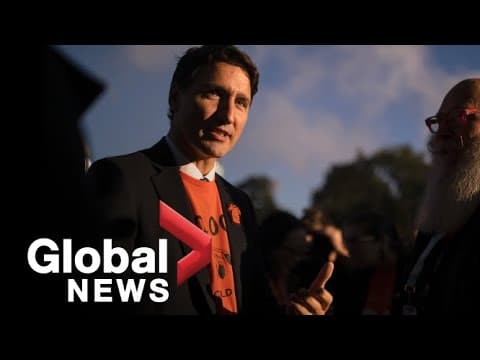
[0:02]Thank you, Carl. Bonjour, good morning. I want to begin by acknowledging that this beautiful morning, in this beautiful land by this extraordinary water, we gather, uh is the traditional territory of the Hoshoni and Ashnabe peoples. I want to thank Gary for the song. I want to thank Grandmother Marie for the beautiful prayer and blessing and lesson, reminding us how we must remain rooted in respect and care for each other and for Mother Earth who cares for us every day of our lives. It's so good to see so many people joining here today. So many strong, present indigenous people, uh reflecting on this day, grieving and healing and sharing their strength. So many non-indigenous people as well. Thank you for coming out today, because you have an essential, or we have an essential role to play on this day. I want to thank the community leaders, Jim, April, Chris, Vance, Tony, others. Thank you for bringing the representation of your communities and your responsibilities here to this moment as well. Thank you to the Niagara Indigenous community and the grandmothers who invited me to be part of today's sunrise ceremony and the sharing circle with survivors. I heard stories this morning of the horrors and pains of residential schools that happened many years ago, in some cases generations ago, but that are every bit as present today as they ever were. As we reflect on truth and reconciliation, it's not just a thing of the past, as articulations today and challenges that families are facing, challenges that communities are facing, and challenges that we are all facing. We heard about the challenges of leadership, challenges of family, challenges of healing. It was an extraordinary privilege for me to be able to witness and hear, and to reflect, of course, on my responsibility to make sure that all of us in this country are moving forward in the right direction together. Because this is a day for indigenous peoples, it's a day to recognize that, yes, you are still here, you are still strong and you are an indissociable part of the present and the future we build every day as a country.
[3:10]It is. It is a day, it is a day to remember, to grieve, to take another step along healing. But it is also a day for non-indigenous peoples, to recognize that you should not have to carry this burden alone. How many times do indigenous people need to tell their stories of trauma, of loss, of pain, of grief, until we absorb those stories as non-indigenous people and make them our own, because they too are the story of Canada and therefore they too are the story of each of us.
[3:59]We talk about what happened in residential schools where systematically, deliberately, indigenous children were taught that they had no worth, no value, no value to their language, to their culture, to their identity, to their traditional knowledges, to their anti and elders' teachings. That was what residential schools did to generations of indigenous people who carry that trauma still today. But let us not forget that every single school across this country through all those decades was also a residential school, be in the way that it taught non-indigenous people, that indigenous people had no worth, had no culture, had no language. And we carry that untruth in our learnings directly, from when we were kids in school. We carry also that learning built into the very stones of our institutions, to the systems that surround us. Lack of value, of respect, of celebration of indigenous, languages, culture, and identity, is woven into the fabric of every part of this country, because for so many years, it was taught the same way it was being taught in horrific ways, or attempted to be taught in horrific ways to indigenous kids in residential schools. So this day is not just about indigenous people or indigenous reconciliation. It is about truth, and that truth is, we all need to open our eyes to the truth of how Canada evolved and came to be, and how we need to make deliberate choices to undo the falsehoods and the wrongness that is part of it. But when I look at this beautiful park filled with hopeful, positive faces, strong indigenous children, allies of every different background, as Canada represents in the best of it. We know we are on the right track. We are on the path, and it is going to take many years. But we must today and every day, rededicate ourselves to that. And what a privilege to be able to do it this morning in the presence of Phyllis Webster, whose courage and sharing her own story helped mobilize people, including all of us across this country. I look out into this crowd, and every orange shirt is an act of solidarity with Phyllis's story and the experience of survivors. pour ceux qui ne savent pas, Phyllis est une survivante du système des pensionnats. Quand Phyllis avait 6 ans, elle a mis un beau chandail orange pour se rendre à son premier jour d'école. C'était un chandail orange que sa grand-mère lui avait acheté et qu'elle avait choisi. Elle avait très hâte de commencer l'école. But when Phyllis started school, her orange shirt was taken away from her. She asked for it back, but was denied. Her joy was taken from her, and so was a part of her home and the opportunity to express herself. Depuis ce jour, Phyllis n'a pas porté de vêtements orange jusqu'en 2013, quand elle a raconté son histoire lors d'une cérémonie de commémoration. As soon as Phyllis shared the story of her own orange shirt, it began to spread and spread. It resonated deeply with people. It symbolized the pain of residential schools. The way indigenous children were stripped of their culture, their language, their connections to their families, were prevented from hearing their parents say, I love you and learning how to say it to their own kids, years later.
[9:35]Tears for the kids, alone and lonely in residential schools. Tears for the parents, who were unable to give their kids the love, the protection, the support that they so needed. Tears from aunts, grandfathers, and grandmothers, watching their kids lose that precious time with them, the precious teachings and share that they had learned from their aunties and grandparents going back millennia.
[10:20]This day fulfills a long-standing need to come together as a country to recognize the ongoing legacy of these so-called schools, especially as more and more unmarked grave sites are uncovered. The National Truth and Reconciliation Day holds space for every Canadian, indigenous and non-indigenous, to grapple with this part of our history, to honor those who lost their lives and to think about ways each of us can support survivors and be better allies. Reconciliation is the responsibility of every single Canadian, and we know it will take time. It's important to listen, to learn, and to move forward to not repeat the mistakes of the past. Scars don't heal overnight, and trust can take a long time to rebuild. But we will be there together every step of the way. La réconciliation, c'est la responsabilité de tous les Canadiens. C'est important de donner l'espace aux voix et aux histoires autochtones et de reconnaître la vérité. Over the past number of years, we've made historic investments in indigenous priorities like health care, housing, infrastructure, ending boil water advisories, moving forward to protect language, to protect culture, to protect traditional knowledge, to lift up indigenous identity. And that happens by putting indigenous leadership and indigenous knowledge and indigenous priorities at the center of everything we do as we journey this, this, uh, this path. We will continue to make these important investments and work with you to close all these gaps that continue to exist. But today, today it is an honor to stand with you all, and I'm grateful that you're sharing your stories with me, with Canadians, and now increasingly with people from all over the world. I will unfortunately be having to leave this ceremony before the end because I want to attend the national ceremony in Ottawa this afternoon. But I will hold your stories close to my heart throughout this day and throughout this year as we continue the hard work of making Canada the country we all know and hope it can be inside our hearts, but that we all have a lot of work still to do to get there. Mercy. Meuch. Thank you, my friends.