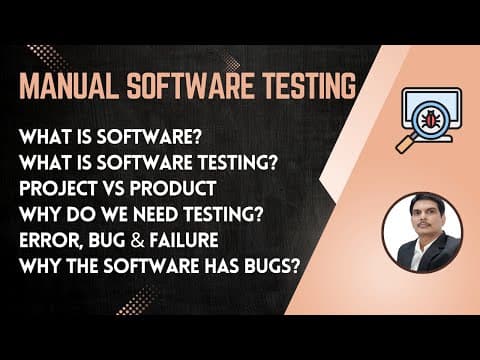
[0:01]Hey everyone, welcome you all. So from today, I'm going to start a new series on manual software testing on YouTube live sessions. And especially beginners they have requested to upload a new series on manual software testing, especially manual testing concepts and manual testing process and Jira and as well as Agile process along with some project. So I'm just planned for that and from today we are going to see. So especially for today we are going to start some basic concept from manual testing, okay? Now let's get start. So manual testing we are going to learn in three different phases or we can say modules. The first module, the first module testing concepts, your first module we are going to learn testing concepts. So what is testing concept means basically this is all completely theoretical concept guys, okay? But I don't want to get you bored, so I'll interact more and I'll give practical experiences and some scenarios also don't worry. So testing concept this is module one. In this particular module, we are going to learn some very basics of testing, like what is software testing, what are the different levels of testing, what are the different types of testing we have to conduct on your application. Like what is software, what are the different type of softwares are available and SDLC, STLC, like a lot of things are there. So we are going to learn some basic concept from testing because before going to conduct testing we have to know what kind of testings are there and how we have to conduct those testings. So that is a theoretical part. Okay, so testing concept this is a module one. In this particular module we are going to learn some very basics of testing like what is software testing, what are the different levels of testing, what are the different types of testing we have to conduct on your application. Like what is software, what are the different type of software are available and SDLC, STLC, like a lot of things are there. So we are going to learn some basic concept from testing because before going to conduct testing we have to know what kind of testings are there and how we have to conduct those testings. So that is a theoretical part. Okay, so testing concept and if I just look at the curriculum, so the basic concept will be there like what is software testing types of software and software quality, what is project and product and why do we need to testing and SDLC, STLC, a lot of things are and test design techniques, these are very, very important topics which are going to discuss. And white box testing, black box testing, what is there and functional and non-functional testing. So all these things we are going to discuss as part of module one. So this is mostly theoretical part, okay? Because before jumping into the practical part we have to know some basic concepts theoretically. So almost four to five sessions we are going to spend on this particular module, software testing concepts. So this is the first module, theoretical part. Okay? Then basically this module says like what? Like what to test? Okay? And the second module is a practical part. Okay, second module is a practical part. Software testing project. So here we are going to start project along with some concepts like how to write how to analyze the requirements, how to write the test plan, how to write the test cases. How to execute our test cases and we are going to learn about bugs bugs or defect life cycle, how to report the bugs. So these concepts are purely practical part, so in this module we are going to learn project and this is purely practical orientation and here we are going to learn how to test. Okay, in the first module we are mainly focusing on what to test because the theoretical part. In the second module we are going to test like we are going to test the application directly, like how to test. So what are the different techniques are available, right how to write the test cases, how to review the test cases. So these things will be part of module number two. Testing project. So here you will get the practical experience.
[3:51]Okay, so this is a module number two because we cannot directly jump into project because before that we need to know some basic concept. If you know the what part, then we can jump into how part. So what to test and how to test. And once these two modules are completed then the module three is for agile process. This is purely process oriented because in the nowadays all the companies are using Agile process, okay? And you have to know this process. Until unless you know this process, it is very difficult to survive in the company. So previously waterfall model, spiral model, there are traditional models are available because these are process model, because if there is any company, there should be some process followed by people, right? So here Agile process which is very, very important and most of the companies are following Agile process. So here in module three, we are going to discuss Agile process like how we will get the requirements, how to write the stories and epics, how we can do the backlog plan or sprint plan, how the cycles will go on. So how we can interact in the project interact within the project team, Scrum, all these things we are going to discuss as part of Agile process and here itself I'm going to discuss about one important tool called Jira. So Jira is basically Agile test management tool or we can say Agile tool. And in this particular application, we can track everything in the software development from the beginning from the requirement to till we deliver the software to the customer. Everything we can track into this particular tool. Okay, so this is Agile process we are going to discuss which is Jira tool. There are a lot of concepts are there guys. So I'm not writing in detail because I already have the curriculum here, so I'll share this curriculum later, you guys can go through the topics, okay?
[6:01]So these are the three different modules which we are going to cover as part of manual testing. So with this Jira tool we will able to complete manual testing. Okay, and apart from that in addition I'm also going to share you the SQL videos because SQL is not part of our course because SQL itself will take 10 to 15 sessions. So I'm going to provide the video sessions or recorded video sessions apart from this manual testing course, okay? You guys can go through the sequel videos and that is also very important for testing prospective because if you go for an interview people will ask you some questions on from SQL also along with the manual testing. So that is also very, very important. Right, so that will be going to share after completion of manual testing. Right, so this is a part of manual testing curriculum and once you completed manual testing then I'll share automation testing and everything, okay? That is a different curriculum we are going to learn. All right. So for today's session I'm going to start with module one. So are you guys clear so far everyone about this curriculum? Can you please confirm in the chat window. So if you ask any questions guys, so please interact in the chat window immediately. And every time I'll ask the confirmation from you guys, so please put in the chat window, okay? All right. So let us start with a few some basic concept from manual testing, okay? So today is introduction session, so I'm just going to cover some basics like what is software, what is software testing and why do we need to software testing all these things, okay? So people who are completely beginners, okay? And they don't have any ID background. I'm going to start from very, very basic guys from the scratch and you don't need to worry about anything if you just know how to use MS Word document, Excel sheet, that is that knowledge is enough and basic internet knowledge is enough to start learning this concept, okay? So you don't need to worry and afraid of anything, I'll go from very basic. If you have not understood anything, please use chat window to post your questions, okay? All right. So this is a small presentation I have, so later I'll share this presentation, okay? First let us see the concepts. And one more thing is for every concept guys after explanation at the end of the session, I will also share the presentation as well as notes and materials, so don't worry. So you guys can go through them. All right. So first let us start with what is software like what is the types of softwares? So everywhere we heard this term software. What is software? Simple definition. Everyone know about software, but if you come if I ask the definition, most of the people cannot answer this question. Software, everybody knows the software. We are daily in daily everyday we are using softwares in mobiles or computers everywhere we are using software. But what exactly software means? So if you say definition of the software, the software is a collection of computer programs that helps us to perform a task. Suppose, if you want to perform some task, guys, suppose if you want to do some manual task, right? So through the machine I want to do the task. So that machine needs some software. Okay? So for example, if I take a mobile mobile, right? So if you have only mobile, right? We cannot do anything with mobile. In that mobile, there should be some apps or some software should run and with that software we are doing all the things, right? Suppose if I take some WhatsApp or LinkedIn, whatever apps you have in the mobile, if I don't have those apps, can you use your mobile? No, right? So you need to have some software in that and then only we can use a mobile. Similarly, software is a collection of computer programs. And how those how how the software will be developed which is basically collection of programs. And the developers will write n number of programs and collectively we can call as a software. So what is a program? Program is something called as a coding, like they will write some instructions to the computer. So the instructions can be understandable by the computer and collectively we can call it as a software. So software is a collection of computer programs that helps us to perform a task.
[10:23]Okay, simple definition. But in the market, there are different type of softwares are available. There are different types of softwares are available. So mainly there are three categories. One is system software, okay? Let me just write some notes here. Okay, so types of software, system software and programming software and application software.
[10:52]System software, programming software and application software. So these are the three different types of softwares are available. Three different types of softwares are available. One is system software. I'll tell you what is system software. Normally device drivers, operating systems, servers, utilities, etc. These are all comes under system software. What does it mean? Suppose you have your desktop or laptop, okay? And you are connecting all the accessories to your computer. You are connecting keyboard, you are connecting mouse, right? You are connecting some other screens or there or you are connecting printer to your computer, right? So these are different accessories or devices are connecting to your computer. But if you want to use those devices, we need to install some additional drivers or sometimes your computer also will come along with the drivers. And those drivers also comes under the system software and basically these softwares are used to run the systems. Okay? Suppose if you connect suppose if you have connected your keyboard to the computer, how your computer will able to identify your keyboard the instructions are coming from keyboard. It doesn't know basically, right? So there should be some software. The computer should have some intelligence to identify your keyboard, to identify your mouse, to identify your monitor and everything. So that is basically comes under the system software. So device drivers. And operating system. Operating system means what? Windows, Linux, Mac, so these are all operating systems. So you have a computer but if you don't have any operating systems, how can we use or how can install other softwares without using operating system? Because first as soon as you start your computer, operating system must be there. So on top of operating system, we are going to install other softwares, right? That is the base. Once you have computer, you need to install some operating system. It can be anything. So that is also comes under the system software because if you want to run or start system, we need some operating system. So that's the reason which is comes under system software and servers are some utilities files or some utilities means suppose if you write something, right? If you write some text or if I write some document, internally the computer software is able to recognize it. So to run special software, we need to also have some utilities. So these are all comes under system software, device drivers, operating systems, servers, utilities. All these things are comes under system. So basically the system software will be used to run the systems. Okay? That is a one category of softwares. And the second category is a programming software. So what is programming software means? Compilers, debuggers, interpreters, so these are all examples of programming software. That means suppose developers are writing the code or some program. How program will be executed? How the program will be produced some output? Suppose when I use a computer, we are giving some input to the computer, we are getting some output. So who is processing internally? When I give some input to the computer, someone should be there to process that input and produce the output and that thing will be done by the compilers, debuggers, interpreters. So these are the softwares which will do some processes when you run your program. Normally developers work with these programming software. So whatever the programs they have run to execute the programs and providing the output, the compilers, debuggers, interpreters will be used internally. So that is comes under the programming software. And the last one is application software. So this is a very, very important area where we have to focus on. Application software. So application software is nothing but the users will use that applications or users will use that software. For example, web applications. So everyday we are using web applications in case of Facebook or LinkedIn or Amazon or online portals, everything is comes under web applications. And mobile apps. Suppose you are using mobile, right? You have n number of apps in your mobile. All those things are comes under application software. And desktop applications. Desktop application means what? You can install those applications in your laptop or your computer like MS Word document, Excel, Outlook, Notepad, calculator. So these are all comes under desktop application. So calculator is a desktop application. Your paint is a desktop application.
[15:33]So all these comes under desktop applications. So basically there are three kinds of applications, application softwares, one is web applications, mobile applications, desktop applications. So everyday and day-to-day basis, we are working with these applications.
[17:10]So these are all comes under application software. Our testing is also mainly focused on application software. We are going to test the application softwares. Okay? So this is basically understanding the basic understanding of what is software, the types of software. Okay? So the next thing is what is software testing? We understood what is software testing types of software testing. Now we need to understand what is software testing. Okay? So next one, what is software testing? We already know what is software. Now we are understanding what is software testing and then why the software testing is required. So this is one of the important interview question also. Like what is the software testing? So normally when you purchase any product, right? So what you will do? You will do some basic functionalities working or not. So let me just give you for one example. Suppose you want to buy a mobile, okay? So before buying a mobile, you will have some budget, okay? And with that budget, within that budget, you are expecting some features to be there in your mobile. Okay, you have some budget and you are expecting some features, some functionality should be there in your mobile.
[18:46]And once you bought your phone, you started using your mobile and then you are started finding some bugs or issues in your mobile. So something is not working. Or on or off is not properly working, right? Or screen is not properly appearing, some apps are striking. So if you find these kind of issues in your mobile, how you will feel? Definitely you will start frustrating with that product, right? So why these things this thing is happened because of in lacking of testing. Because you bought a mobile, you bought a product but this is buggy product. So you have some issues with that product. Why these issues are there in the product because testing is not properly conducted, right? Each and every function each and every feature is properly working or not. It is not properly tested. So that is the reason you start started frustrating with that product, right? Same thing will happen with the software also. Same thing will happen with the software also. But who is using software? So for example, let us say some bank, okay? So let's say I have something called X bank. So this bank is doing some transaction on day-to-day basis manually. And after few days, this particular bank wanted to automate the process.
[20:09]Means what? Whatever the transactions they are doing manually, they want a software and using that software, they wanted to do those tasks. Okay? Through the software. And what this bank, so bank is nothing but what? This is a small company. Okay? And this particular company or bank will approach an IT company, okay? Will approach an IT company. And once they approach this IT company, they will explain their requirement. So what they exactly they do in their organization. So what kind of operations or actions or tasks they do on day-to-day basis in their organization. So they will explain the entire the process, the requirement, everything into this IT company. Along with that, the budget, what is the budget they have and within what time they need the software. So all these things will be explained to this IT company. Now what IT company will do is IT company will develop the software.
[21:42]Will develop the software and it also to be tested, okay? Test the software and after testing, then deliver the software to the company called X bank.
[21:57]So this is actual process. So some company will approach the IT company by saying all their requirement, budget and time. And based on that, IT company will agree the requirement, agree the proposal and then they start developing the software and they will recruit some number of people, developers, testers, designers, program managers, all these people. And they take some time to develop the software and then finally, before delivering the software to the bank, we have to conduct the testing here. So after development, testing comes into picture. So why we need to do the testing? What is testing here? Why we are conducting testing here? Because we have to release the quality product to the customer. We have to deliver the quality product to the customer. So that is the main intention of doing software testing. Okay? So software testing will play very, very important role because if you deliver the buggy product to the customer, he'll start frustrating with it because he spent a lot of budget, a lot of time. Right? So this is our responsibility. The company responsibility to provide the quality product to the customer. It should not have any bugs. It should work according to customer requirement. So all these things we have to take care while performing the testing, the software.
[24:23]Okay? So what is software testing? Let me write some notes here. So what is what is software? We understood what is software. Now we are understanding what is software testing. Software testing. So software testing is a part of software development process. Software testing is an activity to detect and identify the defects in the software. So this is the main intention of the tester. What is the job of tester means? He has to identify the defects and he has to make sure our application or software is working according to customer requirement or not. Because initially customer will provide you some requirement, the functionality. And our software also should perform the same thing. Whatever the customer is expecting. Suppose the customer is said something and we develop the software for something else, it doesn't work, right? So the main intention of software testing is it is a activity to detect and identifying the defects. We have to execute some test cases. I'll tell you what is the test case and how to execute all these things. So the main intention of software testing is we have to find the defects in the software. Okay? And the main objective is to release the quality product to the client or customer. So this is all about what is software testing.
[26:07]The next one is what is quality? So here we are talking about quality. What is quality? We are everyday we are talking about quality. If I buy something, we are always expecting the quality, right? But what exactly quality means? The main objective of testing is to release quality product to the client. But what is the software quality? So software quality is something called like customer justification. So how well our product or software is working? The customer will decide. Okay? So here there are some parameter, based on that we can say whether our software is quality or not. Quality software or not. So what are those parameters? Let me just tell you. So software quality. So these are all very important guys, so beginner as a beginner, so please try to understand this. Very simple terms, software quality. So why we are discussing software quality? Because our ultimate goal of testing is to deliver the soft quality product to the customer or client. But what is software quality? So software quality can be measured.
[27:19]So later I'll tell you what are the metrics we have to use, but mainly we can say software is a quality.
[27:33]Based on certain parameters. So the first parameter will be the bug-free. What is meant by bug-free? So our software should not have any bugs, that's the first thing. But 100% software 100% softwares will not be bug-free guys, but at least one or two percent there will be bugs, but they are very, very minor bugs. The customer process or task will not impacted by those bugs. But 100% quality product cannot be always possible to release to the release to the customer, okay? It is not not at all possible. At least one or two percent bugs will be there, but they are very minor bugs. We can ignore those bugs, okay? And the final thing the objective of testing is to release the quality product to the client. But what is the soft soft quality? So software quality, if I say a product or software is very quality product, I should be I can say based on certain parameters, okay? So what are those parameters? So the first parameter is bug-free. So based on these parameters, we can say our software is quality software or not. The first parameter is bug-free. What is meant by bug-free? So our software should not contains any bugs. That's the first thing. Second thing delivered on time. So I said before when I IT company is approaching the company, so some X company is approaching the IT company, they have some budget and they have some time also. Within that time, we have to develop and test the software, and we have to deliver the software to the company, right? And they spent some budget and also time. Suppose what happens, suppose development and testing is taken more than the committed time. Then what happens? We have to pay to the staff also, right? We have to spend a lot of time. Right? So what happens? If you are not able to deliver the software within the time or on time, that is also considerable because the customer has to spend more budget. Because automatically the time is increased like duration is increased automatically, you have to spend money on the staff also, right? Employees like developers, testers, who is working on that project, you have to pay to them, right? If suppose time is increased. So delivered on time. So not only bug-free, we should also deliver the software on time. That is one parameter. The third parameter is within the budget. Sometimes, some organization will have some budget and once you start developing and testing, the budget will be increased. That should not be happened. So whatever the time and budget they have mentioned initially, we have to deliver the software within that particular time and within that particular budget. And then only the customer will say our product or our software is quality. And not only bug-free and it is also depends on other factors. And it should be delivered on time and it should be delivered within the budget. And finally it should meet the requirements or expectation from the customer. Okay? So whatever software we developed, that should fulfill the requirement of customer. So that's the first and most important task. Customer said some requirement and we have developed and tested software, it should work according to their requirement. So this is very, very important. It should meet the requirements or expectations from the customer and finally it should be maintainable. Maintainable means what? After installing our software in the customer environment, they should able to work with that. And if there is any small issues, they should able to resolve themselves and it should be user friendly. Okay? In that case we can say it is a maintainable. So when I deliver a software to the customer, if our software is fulfilling all these parameters, we can say which is a quality product or which is a quality software. And to make sure all these things should be there, we have to conduct our testing. So the main intention of testing is to deliver the quality product to the customer. And when we say our product or software is a quality having soft quality means which we have to follow these parameters. It should be it should it doesn't have any bugs, we can say bug-free and it should be delivered on time. It should be delivered within the budget. And it should also means customer requirements or it should work according to the customer requirement or expectation and finally it should be maintainable in their environment. Okay? So these are the main quality standards. So if I say software is a quality software, then we have to follow these parameters. Okay? And finally why we need testing? We understood what is project and product and why we need to testing? So this we already covered. Why do we need testing? The ultimate goal is to release the quality product to the customer. So that's the main intention. Okay?
[39:38]So finally, I'll just explain about these terms, error, bug and failure. So a lot of people exactly don't know the difference between these three.
[44:26]And which is very important to know that. Okay? So most frequently I use these terms, bug or defect, both are same. But error is different, failure is different.
[44:42]Okay? So these are all some basics guys, so why the software has bugs? So far we are discussing like why what is software, what is software testing and why we need to conduct the testing, right? But why the software has bugs? So when I develop some software, it it contains some bugs. But why we should have bugs? There are a lot of reasons are there. Why the software is having bugs? There are a lot of reasons. The mainly five reasons, guys, there are mainly three, five reasons we can say. The first reason is miscommunication or no communication.
[45:32]Means what? There is no proper communication between the developers and testers. Means what? Developer will develop something and tester will expecting something else. Or requirement is having some functionality and developer is implemented or developed some other thing, some other functionality and tester is expecting something. So there will be gap between the documentation, development and testing. So that is basically comes under miscommunication or no communication. So that is causing the software bugs. And the second reason is a complexity of the software. Suppose the software is very complex, it is almost three, four, five years project and so many people are working like n number of developers, n number of testers, automation people.
[47:08]So much complexities and n number of modules are there. Sub modules are there. In that case also we can miss some bugs, okay? Like integration testing, unit testing, there are lot of testings we will conduct and somewhere we may miss something else. So that is again causing the bugs in later stages. So suppose in some cases, in sometimes even if the software is very complex, there are some chances, we have some bugs in your software. And the third reason is programming errors and most of the times programming errors in the sense it is a responsibility of the developers. So developers will write the program, but the program is working fine, but whatever output is producing is not correct. That comes under the programming error. So for example, developer is written a program to add a to add two numbers. Let us say some example, what is programming error? So developer is written some programming some program and when I pass two inputs, let's say I have passed two numbers, let's say two, three and what is the output I'm expecting two plus three, five I'm expecting. Okay, and this way the program is written the code, but when I run the program, what happens? When I pass this input, which is giving the output but something else. Let's say it is giving something called 10. The program is running perfectly fine. But whatever the output I'm getting from the program is incorrect. So why this is gone the why we are getting this incorrect error because of programming error.
[48:43]So the developers will take care of this programming errors. Okay? So that is one thing. And the next one is a frequently changing requirements. This is a major cause. So sometimes what happens is like initially the customer will give you few number of requirements. Okay? And okay, we have started, we have understood all the requirement, we have started development and in the middle of the development sometime again developer again customer come back and change their requirement. But initially they said something, after some time after developing or during the testing phase, they'll come back and ask us to change some requirement. And that is also causing the bugs. And sometimes it may possible or it may not be possible to change the application according to their requirement. So even if your customer requirements are frequently changing, that is also sometimes causing the bugs. And the last reason, lack of skilled testers. If the testers doesn't have proper skill set, then definitely he will miss the bugs and those bugs will be faced by the customers. And he will started frustrating by seeing those bugs in the production environment. Okay? So the tester should have proper skill set. That is very, very important. And tester should have a different mindset guys, especially for tester we need to always think about in the negative way. So normally people are saying positive way, we need to think, but here the testing point of view, always we have to think like we have to break the application somewhere. We need to find the application. If you want to find the application, if you want to find some bug, then what you have to do? We have to provide some invalid data. Okay? We have to do some unwanted stuff in our application. So then whether we are while providing the some data to the application, how it is behaving, whether it is behaving according to customer requirement or not. So that we need to test. So always our focus should be on breaking the application. Okay? So if everything is working fine, there is no job for tester. We have to break your application with our skill set. So that is exactly software tester job. Okay? So for that, we need to have proper skill set.
[51:00]That's very, very important. Okay? So why the software is having bugs? Miscommunication or no communication, because of software complexity, sometimes programming errors also causing the bugs. And if the requirements also keep on changing very frequently, that is also sometimes causing the bugs. And finally, lack of skilled testers. If the testers doesn't have proper skill set, then definitely he will miss the bugs and those bugs will be faced by the customers. And he will start frustrating by seeing those bugs in the production environment. Okay? So the basic difference between error, bug or defect or failure. Okay? So these are all some basics guys, so why the software has bugs? So far we are discussing like why what is software, what is software testing and why we need to conduct the testing, right? But why the software has bugs? So when I develop some software, it it contains some bugs, but why we should have bugs? There are a lot of reasons are there. Why the software is having bugs? There are a lot of reasons. The mainly five reasons, guys, there are mainly three, five reasons we can say. Why the software has bugs? The first reason is miscommunication or no communication.
[52:32]Means what? There is no proper communication between the developers and testers. Means what? Developer will develop something and tester will expecting something else. Or requirement is having some functionality and developer is implemented or developed some other thing, some other functionality and tester is expecting something. So there will be gap between the documentation, development and testing. So that is basically comes under miscommunication or no communication. So that is causing the software bugs. And the second reason is a complexity of the software. Suppose the software is very complex, it is almost three, four, five years project and so many people are working like n number of developers, n number of testers, automation people. So much complexities and n number of modules are there. Sub modules are there. In that case also we can miss some bugs, okay? Like integration testing, unit testing, there are lot of testings we will conduct and somewhere we may miss something else. So that is again causing the bugs in later stages. So suppose in some cases, in sometimes even if the software is very complex, there are some chances we have some bugs in our software. And the third reason is programming errors. And most of the times programming errors in the sense it is a responsibility of the developers. So developers will write the program, but the program is working fine, but whatever output is producing is not correct. That comes under the programming error. So for example, developer is written a program to add a to add two numbers. Let us say some example what is programming error. So developer is written some programming some program. And when I pass two inputs, let's say I have passed two numbers, let's say two, three and what is the output I'm expecting? Two plus three, five I'm expecting. Okay? And this way the program is written the code, but when I run the program, what happens? When I pass this input, which is giving the output but something else. Let's say it is giving something called 10. The program is running perfectly fine, but whatever the output I'm getting from the program is incorrect. So why this is gone the why we are getting this incorrect error because of programming error. So the developers will take care of this programming errors. Okay? So that is one thing. And the next one is a frequently changing requirements. This is a major cause. So sometimes what happens is like initially the customer will give you few number of requirements. Okay? And okay, we have started, we have understood all the requirement, we have started development. And in the middle of the development sometime again developer again customer come back and change their requirement. But initially they said something, after some time after developing or during the testing phase, they'll come back and ask us to change some requirement and that is also causing the bugs. And sometimes it may possible or it may not be possible to change the application according to their requirement. So even if your customer requirements are frequently changing, that is also sometimes causing the bugs. And finally lack of skilled testers. If the testers doesn't have proper skill set, then definitely he will miss the bugs and those bugs will be faced by the customers. And he will start frustrating by seeing those bugs in the production environment. Okay? So why the software is having bugs? Miscommunication or no communication, because of software complexity, sometimes programming errors also causing the bugs. And if the requirements also keep on changing very frequently, that is also sometimes causing the bugs. And finally lack of skilled testers. If the testers doesn't have proper skill set, then definitely he will miss the bugs. And those bugs will be faced by the customers and he will start frustrating by seeing those bugs in the production environment. Okay? So why the software is having bugs? Mainly five reasons. Why the software has bugs? The first reason is miscommunication or no communication. Means what? There is no proper communication between the developers and testers. Means what? Developer will develop something and tester will expecting something else. Or requirement is having some functionality and developer is implemented or developed some other thing, some other functionality and tester is expecting something. So there will be gap between the documentation, development and testing. So that is basically comes under miscommunication or no communication. So that is causing the software bugs. And the second reason is a complexity of the software. Suppose the software is very complex, it is almost three, four, five years project and so many people are working like n number of developers, n number of testers, automation people. So much complexities and n number of modules are there. Sub modules are there. In that case also we can miss some bugs, okay? Like integration testing, unit testing, there are lot of testings we will conduct and somewhere we may miss something else. So that is again causing the bugs in later stages. So suppose in some cases, in sometimes even if the software is very complex, there are some chances we have some bugs in your software. And the third reason is programming errors. And most of the times programming errors in the sense it is a responsibility of the developers. So developers will write the program, but the program is working fine, but whatever output is producing is not correct. That comes under the programming error. So for example, developer is written a program to add a to add two numbers. Let us say some example what is programming error. So developer is written some programming some program. And when I pass two inputs, let's say I have passed two numbers, let's say two, three and what is the output I'm expecting? Two plus three, five I'm expecting. Okay? And this way the program is written the code, but when I run the program, what happens? When I pass this input, which is giving the output but something else. Let's say it is giving something called 10. The program is running perfectly fine, but whatever the output I'm getting from the program is incorrect. So why this is gone the why we are getting this incorrect error because of programming error. So the developers will take care of this programming errors. Okay? So that is one thing. And the next one is a frequently changing requirements. This is a major cause. So sometimes what happens is like initially the customer will give you few number of requirements. Okay? And okay, we have started, we have understood all the requirement, we have started development. And in the middle of the development sometime again developer again customer come back and change their requirement. But initially they said something, after some time after developing or during the testing phase, they'll come back and ask us to change some requirement. And that is also causing the bugs. And sometimes it may possible or it may not be possible to change the application according to their requirement. So even if your customer requirements are frequently changing, that is also sometimes causing the bugs. And finally lack of skilled testers. If the testers doesn't have proper skill set, then definitely he will miss the bugs and those bugs will be faced by the customers. And he will start frustrating by seeing those bugs in the production environment. Okay? So why the software is having bugs? Mainly five reasons.
[1:00:07]Why the software has bugs? The first reason is miscommunication or no communication. Means what? There is no proper communication between the developers and testers. Means what? Developer will develop something and tester will expecting something else. Or requirement is having some functionality and developer is implemented or developed some other thing, some other functionality and tester is expecting something. So there will be gap between the documentation, development and testing. So that is basically comes under miscommunication or no communication. So that is causing the software bugs. And the second reason is a complexity of the software. Suppose the software is very complex, it is almost three, four, five years project and so many people are working like n number of developers, n number of testers, automation people. So much complexities and n number of modules are there. Sub modules are there. In that case also we can miss some bugs, okay? Like integration testing, unit testing, there are lot of testings we will conduct and somewhere we may miss something else. So that is again causing the bugs in later stages. So suppose in some cases, in sometimes even if the software is very complex, there are some chances we have some bugs in our software. And the third reason is programming errors. And most of the times programming errors in the sense it is a responsibility of the developers. So developers will write the program, but the program is working fine, but whatever output is producing is not correct. That comes under the programming error. So for example, developer is written a program to add a to add two numbers. Let us say some example what is programming error. So developer is written some programming some program. And when I pass two inputs, let's say I have passed two numbers, let's say two, three and what is the output I'm expecting? Two plus three, five I'm expecting. Okay? And this way the program is written the code, but when I run the program, what happens? When I pass this input, which is giving the output but something else. Let's say it is giving something called 10. The program is running perfectly fine, but whatever the output I'm getting from the program is incorrect. So why this is gone the why we are getting this incorrect error because of programming error. So the developers will take care of this programming errors. Okay? So that is one thing. And the next one is a frequently changing requirements. This is a major cause. So sometimes what happens is like initially the customer will give you few number of requirements. Okay? And okay, we have started, we have understood all the requirement, we have started development. And in the middle of the development sometime again developer again customer come back and change their requirement. But initially they said something, after some time after developing or during the testing phase, they'll come back and ask us to change some requirement and that is also causing the bugs. And sometimes it may possible or it may not be possible to change the application according to their requirement. So even if your customer requirements are frequently changing, that is also sometimes causing the bugs. And finally lack of skilled testers. If the testers doesn't have proper skill set, then definitely he will miss the bugs and those bugs will be faced by the customers. And he will start frustrating by seeing those bugs in the production environment. Okay? So why the software is having bugs?
[1:03:40]Mainly five reasons. Why the software has bugs? The first reason is miscommunication or no communication. Means what? There is no proper communication between the developers and testers. Means what? Developer will develop something and tester will expecting something else. Or requirement is having some functionality and developer is implemented or developed some other thing, some other functionality and tester is expecting something. So there will be gap between the documentation, development and testing. So that is basically comes under miscommunication or no communication. So that is causing the software bugs. And the second reason is a complexity of the software. Suppose the software is very complex, it is almost three, four, five years project and so many people are working like n number of developers, n number of testers, automation people. So much complexities and n number of modules are there. Sub modules are there. In that case also we can miss some bugs, okay? Like integration testing, unit testing, there are lot of testings we will conduct and somewhere we may miss something else. So that is again causing the bugs in later stages. So suppose in some cases, in sometimes even if the software is very complex, there are some chances we have some bugs in our software. And the third reason is programming errors. And most of the times programming errors in the sense it is a responsibility of the developers. So developers will write the program, but the program is working fine, but whatever output is producing is not correct. That comes under the programming error. So for example, developer is written a program to add a to add two numbers. Let us say some example what is programming error. So developer is written some programming some program. And when I pass two inputs, let's say I have passed two numbers, let's say two, three and what is the output I'm expecting? Two plus three, five I'm expecting. Okay? And this way the program is written the code, but when I run the program, what happens? When I pass this input, which is giving the output but something else. Let's say it is giving something called 10. The program is running perfectly fine, but whatever the output I'm getting from the program is incorrect. So why this is gone the why we are getting this incorrect error because of programming error. So the developers will take care of this programming errors. Okay? So that is one thing. And the next one is a frequently changing requirements. This is a major cause. So sometimes what happens is like initially the customer will give you few number of requirements. Okay? And okay, we have started, we have understood all the requirement, we have started development. And in the middle of the development sometime again developer again customer come back and change their requirement. But initially they said something, after some time after developing or during the testing phase, they'll come back and ask us to change some requirement and that is also causing the bugs. And sometimes it may possible or it may not be possible to change the application according to their requirement. So even if your customer requirements are frequently changing, that is also sometimes causing the bugs. And finally lack of skilled testers. If the testers doesn't have proper skill set, then definitely he will miss the bugs and those bugs will be faced by the customers. And he will start frustrating by seeing those bugs in the production environment. Okay? So why the software is having bugs?
[1:07:13]Mainly five reasons. Why the software has bugs? The first reason is miscommunication or no communication. Means what? There is no proper communication between the developers and testers. Means what? Developer will develop something and tester will expecting something else. Or requirement is having some functionality and developer is implemented or developed some other thing, some other functionality and tester is expecting something. So there will be gap between the documentation, development and testing. So that is basically comes under miscommunication or no communication. So that is causing the software bugs. And the second reason is a complexity of the software. Suppose the software is very complex, it is almost three, four, five years project and so many people are working like n number of developers, n number of testers, automation people. So much complexities and n number of modules are there. Sub modules are there. In that case also we can miss some bugs, okay? Like integration testing, unit testing, there are lot of testings we will conduct and somewhere we may miss something else. So that is again causing the bugs in later stages. So suppose in some cases, in sometimes even if the software is very complex, there are some chances we have some bugs in our software. And the third reason is programming errors. And most of the times programming errors in the sense it is a responsibility of the developers. So developers will write the program, but the program is working fine, but whatever output is producing is not correct. That comes under the programming error. So for example, developer is written a program to add a to add two numbers. Let us say some example what is programming error. So developer is written some programming some program. And when I pass two inputs, let's say I have passed two numbers, let's say two, three and what is the output I'm expecting? Two plus three, five I'm expecting. Okay? And this way the program is written the code, but when I run the program, what happens? When I pass this input, which is giving the output but something else. Let's say it is giving something called 10. The program is running perfectly fine, but whatever the output I'm getting from the program is incorrect. So why this is gone the why we are getting this incorrect error because of programming error. So the developers will take care of this programming errors. Okay? So that is one thing. And the next one is a frequently changing requirements. This is a major cause. So sometimes what happens is like initially the customer will give you few number of requirements. Okay? And okay, we have started, we have understood all the requirement, we have started development. And in the middle of the development sometime again developer again customer come back and change their requirement. But initially they said something, after some time after developing or during the testing phase, they'll come back and ask us to change some requirement and that is also causing the bugs. And sometimes it may possible or it may not be possible to change the application according to their requirement. So even if your customer requirements are frequently changing, that is also sometimes causing the bugs. And finally lack of skilled testers. If the testers doesn't have proper skill set, then definitely he will miss the bugs and those bugs will be faced by the customers. And he will start frustrating by seeing those bugs in the production environment. Okay? So these are all some basics guys.


