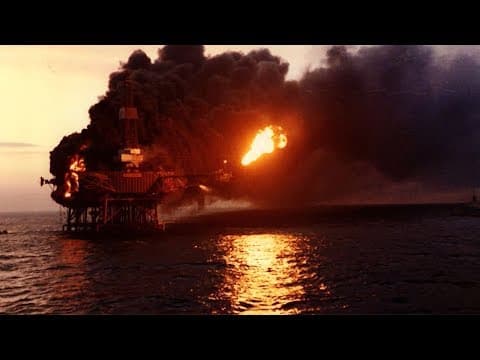
[0:01]made a explosion and fire on the Piper platform. All personnel abandon. Oh really on fire, isn't it? It's on fire already. 01 the Thors, the situation is that the platform is completely on fire from sea level to top. Uh, we have infact pulled back somewhat, uh the structure is collapsing, and it is uh total fire. Uh we are continuing to spray water on it. One of the standby vessels has reported The journey that we've taken on safety over the three decades driven by the legacy of that dreadful night and its aftermath, the tragedy of Piper Alpha must be a constant reminder to us all.
[0:59]30 years on from the Piper Alpha disaster, our conference provides an opportunity to consider and reflect on a number of themes.
[1:13]When I read reports about major accidents, I'm struck by the fact how frequently they have been preceded by signs indicating danger. But those signs were not recognized or at any rate effectively acted on to prevent the accidents in question, or at any rate to limit their extent.
[1:48]The fact of the matter is that the Piper Alpha disaster and all the change that followed on that were very substantial, and people are still living with and living under those changes. So it's still highly relevant. But the other aspect of it is that the Piper Alpha disaster, like many major accidents, is in fact um a good source of learning how to prevent further accidents, large or small.
[2:16]Because if you examine a major accident, you need to get down to the basement to find out all the underlying factors. Now those factors are in themselves are very important because they can happen again, but they can be prevented from becoming a major accident. So it's got something to tell us.
[2:44]Norway shares the same North Sea waters as Britain, but has developed its oil industry differently. With a population of just over 4 million, there weren't the same pressures for speedy development. They opted for a highly regulated oil industry, and they've restricted the flow of oil to try and prevent their economy overheating. The design, safety and operation of Norway's rigs is controlled by an independent body, the Norwegian Petroleum Directorate, who advised the government to make risk analysis statutory seven years ago, following two accidents. We certainly were looking around. When I say we, myself supported by my legal team and others to see what more other models there were to look at. And Norwegian model was certainly one to look at because you had had to deal with your own disaster only a few years before that. Risk analysis is uh necessary as we see it because we want to evaluate any early design with regard to possible accidents and scenarios and the effect these could have. To ensure that any installation being put in the water are adequately protected. We had Alexander in 1980 with 123 died and you saw a change in thinking from prescriptive legislation to risk-based legislation happened in Norway. Uh people going up in 1988 just reinforced that and what you saw from the addition of Piper was a general approach across the global oil industry that said we're moving away from prescriptive to risk-based.
[4:32]En eller annen her forklarte hele greia på denne måten. Å borre etter olje, det er å plassere borret på bånn og dreie til høyre. Vi har sikkert oppfattet at det er mer komplisert enn som så. Det er en lang rekke faktorer som må tas med i beregningen. Hey!
[4:52]Dette var jo på mange måter og det en syretest for norske regime og som Agnedal uttalte i et intervju for en stund siden at han da ble han fikk veldig mye kritikk for å snakke om internkontrollprinsippene at det ikke ville fungere. Men etter at en innførte de tilsvarende prinsippene i i Storbritannia, så stilnet den kritikken.
[5:22]This is the RFT life jacket. Until Piper Alpha, the most serious North Sea accident was a helicopter crash in which 45 men died. Until Piper Alpha, engineers who designed these chemical plants in the middle of the sea did not believe an uncontrollable chain reaction on a platform could completely destroy it. Det har vært hendelser i etterkant av Piper Alpha som har hatt veldig mange likheter. Det ser vi og i Norge at deler av de trekkene som eller tingene som kommer opp i Cullen rapporten. Dette her med styring, kommunikasjon mellom partene, altså mellom de som utfører arbeidet, de som leder og planlegger arbeidet og så videre er gjennomgående ting som en finner i for eksempel i granskningsrapporter. Så sånn sett så er det veldig mange trekk av disse grunnleggende trekkene i Cullen-rapporten som er aktuelle i dag.
[6:29]It's no much good having an investigation if it doesn't lead to a lasting improvement in safety. In other words, in results being embedded in the assessment and control of risk and reflected in the way in which work is tackled and done.
[6:47]It's a fact of life that major change very often does depend upon when there's something really bad, some major accident has happened. But you see, they're not only a disaster but there's also an opportunity to change things, and uh we're living with the benefits of that change. So that's what I would mean by the legacy, because all the good things that have come out of it, we're still getting the benefit from. You can't you can't assess the number of accidents that have never happened. Large or small, but we're living with the benefit of that, we hope.