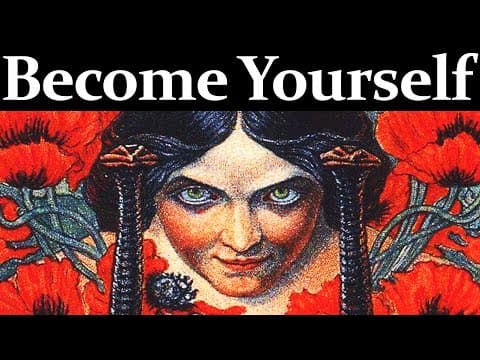
[0:08]What if I told you that the person you're most afraid to become is exactly who you're meant to be? No, not the version of you that smiles when they're supposed to, says the right things at the right times, and keeps it all together while quietly falling apart. Not the version of you that works hard to be agreeable, presentable, normal. I'm talking about the version you buried, the one you were told was too much, too intense, too angry, too ambitious, too emotional, too wild, that version. The one you've spent your whole life avoiding, the one hiding in the shadow.
[0:48]You think you're making your own choices, you think you're in control. But what if your entire life has been a performance, a carefully constructed mask designed to be accepted, to be liked, to be safe. And behind that mask, there's a voice you've silenced so many times that you barely recognize it anymore. You tell yourself you're fine, that you're doing everything right, that your life is good. But there's a quiet, aching hollowness that keeps returning. In moments of stillness, in the middle of the night, in those strange moments when your smile fades, and you're left with that familiar question. Whose life am I really living? Carl Jung, one of the most important thinkers in modern psychology, believed that our deepest suffering doesn't come from trauma, mistakes, or even pain. It comes from fragmentation, from disowning parts of ourselves that we've labeled as bad, wrong, dangerous, or shameful. Not because they truly are, but because someone once taught us they were. Maybe your family told you that anger is ugly, that sexuality is sinful, that ambition is selfish. Maybe society told you that vulnerability is weakness, that power corrupts, that being different is a problem to be corrected. So you split. You hid the parts of yourself that didn't fit, and those parts didn't disappear. They sank into the unconscious, into what Jung called the shadow. And there, in the darkness, they grew. And now, without you even realizing it, those disowned parts are running your life. They show up as sabotage, projections, anxiety, depression, addictions, broken relationships, fake smiles, unexplained emptiness, all symptoms of a self you've betrayed. You're not lost, you're not broken, you're just divided. And wholeness, true psychological liberation, will never come from trying to be more perfect. It will only come when you finally have the courage to turn toward the very aspects of yourself you were taught to fear. This is not a video about becoming your best self. It's about becoming your real self, the one you've been running from. The one you buried under years of conditioning, shame, and self-rejection. Because Jung understood something few people are willing to confront. Until you face your shadow, until you integrate it, you will never be free. This is a journey into the terrifying, liberating process of individuation, the becoming of the whole self. It's brutal, it's beautiful, and it's the only way out of the cage you didn't even know you were in. So let me ask you again. What if the person you're most afraid to be is the only person who can save you? Let us begin.
[3:57]Since you were a child, you've been learning who to be. Not who you are, but who you're supposed to be. You were praised when you were polite, punished when you were loud. You were rewarded for being good, shamed for being difficult. Slowly, unconsciously, you began to shape yourself according to what others expected. You learned to play roles, roles like the obedient son, the quiet daughter, the responsible student, the agreeable friend. And with every smile that wasn't real, every I'm fine, that hid the chaos beneath the surface, you constructed what Jung called the persona, the mask. At first, it was just a survival strategy, but over time, the mask became your identity. You started believing the lie, that you are who you pretend to be, that the version of you who fits in, who keeps things under control, who avoids conflict and discomfort. That's who you truly are. But deep down, you know better. There's a part of you that never fully bought into the act. A part that whispers late at night, there's more to me than this. The persona is not evil. It's not the enemy. It's necessary. We all need a way to function in society. But the moment you become the persona, the moment you forget it's a role, you lose something essential. You lose access to your full self. You start censoring your thoughts, dulling your instincts, suppressing your emotions. You call it maturity, professionalism, or being nice, but in truth, it's self-abandonment. You begin to fear your own power, mistrust your own desires, hide your own needs. And eventually, you start confusing approval with love, fitting in with belonging, control with safety. Think about it. How often do you say yes when you mean no? How often do you smile while feeling resentful, perform while feeling empty, stay quiet when your soul is screaming to speak? You're not being strong, you're being invisible. The mask may protect you from rejection, but it also shields you from intimacy, purpose, and authenticity. And the longer you wear it, the more disconnected you become from what's real. Jung warned us, every calling lies hidden in the shadow of the mask. The version of you that wants to create, to speak truth, to love fiercely, to stand up, to break rules, that version was exiled, banished into the unconscious so the persona could survive. But survival is not the same as living, and the price you pay for staying socially acceptable is your soul. But here's the secret most people never dare to face. The parts of you that don't fit in are not your flaws, they are the keys to your liberation. Your anger, it's your boundary, your ambition, it's your drive, your desire, it's your vitality, your weirdness, it's your originality. What you repress becomes your prison. What you reclaim becomes your power. So the question is, how do you find what's been lost? The answer lies in the part of your psyche that holds everything you've rejected, everything you were told to suppress, everything that scares you, the shadow. And it's waiting for you to turn around and face it. In the next part, we'll descend deeper, into the realm of the shadow, and uncover how what you've been avoiding might be controlling you. If this content is making sense to you, click the subscribe button and subscribe to the channel. Thank you for your support!
[8:01]There's a place inside you where everything you've ever denied, suppressed, rejected, or feared has been buried. It's not gone. It didn't disappear. It didn't die. It just went underground. Jung called it the shadow, the unconscious dimension of the psyche, where all the parts of you that don't fit the persona are exiled. Every time you felt rage and were told to calm down. Every time you wanted to speak up, but were told to stay quiet. Every time you felt desire and were shamed for it. Those parts of you had nowhere to go, so you pushed them down. You tried to forget, and slowly, piece by piece you became smaller, more acceptable, more tame, more polite. You performed, you adapted, you became normal, but you also became fragmented. And what you didn't realize is that the more you repress something, the more power it gains over you. You think you're in control, but the reality is, your shadow is. That quiet voice of self-doubt that won't go away, that explosive anger that erupts out of nowhere, that shame that floods you when you speak your truth, that pattern that keeps repeating in your relationships, the envy, the bitterness, the self-sabotage, the guilt. That's not just how life is, that's your shadow, running the show from behind the curtain. Jung warned us, until you make the unconscious conscious, it will direct your life and you will call it fate. You think you're choosing, you think you're making decisions based on reason, on logic, on values. But unless you've done the brutal work of confronting your shadow, much of what you call choice is actually compulsion. It's a defense mechanism dressed up as a plan. It's your wounded inner world projecting itself onto everything you see. And the most dangerous part, the shadow doesn't just hold the things you fear, it holds the things you need. Your power is in the shadow, your vitality is in the shadow, your creativity, sexuality, confidence, assertiveness, your raw instinct to live, they're all in there buried under years of shame, guilt, and repression. You didn't lose them. You locked them away and threw away the key, but now the vault is cracking, and what's inside is begging to be seen. But most people run. They spend their whole lives avoiding their shadow, terrified that if they let it out, they'll become dangerous, selfish, monstrous. They confuse authenticity with destruction. But the real danger is not integrating it, because what you repress will find a way out, through breakdowns, addictions, rage, projection, and emptiness. The shadow doesn't disappear just because you ignore it. It only becomes more chaotic. So the real question is this, do you want to keep pretending you're fine, while secretly being ruled by everything you've refused to face? Or are you finally ready to look at what you've hidden? If integrating your shadow were easy, everyone would do it. But they don't, because fear stands in the way. Not surface level fear. Not the kind you talk about casually. I'm talking about existential fear, the kind that threatens your identity, your sense of safety, your belonging. These fears are the invisible chains that keep you divided, exhausted, and trapped inside a version of yourself that feels increasingly false. Let's expose them. The first fear is this, if I accept my shadow, I will become a bad person. You've been taught to believe that your darker impulses define your morality. That anger makes you cruel, that ambition makes you selfish, that desire makes you immoral, that power makes you dangerous. So you suppress them, convinced that repression equals goodness. But Jung saw this as a tragic misunderstanding. The shadow is not only cruelty or evil, it is everything you were forced to disown. Legitimate rage, healthy sexuality, unclaimed strength, creative fire. When these energies are unconscious, they do become destructive. But when they are conscious, they become choice. Integration doesn't make you immoral, it makes you responsible. A person who knows their capacity for darkness is infinitely safer than someone who pretends it doesn't exist. The second fear cuts even deeper, if I am authentic, I will be rejected. And this fear isn't irrational. Jung never sugarcoated this. Yes, some people will reject you when you stop performing, when you stop being convenient, when you stop being predictable. But here's the truth most people never confront. You are already being rejected, just not by others, by yourself. Every time you silence your truth to keep the peace, every time you betray your instincts for approval, you reinforce the most painful rejection of all, self-abandonment. You can be accepted for a mask and feel empty, or be rejected for your truth and feel alive. There is no path where everyone approves. You must choose who you are willing to disappoint. Then, there is the fear of power. If I claim my power, I will hurt others. This fear often comes from witnessing power abused by parents, institutions, authority figures. So you associate power with domination, violence, control. You decide it's safer to be small, passive, harmless. But Jung made a crucial distinction. Repression of power does not make you peaceful, it makes you weak and resentful. True integrated power is not about crushing others, it's about boundaries, about saying no, about occupying space without apology. When power is denied, it leaks out sideways, through sarcasm, passive aggression, manipulation, self-sabotage. Power integrated becomes clarity. Power denied becomes poison. And finally, the most terrifying fear of all, I don't know who I am without my defenses. This is the fear no one wants to admit. You've built your entire identity around what you are not. I'm not angry, I'm not selfish, I'm not intense, I'm not like them. But what happens when you integrate the very traits you used to define yourself against? Your old identity collapses, and that feels like death. Jung understood this well. Individuation requires a symbolic death, the death of the false self. The ego panics when its familiar structure dissolves. But what feels like annihilation is actually rebirth. You don't lose yourself, you finally meet yourself. These fears are not weaknesses, they are gates. And on the other side of each gate is a version of you that is more whole, more grounded, more real. But understanding this intellectually is not enough. In the next part, we'll go beyond theory and enter the real work. The brutal transformative process Jung called individuation. Not as an idea, but as a lived confrontation with yourself. This is where everything changes.
[17:16]If what you're hearing resonates with you, you'll find real value in my ebooks. Beyond the shadow breaks down Jung's core ideas, while dialogues with the unconscious gives you a 30 day path to apply them in your life, both are linked in the pinned comment.
[17:36]Understanding the shadow is not enough. Reading Jung, quoting Jung, even intellectually agreeing with his theories, none of it matters unless you do the work. Because the shadow doesn't dissolve through awareness alone, it demands confrontation, it demands integration. And that means stepping into the fire of your own discomfort and standing face-to-face with the parts of yourself you've always tried to escape. So how do you do that? You begin by pulling your projections back. Jung taught that what you most hate, judge, or obsess over in others, is often a mirror of your own unconscious. The traits you disown in yourself. So start here, make a list of five traits that trigger you in other people. Arrogance. Laziness. Selfishness. Manipulation. Coldness. Then ask yourself, where does this live in me? Not in theory, not abstractly, but specifically. When have you acted this way? Where does that impulse show up in your life, even subtly? This is not about shame. It's about reclaiming power. Because as long as you project, you're at war with your own psyche. But when you reclaim the trait, you're no longer triggered. You're whole. Next, engage in active imagination. This Jungian method invites you to initiate dialogue with your shadow directly. In a quiet, meditative state, visualize the part of yourself you fear the most, your rage, your desire, your sadness, your ambition as a figure. Give it a face, let it speak, ask it questions. Why are you here? What do you want? What happens when I ignore you? Write down what it says. Don't censor, let it speak freely. You'll be surprised, often what you feared is not a monster, but a part of you that's been exiled for so long it had to scream to be heard. Then, begin micro-experiments in embodiment. Shadow integration is not philosophical, it's behavioral. It must show up in the real world. If you fear being assertive, practice saying no without apology. If you fear being seen, post something vulnerable. If you repress playfulness, do something useless, silly, creative, just because it feels good. These are not small acts. They are revolutions. Each one reclaims a piece of your authenticity. The goal is not to become someone else, it's to remove the barriers between you and who you already are. Write a letter from your future self, the version of you who has integrated their shadow. Let that self speak to you. Let it tell you what changed, what died, what was reclaimed. Let it guide you from the other side of transformation. This isn't fantasy. It's a dialogue with your potential, and it often reveals what your conscious mind is too afraid to admit. Then, perform a ritual death of the persona. Jung emphasized that the mask must fall for the self to emerge. Identify the role you've been playing. The nice guy, the high achiever, the caregiver, the perfect daughter. Write a goodbye letter. Thank it for protecting you, then burn it, or bury it, or dissolve it in water. Say out loud, I am not just this role, I am everything I've hidden, I am the full spectrum. These symbolic acts matter. The unconscious understands ritual far more deeply than words. And finally, journal your shadow daily. Ask yourself, what impulse did I repress today and why? Where did I feel fake or performative? What truth did I swallow? Who triggered me and what does that say about me? This is not just journaling. It's a mirror, a scalpel, a portal. The more you confront, the less power your unconscious has over you. And the more you reclaim, the more energy becomes available to you. Energy that was once spent repressing, hiding, pretending and performing. Now that energy is available for creation, for purpose, for connection. You feel more alive. Not in a shallow motivational way, but in the sense that you're finally inhabiting your body, your voice, your instincts, your desire. You laugh louder, you cry deeper, you speak more clearly, you love more fiercely. And yes, you'll still struggle, you'll still fall into old patterns. That doesn't mean you've failed, it means you're human. Jung never promised transcendence, he promised wholeness, and wholeness includes contradiction, it includes imperfection, it includes falling down and getting back up, again and again. But this time, as someone who knows who they are. So if you find yourself becoming less comfortable, more intense, more honest, more alive, congratulations. You are becoming the person you were once afraid to be. The version of you that doesn't betray itself to be accepted. The version of you that no longer hides behind the mask. That version, that's not a monster. That's not a problem to fix. That is yourself. Finally emerging from the shadows. Now I want to hear from you. What's one part of yourself you've been afraid to accept? Drop it in the comments, even if it's messy, even if it's hard to say. This is the space for truth, not performance. And someone else reading your words might feel a little less alone. And if this video made you stop and think, don't stop here. Watch the next one. You've already come this far. Keep going.


