[0:04]Have you ever wanted to say to your boss, stop talking, you're not listening to me. I've actually said that to her face. Yep. I am her boss. And obviously, I didn't fire her. We were locked away in a rental house on a writing retreat. All out of snacks, behind on the deadline for our very first book about listening. So, you know, super low-stress situation. I wanted us to make up time and try to hit the deadline. And I wanted us to fix the section we had just written because it was not good enough. But every time I brought it up, Megan rushed past it until finally I snapped. Stop talking, you're not listening to me. Okay, listen, I was listening obviously. I was not scrolling on my phone and I wasn't multitasking. But there's something else I wasn't doing, and it took us three years of researching the way great leaders, managers, individual contributors listen to figure it out. We asked the question, what makes someone a great listener at work? Across dozens of interviews, we heard things like, my manager's a great listener because she gets just as excited about my big wins as I do. My work wife is a great listener because she tells me when it's time to stop whining and to get back to work. Now, we took all these answers. We wrote them out on brightly colored sticky notes, spread them across the dining room table, put them into groups, and that's when it hit us. It's not that people weren't listening at work. It's that there's more than one way to be a great listener at work. Great listeners flex, they shift, they adapt what's going on in their head and what they say back. Because yes, responding is absolutely part of listening, and anyone can learn to be a great listener. You just have to stop listening the way you want and start listening the way they need. We call it adaptive listening. And when you do it, you build more trust, you get better results and you get it all faster. And you could start doing it right now. Now, some of you might be thinking, wait, do you mean active listening? No, not quite. Don't get us wrong, active listening is valuable, but it was created in the 1950s for therapists and counselors. Not for a busy back-to-back work day with constant pings, talking up, down, across, virtually and in person. Yeah, work happens a lot faster than therapy. Uh, maybe you know that. We know that, you can trust us. And also there's a lot more interruptions at work, and it's the goals that are the biggest difference between active and adaptive listening. At work, every time someone talks to you, they have a goal they're trying to achieve. Whether it's in the mid-morning sink or it's in the quarterly business review or it's just small talk all over the place. There is always a goal they are trying to meet. Now don't worry, there are not infinite goals for you to learn. Adaptive listening narrows it down to just four, and the first one might surprise you because it doesn't sound like the active listening you might be used to. We call it discern listening. And here's how it plays out. I was once coaching an executive who had to give a big, huge main stage keynote. And during the rehearsal, he was giving his talk and there were 17 other people from his team in the room. And I heard him say this phrase 22 times. I counted. The phrase went like this. It's not just X, it's Y. Like, it's not just more speed, it's more potential. Now, Megan and I love contrast framing as a writing tool. But she was concerned that people would assume AI wrote his talk because all over social media at the time, people were freaking out about that. AI is over using contrast framing. So I said that out loud and he sighed, looked at the ground and went, I did have AI write this talk. Yeah, so good thing for him and his team, I was using discern listening. Sometimes at work, you have to critique and evaluate. If you don't, the product could flop, the campaign could fail, the client relationship could fracture. But if that kind of listening makes you feel uneasy, that is okay. The next one might make you feel more comfortable. We call it immerse listening. So think back to the first week at your job. You probably went through orientation. Where you learned about the company mission, the org structure, how to set up your tech. What the orientation leader needed was for you to understand and remember what they said. You know what they didn't need you to do? They didn't need you to raise your hand and say, I think this mission needs a rewrite. Or this org structure, it's not working for me. That would be discern listening. And that also be very rude to do your first week at a new job. Immerse listening is the closest to active listening because there are plenty of times at work where you just need to soak in all the details. As long as you actually remember what you were supposed to remember. But again, immerse listening is just one of the ways you need to listen at work. What about those meetings where time is running out, everybody is still debating and somebody's got to make a decision? Yeah, that is when the person or the group needs advance listening. That's listening with a goal of moving people, projects, processes forward. So that's listening with a mind of, okay, what has to happen next? Not listening for what's working or not working, that's discern. Not listening for what do I need to remember, that's immerse. When you know someone is struggling and they're up against a deadline, you can listen and respond in a way that helps them get unstuck. And sometimes, sometimes that means you can interrupt them. Are you shocked we just told you great listeners sometimes interrupt? Uh Nicole and I were in more of a working session type meeting. We were putting together a recommendation that we wanted to pitch our executives. And we cared a lot about it. We really wanted to get it right. We were working up to the last minute, but something just wasn't clicking. We were in a virtual meeting, and I ended up with my head in my hands and I said, oh, Megan, this argument just flip the main points. Flip the order of the main points. Yep, I interrupted her right then and there, and she wasn't mad at me. She was relieved. Because instead of nodding and going, oh man, I know, isn't this frustrating? I read the room. I helped her get unstuck, and there are plenty of times at work where you are in high energy, high action meetings where everybody is ready to get to the finish line. But there are also plenty of times at work where people don't need you to move forward with such urgency. They don't need you to remember every single detail. They don't need you to find all the risks. Like, what if the team is celebrating a big win or somebody has some bad news to share? That's where the fourth goal comes in and it comes with a twist. So Nicole and I, as direct report manager, uh have multiple weekly one-on-ones. She came to me in a one-on-one after she had finished her own client meeting, where she had pitched to an executive three different creative ways he could open up his presentation. And Nicole, what was the feedback you got on that from the client? Nicole, it's not that I don't like them, it's that I hate them. They're all tied for last place. Yeah, so okay, I'm a department head. I care a lot about keeping clients happy. But I also care about Nicole, and I know she has a track record of getting it right. So in a split second, I made a call to say, whoa, you must have felt so thrown. And in that split second, Megan gave me exactly what I needed, support listening. She didn't rush in to fix it. She didn't scold me. She didn't probe me with more questions. She validated my emotions. And don't worry, the client liked my revisions. Yeah, that is not the big reveal, it's this. Support listening is the only type of listening that you need to do every single time you listen at work. Even when the person has to do with the goal of I need you to discern, or I need you to immerse, or I need you to advance, they always need you to support. And nod of appreciation, a heavy side to match theirs. Sometimes that's all it takes. And sometimes they just need you to sit with them. So when you take these four goals and you move them into this order, They spell the word said. Because at work you are always listening to what is said and even what's not said. Ready for a bonus? You're already really good at meeting one of these goals. Because just like there are four goals, there are four listening styles and they have the same names. All right, so the goals, support, advance, immerse, discern, that's what someone needs from you. The styles, support, advance, immerse, discern. That is the way you naturally listen. So here's where it gets interesting. Now, when you know someone's goal, you get to decide. Am I gonna listen the way that's easier for me? Or am I gonna adapt to help them meet their needs? You might have already spotted your said listening style, but if not, let's go through each one. You might be a support listener if you're listening in a group and you get frustrated when not every voice gets a chance to contribute. And that's because support listeners prioritize other people's emotions. So they want every voice in the room to be heard. You might be an advance listener if you get frustrated when you get to the end of the meeting and no one's made a decision. Or everyone's looking around going, so what's next? That is because advanced listeners prioritize forward momentum. And for better or worse, that is me. You may be an immerse listener if you get frustrated when people start jumping in and offering options before all of the context and background has been shared. And that's because immerse listeners prioritize the content, so they want the full picture. And you might be a discern listener if you get frustrated when people jump to solutions a little too quickly. And that is because discern listeners prioritize evaluation. They want to spot all the pitfalls before they give the yes. That's Nicole. That's me. Sometimes I get a reputation for being a naysayer, but I swear I have noble intentions. Because I want to make sure we don't fall face first into a dark hole no one saw coming. So sometimes your said listening style matches up perfectly with the goals, listening's very easy. But most of the time, you have to learn how to adapt to meet someone else's need. So the fresh out of college new hire knows when it's appropriate to have small talk with that customer to build the relationship. And when it's time to move forward and make the ask to make the sale. So that people leaders know when everyone on the team is already on the same page and we can rush ahead. And when they are too tired or angry to be productive anymore. No matter what they might have said to your face. Great listeners, adaptive listeners, know how to process and respond in the right way at the right time for the person speaking to them. Yeah, okay, so the opposite of the way I listened to Nicole on our writing retreat. I was pushing us forward to meet a deadline that didn't really matter. I needed to be less advanced and more discerned. And I could have done better too. I could have said, Megan, I know you're concerned about this deadline. I am too. But, you know, we really have to rewrite this section. So let's either do that now or make some time for that later. Yeah, that would have been much kinder. But you know, we hadn't written the book yet, so we weren't wise and we were out of snacks. So we are going to give each other a pass. Because being a great listener at work is hard. Work is messy. People are messy. You are all messy. But at least now you'll know why that meeting got heated, why that project stalled, why that one-on-one felt just a little bit off. And with just a little bit of practice, you'll get it right the first time. You'll listen the way your leaders, your direct reports, your customers, maybe even your partners and your parents need. You'll give them what they need, and all you got to do is ask yourself one question first. What does this person need from me right now? That's it. That's enough to stop listening the way you want and start listening the way they need. Want more trust and better, faster results at work? Your next opportunity to be a great adaptive listener is just one meeting, one presentation or one writing retreat away. Thank you.
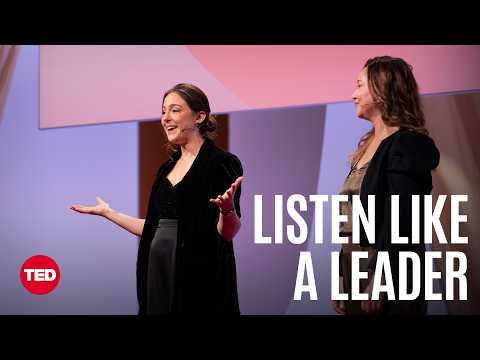
How to Be a Great Listener | Maegan Stephens, Nicole Lowenbraun | TED
TED
12m 48s2,290 words~12 min read
YouTube auto captions
Transcript source
YouTube auto captions
This transcript was extracted from YouTube's auto-generated caption track. The transcript below is server-rendered so it can be read, searched, cited, and shared without opening the original YouTube player.
Pull quotes
[0:04]Have you ever wanted to say to your boss, stop talking, you're not listening to me.
[0:04]All out of snacks, behind on the deadline for our very first book about listening.
[0:04]And I wanted us to fix the section we had just written because it was not good enough.
[0:04]But there's something else I wasn't doing, and it took us three years of researching the way great leaders, managers, individual contributors listen to figure it out.
Use this transcript
Related transcript hubs
Watch on YouTube
Share
MORE TRANSCRIPTS


