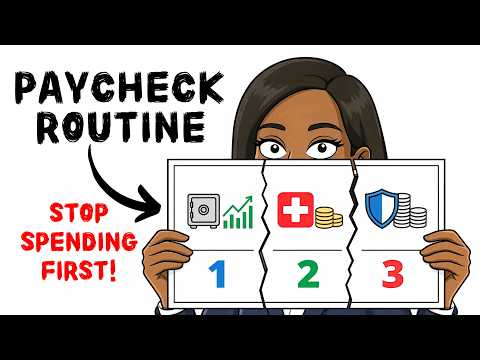
[0:00]A study by Payroll.org found that 49% of American workers said a one-week delay in their paycheck would be very difficult to manage.
[0:09]Another 28% said somewhat difficult. That's 77% of working Americans who can't handle seven days without income.
[0:16]According to Bankrate's 2026 Emergency Savings Report, 24% of Americans have zero emergency savings.
[0:24]59% can't cover a $1,000 unexpected expense without going into debt or selling something.
[0:31]The Federal Reserve's 2024 survey found only 55% of adults have set aside enough for three months of expenses.
[0:39]These aren't minimum wage earners struggling with impossible math. This pattern cuts across income levels, education backgrounds, and career paths.
[0:46]Goldman Sachs Research found 41% of Americans earning between $300,000 and $500,000 report living paycheck to paycheck.
[0:57]40% of those earning over $500,000 say the same. The problem isn't how much money comes in, the problem is what happens between the moment it arrives and the moment the next paycheck lands.
[1:10]Most people treat their paycheck like water flowing through their hands. It shows up, disappears, and they can't explain where it went.
[1:17]They know they earned money. They know it's gone. The middle part remains a mystery they'd rather not examine too closely.
[1:23]Everything costs 30% more than it did three years ago. Inflation has fundamentally reshaped what a paycheck can actually buy.
[1:32]High yield savings rates have dropped from the 4 to 5% range in 2023 and 2024 down to 3 to 4% today.
[1:41]Retirement contribution limits have increased. The economic landscape has shifted dramatically, and your paycheck routine needs to reflect that new reality.
[1:49]This video gives you a precise flow chart for handling every single paycheck in 2026. The order matters more than most people realize.
[1:58]Follow this sequence exactly, and you'll build wealth while everyone around you wonders why they're still broke despite earning similar incomes.
[2:05]Step one happens before anything else touches your money. Pay every minimum payment on every debt you carry.
[2:13]Credit card payments, student loans, auto loans, buy now pay later debt, medical payment plans.
[2:19]Whatever monthly obligations exist in your financial life, the minimum payment gets handled first.
[2:24]Think of this as your treading water step. You're not making progress yet. You're not swimming towards shore.
[2:30]You're simply keeping your head above water so you don't drown. Missing even a single payment damages your credit score, and damaged credit creates expensive problems that compound for years.
[2:41]A lower credit score means higher interest rates on future borrowing. It means larger security deposits on apartments. It means higher insurance premiums in many states.
[2:50]Potential employers who check credit reports might pass on your application entirely. Credit scores are calculated through five factors, and the top two dominate the formula.
[2:59]Payment history accounts for 35% of your score. Amounts owed relative to available credit accounts for another 30%.
[3:07]Together these two factors comprise 65% of what determines your creditworthiness. The implication is straightforward.
[3:14]Make on time payments consistently and keep debt utilization reasonable. Your score takes care of itself. No tricks required, no gaming the system necessary.
[3:24]You don't need a complete debt elimination strategy yet. That conversation comes later in step five.
[3:29]Right now, the only objective is ensuring automatic payments are established so nothing gets missed.
[3:36]Every lender offers auto pay options. Use them. Step 1.5 deserves its own designation because it makes everything else dramatically easier.
[3:46]Automate everything. Setting up automatic transfers for every step we're about to cover might be the single best financial decision available to you.
[3:54]Automation removes willpower from the equation entirely. Removing yourself from the equation is exactly what needs to happen.
[4:02]The psychology is simple and well documented. You cannot spend money you never see.
[4:07]When transfers happen automatically before funds hit your checking account, you're not relying on discipline after an exhausting work day.
[4:15]You're not relying on memory when life gets chaotic. You're not fighting temptation when an appealing purchase presents itself.
[4:21]The money moves before any of those factors come into play. It flows into the right accounts seamlessly without requiring a single conscious decision after the initial setup.
[4:32]Research from state facilitated retirement programs confirms the power of this approach. Workers who save through automatic payroll deductions are dramatically more likely to continue saving than those who attempt manual transfers.
[4:45]Over a million workers have accumulated more than $2 billion in state auto IRA programs through contributions they never had to think about.
[4:54]According to Payroll.org's 2024 survey, nearly 92% of American workers already receive pay through direct deposit.
[5:01]The infrastructure for automation already exists. Most banks and brokerages allow scheduled recurring transfers with specific amounts on specific dates.
[5:11]The technical barriers are essentially zero. Take 15 minutes after watching this video. Review all the steps in this flow chart.
[5:17]Automate your money into the appropriate accounts based on your situation. That quarter hour of setup pays dividends for the rest of your financial life.
[5:25]Step two funds your monthly operating budget. This covers necessities, the non-negotiable expenses keeping your life functional.
[5:32]Rent or mortgage payments, utilities, including electricity, gas, water, and internet, food and groceries.
[5:40]Healthcare costs, transportation expenses, insurance premiums. Calculate your actual monthly number with precision.
[5:48]Vague estimates won't work here. If your rent is $1,750, utilities run $300, car payment is $400, insurance costs $150, groceries average $500, and remaining necessities total $300, your monthly operating budget lands around $3,400.
[6:11]That amount needs to remain in your checking account at all times, untouched by discretionary spending.
[6:17]Keep a small buffer beyond the precise calculation, maybe $300 to $500 extra, because life rarely matches spreadsheet projections.
[6:24]An unexpectedly high electric bill shouldn't create anxiety or overdraft fees. The framework that works across nearly all income levels is 50, 30, 20.
[6:36]50% of after tax income covers needs. 30% covers wants, entertainment, dining out, hobbies, subscriptions.
[6:44]20% goes to savings, investments, and accelerated debt payoff. This split isn't sacred.
[6:49]High cost of living areas might stretch needs to 60%. Lower cost areas could drop it to 40%.
[6:56]What matters is running your own numbers based on actual income and actual expenses.
[7:00]Critical distinction that many people miss. Your monthly operating budget is entirely separate from your emergency fund.
[7:07]Operating budget covers expected recurring expenses. Emergency fund covers unexpected disruptions. Different purposes require different accounts.
[7:15]Step three establishes your emergency fund. Financial advisors used to recommend three months of living expenses. That guidance has shifted.
[7:23]With increased economic volatility, ongoing layoffs across multiple industries, and lingering inflation effects, four to six months is the new baseline recommendation.
[7:32]If monthly needs cost $2,500, your emergency fund target falls between $10,000 and $15,000.
[7:42]That number might feel overwhelming, especially starting from zero. The solution is intermediate goals.
[7:47]Get to $2,000 first, then $5,000, then $10,000. Each milestone builds momentum.
[7:54]This account gets funded before serious investing begins, before aggressive debt payoff, before anything discretionary.
[8:01]The emergency fund prevents everything else from collapsing when life delivers unexpected blows.
[8:06]The statistics on emergency preparedness remain sobering. According to Bankrate's 2026 data, 24% of Americans have no emergency savings whatsoever.
[8:16]Another 30% have some savings, but not enough to cover three months of expenses. 60% report being uncomfortable with their current level of emergency savings.
[8:27]Where you keep this money matters significantly. The national average savings account rate sits at 0.39% according to FDIC data.
[8:37]High yield savings accounts at online banks currently offer 3 to 4% APY, with some accounts still exceeding 4%.
[8:45]On a $15,000 emergency fund, a standard savings account earning 0.39% generates roughly $58 annually.
[8:55]A high yield account at 4% generates $600 from the same balance. Same money, same FDIC insurance protection, 10 times the return.
[9:06]Those high yield rates have declined from where they peaked in 2023 and 2024. Accounts paying 4.5 to 5% came easily.
[9:15]The Federal Reserve cut rates several times in late 2025, and savings rates responded. Even at 3.5%, high yield accounts crush traditional savings by an enormous margin.
[9:27]Step four is where actual wealth building begins. Invest in your retirement accounts. A solid baseline is contributing 10 to 15% of your paycheck toward retirement.
[9:37]Research on millionaire behavior, including Ramsay Solutions survey of over 10,000 millionaires, consistently shows wealth builders invest at least 15% before covering other expenses.
[9:50]They treat retirement contributions as non-negotiable. The contribution limits for 2026 reflect adjustments the IRS makes annually.
[9:57]The 401K contribution limit increased to $24,500 per year for those under 50. Ages 50 to 59 or 64 and older can add $8,000 in catch up contributions, for a total of $32,500.
[10:14]Workers between 60 and 63 qualify for the enhanced catch up provision under Secure 2.0, allowing $11,250 instead of $8,000. That brings the maximum for this age group to $35,750.
[10:31]One important change takes effect in 2026. If you earned more than $150,000 in FICA wages during 2025 and want catch up contributions, those must now be Roth contributions.
[10:44]The pretax option for catch up contributions disappears for high earners. First priority within this step, contribute enough to capture your full 401K employer match.
[10:54]When your employer matches 50 cents on every dollar up to 6%, and you're contributing only 3%, you're abandoning free money.
[11:00]That match delivers a guaranteed 50% return before any market gains enter the calculation.
[11:09]No investment in history offers guaranteed 50% returns. Always take the match. Here's why starting early matters more than almost any other factor.
[11:18]Contributing 10% of a $75,000 salary means $7,500 per year. Invested consistently for 40 years in diversified index funds averaging 8% annually, that grows to approximately $2.1 million by retirement.
[11:36]The math is straightforward. The difficulty lies in maintaining consistency over four decades. This is precisely why automation from step 1.5 proves so valuable.
[11:46]Set the contribution percentage once. Let payroll handle transfers automatically. Never think about it again while decades of compound growth work silently.
[11:55]The IRA limits also increased for 2026. Annual cap rose to $7,500 up from $7,000. Those 50 or older can add $1,100 in catch up contributions, reaching $8,600 total.
[12:12]If you have access to a high deductible health plan, the health savings account deserves serious attention.
[12:18]Contributions are tax deductible. Growth is completely tax free. Withdrawals for qualified medical expenses are tax free.
[12:26]No other account offers this triple tax advantage. In 2026, HSA contribution limits are $4,400 for individuals and $8,750 for families.
[12:40]Recent federal legislation significantly expanded eligibility. Bronze and catastrophic health plans now qualify as HSA compatible, opening access to millions more Americans.
[12:53]Step five addresses high interest debt elimination. High interest debt means anything above 15% APR.
[13:00]Credit cards almost always fall here, with average rates exceeding 20%. Many personal loans qualify.
[13:08]Paying off debt charging 24% interest is financially equivalent to earning a guaranteed 24% investment return.
[13:16]No legitimate investment offers guaranteed 24% returns. Eliminating high interest debt is the closest thing to a sure bet available.
[13:24]Two primary methods exist for elimination. The avalanche method prioritizes highest interest rate first, regardless of balance.
[13:33]Mathematically optimal, you pay the least total interest. Psychologically difficult if your highest rate debt also has the largest balance.
[13:41]The snowball method prioritizes smallest balance first, regardless of rate. You knock off small debts quickly, experience satisfaction from eliminating obligations entirely, and build momentum.
[13:54]The winds feel tangible, even when mathematically suboptimal. Concrete example. Car loan with $8,000 at 7%.
[14:01]Credit card with $3,000 at 25%. Student loans with $15,000 at 5%.
[14:09]Avalanche says attack the credit card because 25% costs most money monthly. Snowball also attacks the credit card first in this case, because $3,000 happens to be the smallest balance.
[14:22]The methods sometimes align. See which approach matches how you actually operate. Some people need mathematical optimization to feel intelligent about their choices.
[14:31]Others need quick victories to maintain motivation through the long grind. Neither is wrong. One nuance worth understanding.
[14:39]Lower interest debt can coexist with investing. If you carry student loans at 4%, investing while holding that debt may make financial sense.
[14:48]Stock market returns historically average 8 to 10% over long horizons. However, every dollar toward 4% debt delivers a guaranteed 4% return.
[15:00]No volatility, no sequence risk, no possibility of losing money. The financially optimal choice often involves investing while holding low interest debt.
[15:09]The psychologically optimal choice for many is eliminating all debt, regardless of rate. Both approaches produce wealthy people.
[15:17]The difference is psychological comfort. Step six expands investing beyond employer retirement accounts.
[15:23]After steps one through five are handled, here's the priority sequence. First, capture your full 401K employer match.
[15:31]Second, max out your Roth IRA. Third, return to your 401K and increase contributions, or open a taxable brokerage account.
[15:40]The Roth IRA deserves special attention because of its unique tax treatment. Earnings grow completely tax free.
[15:47]When you retire and withdraw money decades from now, you pay zero taxes on growth. None. The tradeoff involves contribution timing.
[15:55]You contribute with after tax dollars, money already taxed as income. No upfront deduction, but decades of compound growth remain entirely untaxed.
[16:05]In 2026, those under 50 can contribute $7,500 annually. Those 50 and older can contribute $8,600.
[16:16]After maxing your Roth, consider a taxable brokerage account. Regular investing without special tax treatment, no contribution limits, and full access without penalties.
[16:26]The taxation matters for strategy. Securities sold within one year face ordinary income rates up to 37%.
[16:34]Holdings beyond a year qualify for long term capital gains rates between 0 and 20%. In Roth accounts where growth is tax free, higher growth investments make sense.
[16:44]In taxable accounts, index funds work perfectly. Tax efficient, low fees, reliable over decades. The real insight transcends optimization.
[16:54]Investing consistently, even without perfect allocation, produces dramatically better outcomes than waiting for perfect conditions that never arrive.
[17:02]Step seven moves beyond traditional planning into income expansion. According to Ink, 65% of self-made millionaires had at least three income streams.
[17:11]Tom Corley's five-year research found 45% have four streams, 29% have five or more.
[17:19]In 2026, relying on a single income carries more risk than perhaps any time in recent memory.
[17:25]Tech layoffs continue across major companies. Artificial intelligence reshapes entire industries with unpredictable implications.
[17:33]Economic uncertainty feels less like a phase and more like permanent conditions. Diversification protects against disruption in your investment portfolio and your income simultaneously.
[17:45]You don't need 80-hour weeks building a side empire. Dedicating one to five hours weekly toward building something can generate an extra $100, $500, or $1,000 monthly, depending on skills and approach.
[18:00]Ideas worth considering: Freelancing in your professional expertise. Dividend income from stocks. Content creation through YouTube or newsletters. E-commerce through Etsy or Amazon. Coaching in something you've mastered. Real estate through direct ownership or REITs.
[18:15]Any money from additional streams funnels back into earlier steps. More emergency cushion, higher retirement contributions.
[18:22]Larger taxable account balances. The compounding accelerates because more fuel enters the system. The lifestyle inflation defense activates with every raise.
[18:33]When income increases, immediately redirect at least 50% to savings before adjusting lifestyle. A $5,000 annual raise means increasing your 401K by roughly $200 monthly.
[18:46]The remaining $200 improves your lifestyle. You feel the benefit of earning more, while half the raise builds wealth instead of disappearing into marginally nicer versions of things you already owned.
[18:58]This single rule prevents lifestyle creep, keeping high earners broke. Goldman Sachs found 41% earning $300,000 to $500,000 live paycheck to paycheck.
[19:07]Their income rose dramatically. Expenses expanded to match perfectly at every level. Beyond retirement contributions, several tax strategies reduce your burden.
[19:19]The savers credit provides a direct tax credit for retirement contributions if income falls below certain thresholds.
[19:25]$40,250 for single filers, $80,500 for married couples in 2026. One in five eligible taxpayers fails to claim this credit.
[19:38]The annual reset should happen every January without exception. Contribution limits change yearly. Set a calendar reminder to review new IRS limits and adjust payroll contributions accordingly.
[19:50]The compound effect reveals itself over years and decades. Someone earning $65,000 following this routine, contributing 15% to retirement, building a six month emergency fund, maintaining 50-30-20 allocation, defending against lifestyle inflation, will accumulate significant wealth over 30 years.
[20:10]At 15% savings, approximately $813 flows to investments monthly. Invested at 7% average returns over 30 years, that becomes roughly $920,000.
[20:22]Add employer matching contributions. Add salary increases, with half flowing to contributions. Add tax savings from pretax retirement contributions.
[20:31]Add an HSA growing untouched for decades. Research confirms this path repeatedly. According to Ramsay Solutions, 79% of millionaires are self-made with no inheritance.
[20:43]Only 31% averaged $100,000 or more annually. The typical millionaire reached that status after 28 years of consistent behavior.
[20:53]The paycheck routine isn't glamorous. No secret investments appear. No market timing strategies emerge.
[20:58]A flow chart, automation, consistency. The boring discipline of handling money correctly every single time it arrives.
[21:05]The majority of American workers can't survive a one-week delay in their paycheck. They have no emergency savings.
[21:09]They carry more credit card debt than savings. They'll work until they physically cannot, because they never built anything generating income without their labor.
[21:20]The paycheck routine separates you from that majority. Your next paycheck arrives soon. The only question is, what happens when it does? Execute the routine. Every single time.


