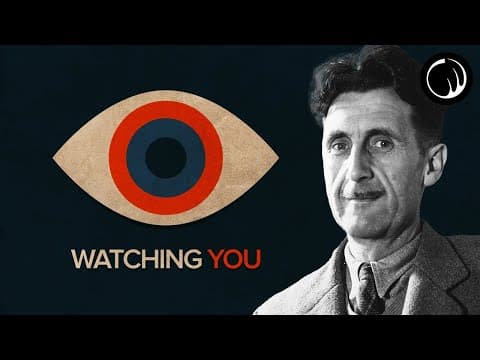
[0:00]This video is sponsored by the book summary app, Blinkist. Discover, learn from and refresh yourself on the world's best books. Use the link in the description and you will receive a 7-day free trial and 40% off Blinkist premium membership. George Orwell is perhaps one of the most widely read and referenced literary figures of all time, certainly of the 20th century. Cited and mentioned by nearly every contemporary ideology and political world view, his voice echoes down the halls of history. His insights about the power of language and technology, as well as his warnings about the manipulation of truth and the threat of totalitarianism, being relevant to rooms on both sides of the hall, left and right, transcend the walls of any one moment, movement, or ideology. Orwell was born in 1903 in Bengal, India, which, at the time, was part of the British Empire. He was born with the name Eric Arthur Blair and would only become George Orwell many years later when using the name as a pseudonym to protect his family and their reputation as well as his own. As a child, Orwell's socio-economic conditions were unusual. His mother, being the daughter of a wealthy man, had the attitude and tastes of someone well-off. But by the time Orwell was born, his family had little money, and his father was working as a civil servant. Orwell would later refer to his upbringing as lower-upper-middle class, a sort of amalgamation of impoverishment and snobbery. After his family returned from India to England, where they were originally from, with the help of some family connections, Orwell was sent to an English preparatory school. Here, both his unusual temperament and his brilliance became apparent, receiving both ridicule from other students, as well as scholarships to England's leading schools, Wellington and Eton. At an early age, however, Orwell found the academic environment miserable. And so, he would never go on to university. Instead, in 1922, he entered the British Imperial Service and worked as a colonial police officer. He was posted in Burma, a province of British India at the time. He also found this experience miserable and conflicting with his values. Five years later, he would resign. Over the subsequent few years, Orwell would work several low-paying service jobs throughout Paris and London, including a part-time assistant job in a secondhand bookshop. Around this time, he would also begin writing and publishing books of his own, including Burmese Days, a clergyman's daughter, and Keep the Aspidistra Flying. Surely influenced by his unique upbringing and his diverse experiences across Burma, France, and London, Orwell would develop a fondness for what he referred to as ordinary people and ordinary life. Individuals who worked normal jobs, were not obsessed with material goods, had minimal education, and didn't strive for nor achieve any sort of prominence, power, or so-called greatness. In contrast, he developed a disdain for intellectuals. Ironically, of course, Orwell would soon become one, perhaps one of the most prominent intellectuals of the 20th century. Orwell's rise to prominence as an intellectual and literary figure can be largely attributed to the catalyzing experiences he had after traveling to Spain in 1936. Initially, he went to Spain as a journalist to report on the Spanish Civil War, but he soon enlisted as a volunteer in the Republican militia to fight against the fascist opposition. “If you had asked me why I had joined the militia I should have answered: ‘To fight against Fascism,’ and if you had asked me what I was fighting for, I should have answered: ‘Common decency!’” Orwell later wrote. During his time in the war, Orwell was shot in the throat and nearly killed by a sniper. Perhaps even more affecting for him, however, was what he witnessed in the coverage and portrayal of the war. Years later, he wrote, “Early in life I had noticed that no event is ever correctly reported in a newspaper, but in Spain, for the first time, I saw newspaper reports which did not bear any relation to the facts, not even the relationship which is implied in an ordinary lie.
[3:49]I saw great battles reported where there had been no fighting, and complete silence where hundreds of men had been killed. I saw troops who had fought bravely denounced as cowards and traitors, and others who had never seen a shot fired hailed as the heroes of imaginary victories, and I saw newspapers in London retailing these lies and eager intellectuals building emotional superstructures over events that had never happened. I saw, in fact, history being written not in terms of what happened but of what ought to have happened according to various ‘party lines.’” Orwell's observations revealed to him a degradation of the value placed on objective truth. Objective truth was being replaced more and more by the faith and subjective truths of ideologies and political parties. “I am willing to believe that history is for the most part inaccurate and biased, but what is peculiar to our own age is the abandonment of the idea that history could be truthfully written.” Orwell wrote. The consequences of this for Orwell risk leading to totalitarianism, a form of government in which individuals lack freedom, and instead, are subordinate to and controlled by the central authority of the state. When there is no belief in objective truth, truth solely exists in the human mind, becoming easily malleable and manipulable. For Orwell, this threat looms regardless of any specific ideological and political leaning, be it left or right. “It is just [the] common basis of agreement [of truth] with its implication that human beings are all one species of animal, that totalitarianism destroys.” He wrote. During the early and mid-20th century, these consequences were unfolding, and totalitarianism was spreading. In Germany, Italy, Spain, the Soviet Union, as well as, in Orwell's mind, England and beyond. In response to this, Orwell believed that literature could be used to help warn against this development. It could be used to shed light on the circumstances of the world and help people fend against the increasing threat to freedom, truth, and well-being. “What I have most wanted to do throughout the past ten years is to make political writing into an art. My starting point is always a feeling of partisanship, a sense of injustice. When I sit down to write a book, I do not say to myself, ‘I am going to produce a work of art.’ I write it because there is some lie that I want to expose, some fact to which I want to draw attention, and my initial concern is to get a hearing.” Orwell wrote.
[6:07]Though Orwell had already written and published several relatively successful books by around the year 1939, his real rise to global mainstream prominence came after the publication of his novella, Animal Farm, in 1945. And it was here that Orwell's mission to spread important ideas and warnings about the threats of the time and future times, began to successfully ensue at scale. In Animal Farm, there is no real main character. Rather, the protagonist of the book is a population of anthropomorphized animals living on a farm known as Manor Farm. Each species of animal represents a different archetype or group of humans in society. One day on the farm, a pig named Old Major expresses to the other animals that they are being exploited by the humans who own the farm, and, if they work together, the animals can and ought to overtake the humans, and create a better future for themselves. A revolution happens, the animals take over, and a new philosophy known as Animalism is established. Two pigs named Snowball and Napoleon take lead over the new conditions of the farm, which soon becomes just Napoleon after he has Snowball chased off. Though things appear to go well initially, hell soon breaks loose, and the pigs who lead the farm begin to lead with malice, selfishness, manipulation, and violence, ultimately becoming the equivalent of the humans that the animals had revolted against. “The creatures outside looked from pig to man, and from man to pig, and from pig to man again; but already it was impossible to say which was which.” reads the final line of the book. Broadly, Animal Farm is a thinly veiled critique of the Russian Revolution and the subsequent rule of Joseph Stalin over the Soviet Union. It showcases and warns against the fallibility and susceptibilities of revolutionary movements and the potential threats of counter-revolutions. What arguably makes this novella so unique and important, however, is its ability to cut through the surface of any single social or political target, and instead, reveal timeless truths about social, political, and psychological phenomena, and to do so with animals. In the form of a fable, like that of Aesop or Disney, Orwell brings the complexities of social and political movements into an accessible, easily understandable allegorical format that can appeal to mass audiences across time and space. And that's exactly what Animal Farm did and does, selling 500,000 copies within the first year of publication and then going on to sell millions and millions more. The same year Animal Farm was released, Orwell lost his wife while she was undergoing a routine surgery. Only a year or two later, he began to fall ill himself with tuberculosis. He would, however, muster everything he had left, and work on one last book. After collapsing multiple times while writing, his science speculative and dystopian fiction novel, 1984, was released in 1949. In brief, 1984 focuses on a character named Winston Smith, who lives in what was once London, but is now a province of the superstate of Oceania. Oceania is run by a totalitarian government known as the Party, which follows the doctrines of English Socialism or Ingsoc, and is led by a dictator figure known as Big Brother. In Oceania, citizens are under constant surveillance and are ruthlessly punished for even so much as thinking thoughts that counter the party's ideological doctrines. Devices known as telescreens are put in everyone's homes, where they both consume broadcasted content and are constantly observed by the Party. What are known as the Thought Police are also always looming, ready to arrest anyone who commits what are known as thoughtcrimes, or simply thinking the wrong things about the Party. Moreover, the Party is constantly producing propaganda in the form of manipulated information, data, statistics, and language. Language is simplified and reduced in Oceania through what is known as newspeak, where words are eliminated from the vernacular in order to prevent the likelihood of nuanced critical thinking. Words are also often used in a contradictory manner in order to undermine the true nature of the things they describe. For example, labor camps are referred to as Joycamps. Torture takes place in the Ministry of Love. The military is referred to as the Ministry of Peace. The department responsible for falsifying data and facts is known as the Ministry of Truth. And the slogans of Oceania are, War is Peace, Freedom is Slavery, Ignorance is Strength. All of this causes citizens to engage in what is known as doublethink, a sort of cognitive dissonance in which they both have their own perceptions and understanding of what is true, and yet they accept what they are being told by the Party as true, despite any contradictions. At the beginning of the novel, Winston writes in his diary, “Down with Big Brother.” By the end of the novel, the narrator concludes, referring to Winston, “Two gin-scented tears trickled down the sides of his nose. But it was all right, everything was all right, the struggle was finished. He had won the victory over himself. He loved Big Brother.” Like Animal Farm, 1984 would obtain immediate success, which Orwell was able to witness in his lifetime before dying of tuberculosis the next year in 1950. Ultimately, it is unclear how cynical Orwell truly was. But the cynical endings to his two masterworks are, arguably, not a declaration of total hopelessness, but a warning for the potential hopelessness that the future could exhibit, the future we are living in now. Since Orwell's passing, his work has only continued to become increasingly popular and culturally relevant. 1984 is likely one of the most widely read books, certainly of the dystopian speculative genre, finding itself still, 75 years later, a part of many, if not most high school English literature classes, as well as college courses. Orwell has become one of the few writers in history to have a term created out of his work, Orwellian. Most broadly, Orwellian refers to any conditions reminiscent of Orwell's work, in which the welfare and freedom of citizens are undermined or at the risk of being undermined, typically by a central political power and ideology. But, arguably, Orwellian is not purely defined by totalitarian conditions, but by the means in which totalitarian conditions are carried out. Specifically, it refers to the intentional distortion and manipulation of language and information for the purposes of serving some ulterior power for power's sake. Like Orwell's work itself, however, this term is often misunderstood, misrepresented, or altered in service to whatever cause the user favors. Often causes and ideologies that Orwell himself would likely have disagreed with. The term Orwellian can apparently be Orwellian itself. What is clear and important to note, however, is that although the Party of Oceania in 1984 originated from socialism, Orwell was not a critic of socialism. He was a critic of totalitarianism, regardless of its origins or political leaning. He was, in fact, a proponent of democratic socialism, a political democracy with a socially run decentralized economy. “Every line of serious work that I have written since 1936 has been written, directly or indirectly, against totalitarianism and for democratic socialism, as I understand it.” Orwell wrote. Furthermore, he was anti-capitalist and believed capitalism incentivizes conditions of suffering and leads to small concentrations of power and wealth. This certainly makes those who reference Orwell in favor of capitalism and against socialism, especially and ironically, Orwellian. Ultimately, regardless of whether you agree with Orwell or like his writing, there is no denying his influence, and there is no denying the value and relevance of exploring the topics and ideas that he did. His insights into how human psychology plays out in the arena of politics, and how the use and control of language influences and controls the thoughts and opinions of a population is likely a timeless and immensely relevant insight to all societies, past, present, and future.
[13:47]His unique ability to use language to convey this insight and warn against the power and influence of language is something only a brilliant writer could even try to do. And his ability to bring incredibly complex and typically dry concepts down into the realm of mass appeal and interest, perhaps has helped ensure that the developments of aspects of the world remain on a track that leads to, at the very least, a less dystopian destination. In truth, we are always susceptible to our own malice and ignorance when we aren't paying attention, individually and collectively. Tyranny is not a part of history, it is a part of humanity. Humanity is always on the brink of slipping into it, of chasing the rabbit of hope into dystopian wonderlands. Orwell realized this, that tyranny was always possible and can occur even in a society in which the intentions are noble, or in a society in which the conditions appear prosperous and democratic. Perhaps our only hope, somewhat countering Orwell's view, is realizing that, in fact, there is no ultimate objective truth, at least that we have access to, and that subjective truth is likely all there is, and all there will ever be for us. We must accept this as a consequence of our condition of ignorance and limitation, our fragmented perceptions and dissenting values. But perhaps, when we take this realization to the extreme, we realize that all individuals, all groups, all organizations, and all nations are fallible and wrong. There is no one idea or truth to follow or believe in. Perhaps in doing this, we burn up all the fuel of totalitarianism, and at the bottom of the tank, we find the collective realization of simple decency, the kind in which Orwell advocated for, the kind in which we arrive at mutually beneficial intersubjective truths based on humility and compassion toward the differences and malleabilities of humanity across time and space, rather than an ultimate rightness and finality right now. Of course, this is far, far easier said than done.
[15:35]But in the words of Orwell, when referring to the conditions of 1984, “The moral to be drawn from this dangerous nightmare situation is a simple one: ‘Don't let it happen. It depends on you.’”
[15:54]Some of the best books we will ever read in our lives, are books we have already read, and many books that would completely change our lives, are possibly books we will never even come across. Both returning to classic instrumental books from our lives, and discovering new books that help further shape our lives, are extremely important for expanding our understanding and keenness about ourselves and the world. But with near infinite options of books to choose from, it could be extremely difficult and time-consuming to do this successfully. However, with this video sponsor, Blinkist, you can much more easily overcome this challenge, create better habits around reading and learning, transform your perception, and constantly be improving the way you think. With over 7,500 non-fiction books and podcasts across tons of different categories and topics, Blinkist beautifully curates and breaks down titles into around 15-minute summaries and key takeaways, which can be both read and listened to. Blinkist also offers personalized recommendations and daily suggestions based on books you read and topics you like, making it even easier to discover new titles you might have otherwise never known about. Whether you want to refresh yourself on Orwell's 1984, or Aldous Huxley's Brave New World, or learn more about totalitarianism and how it grew and developed in Russia, in Masha Gessen's The Future is History, or learn about the various kinds of metaphorical soil most fertile for other political and social phenomena, Blinkist makes it easy to do so. Whenever you find great titles, easily share them with friends and family using Blinkist's feature, Blinkist Spaces. Based on an internal study using survey data from Blinkist customers, 95% of Blinkist members say they read significantly more than before Blinkist, and 91% say they create better habits. You can do the same and get a 7-day free trial and 40% off Blinkist's annual premium membership by using my link in the description. And of course, as always, thank you so much for watching in general, and see you next video.