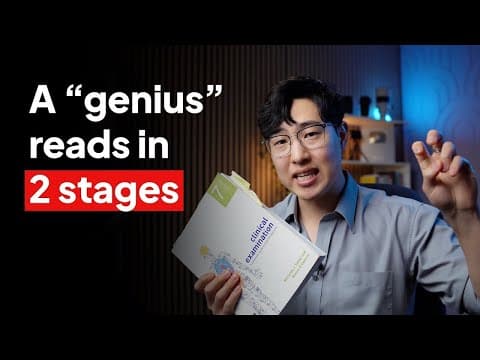
[0:00]In this video, I'll teach you a system for remembering everything you read, study or learn. I've been using this system for the last seven years, starting from learning disease pathophysiology in medical school, through to reading research articles on learning science, or reading books on productivity or business. And the reason the system works so consistently and so well, is because it breaks down that process of reading into two distinct stages. The first stage is the consumption period. And the second stage is the digestion period. Most people think that by focusing on the first stage and consuming more information, they'll be able to therefore remember and apply more information. So they focus on trying to read faster or watching lectures at triple speed or binge listening to audiobooks or watching hours of YouTube tutorials. But that is not how learning works. And once we understand how learning does work, you'll see why my system is so effective. You see, when it comes to remembering and applying information, it's less about how much goes in, and more about how much stays in. And that is what the second stage, the digestion period is all about and it's the part that is often neglected. I'll teach you a system for mastering both of these stages, which in turn increases your raw retention as well as your ability to actually use the knowledge in the way that you need to. But first, we need to ask ourselves, is it even possible to remember everything you read? And the short answer is no, but here's the secret. Trying to remember everything we read should not be the goal in the first place. And we know this because of a man who actually could remember everything. This man's name is Kim Peek, and his story is so crazy that Hollywood made an entire movie about him. Kim Peek was a mega genius and his memory was ridiculous. He was able to memorize a book with such perfect recall that after reading a book one time, he would be able to write it out word for word with every comma and full stop back to front. He memorized so many maps and atlases that he could give you driving directions between any two cities in the world. And the path that he gave you was mentally calculated to be the shortest distance. Now, the reason Kim Peek had such supernatural abilities is because of a very rare medical condition he had called FG syndrome. He was born with macrocephaly, which means he had a larger brain, and he had no corpus callosum, which is basically the bundle of neurons that connect both hemispheres of the brain together. And scientists believe that because he didn't have the normal pattern of neurons, his brain adapted and developed new connections to compensate, which I guess gave him like superhuman memory. Now, I want you to imagine that both you and Kim Peek were about to sit the same exam. Who do you think would do better? And the answer is that it actually depends on the exam. You see, despite his superhuman memory, Kim Peek struggled with reasoning and problem-solving. Which means that if the exam was at the junior levels of schooling, which often tests on the lower levels of learning, which involve a lot of memorization and recall, then Kim Peek would definitely win. But if the exam was at a higher level like university or postgraduate where the reasoning and problem-solving, the higher orders of learning, are examined as a higher priority, then you may actually have the edge. Now, for most of you listening, probably using the knowledge you've consumed to reason and problem solve is kind of the whole point of why you're trying to read and remember in the first place. Which basically means that it is not enough to "remember" everything. Which is good because for most people that's not possible anyway, but it is possible to remember everything you need to remember in such a way that we can use that knowledge in the way we need to. And that is what the system that I'll teach you helps you to achieve. So, to start using the system, we have to understand that not all information is equal. In fact, I break down the information that I read into five different categories using the acronym PACER. And it's important to be able to identify which category the information you're reading to belongs to because for each category, there are specific targeted processes that then help you to deal with and manage that information more effectively. And when we use the wrong process for the specific category of information, it makes remembering what you read much harder, more time consuming, less effective, and that you're more likely to forget what you've read. It also increases the chance of you entering the passive mode of reading, which is where you get to the bottom of a page and you can't even remember what you just read. So the system goes like this. In the first part, where we are consuming information, we want to identify which category what we are consuming belongs to, using the PACER acronym. Then, during stage two, we digest what we've read, using the targeted process for that category, which takes the information and stores it in our long-term memory through the process called encoding. So let's go through PACER together so that you can accurately identify the category of information you're trying to remember. The P in PACER stands for procedural. Procedural information is any information that tells you how something should be executed. For example, this is a book that I use during medical school that taught me about how to do a clinical examination like listen to a heartbeat or take someone's blood pressure. And a lot of the information in this book is about the correct technique to perform the examination. And some subjects and domains have a lot of procedural information. Some great examples of this would be coding and languages. And the targeted process for working with and mastering this type of procedural information is practice. The key is that you want to apply procedural information in real life as early as possible. A lot of people will spend time to read it and memorize it and write lots of notes about it and then a week or two later, they'll try to practice it. But by then, it's too late, we've already forgotten a lot of it and a lot of that time is just wasted. Instead, as soon as you take that procedural information into your brain, try to apply it and practice it as early as you can. Now, straight away, we run into a problem with using this approach. What if we're reading something and we don't have time to practice it right now? The answer is, you either move on to something else or you stop consuming anything and you wait until you have time to practice it. But you do not waste your time trying to just memorize it on the spot. Because here is the crucial part about learning that everyone overlooks. The two stages of consuming and digesting must always be balanced. Everything you consume, must be digested in order for you to retain and use it. Only when stage one is followed by stage two, does learning actually occur. So if we're reading something and we don't have time to use the right process like practice, then most people will say, oh well, I don't have time right now. I'm just going to get through as much of it as I can and they spend more time reading and reading and essentially just consuming more and more. But this is the learning equivalent of overeating. They haven't had a chance to digest it, so they're just going to end up vomiting it all up again through the mental vomiting process we call forgetting. Which is why for most people, the amount that they forget after reading is extremely high with some studies suggesting that up to 90% of what is consumed is forgotten, despite hours of consuming. And if we're forgetting 90% of what we read, rather than consuming more and taking time away from the digesting, it actually makes more sense to spend less time consuming and more time on the digesting and processing. This increases your retention, which therefore increases the amount of working knowledge you're able to build. So earlier I said, what goes into your brain is less important than what stays in your brain. And this principle of balancing stage one consuming with stage two digesting is important not just for procedural information, but for every other category of PACER. Unfortunately, stage two digesting is almost completely neglected for the second category of information, the A of PACER, which stands for analogous. Analogous information is actually one of the easiest types of information to work with and remember and apply, because analogous information is the information that is related to something you already have prior knowledge about. And even if we don't have direct prior knowledge about it, it may remind us indirectly of something that we do have knowledge about. For example, let's say that we are an avid swimmer and we're learning about the physiology of a muscle contraction. When we look at that muscle contraction cycle, we might think, hey, that reminds me a lot about the swimming technique I use. And by connecting the new information about muscle contraction physiology with what we already know our swimming technique, we have created an analogy. And so that is analogous information. Analogies can form with any prior knowledge, including knowledge within a topic itself. And most fields of study, there are concepts or patterns of concepts and relationships that tend to repeat and recur throughout that field. You might have learned about how to solve a particular type of problem last semester, and now this semester, this new problem-solving approach that you're learning for the first time reminds you a lot of that old problem-solving process. And relating those two approaches is also an analogy. So, when we are engaging in stage one, the consumption period of reading, we want to be actively be thinking about whether what we are reading is related to something that we already have knowledge about. And once we identify it as potentially analogous information, the targeted process we want to use here is critique. This is the part I said everyone misses. Once we create an analogy, critiquing it means we examine critically how good that analogy actually is. For example, with the analogy of muscle contraction and swimming technique, critiquing that analogy means asking ourselves, in what way, specifically, are these two things similar or related to each other? In what ways are they different? In what situation does this analogy not make sense anymore? And if there are a lot of differences or a lot of conditions and situations where the analogy breaks apart, then is there a better analogy? Or can we extend or modify that analogy to make it more comprehensive and more accurate?
[12:15]This critiquing process massively drives up our retention and depth of understanding of this new information. And the reason this works is because instead of new information just being new information that your brain doesn't know what to do with, we're actually extending it from what we already know. We're taking our existing network and connecting it to the new information straight away. Which is the reason why creating analogies has been shown in studies repeatedly to be so powerful for our retention and understanding. Now, at this point, you might be looking at the system and thinking, this seems a little forced, it doesn't feel natural. And you're right. In fact, it's crucial that you understand that this is not natural. And that's why it works. If you have no time pressure and it doesn't matter how well you learn something, then you can learn and read however you want. But unfortunately, what research has shown is that there are clear biological limitations of the human brain to how much it can consume and store into our memory in one go. And in the modern day, when there is so much we have to learn, it is very, very easy to exceed that biological limit and then get overwhelmed. Learning is extremely complicated. So, to be able to learn a lot in a short amount of time, reach a high level of knowledge, a lot of processes need to go right. And wasting time on trying to memorize reference information while you are reading it, instead of spending that time on the first three types, is one of the worst offenders, and as soon as you get into that mind frame of reading something and then reading it again, trying to get it into your head, you can say goodbye to your learning efficiency.