[0:00]All right, um the uh the war continues, uh and we're starting to finally see the market shift. I think this was a big week for um ending what I talked about last week, which is I think investors finally got rid of the uh the Taco PTSD and realize that this is not the same situation as last year.
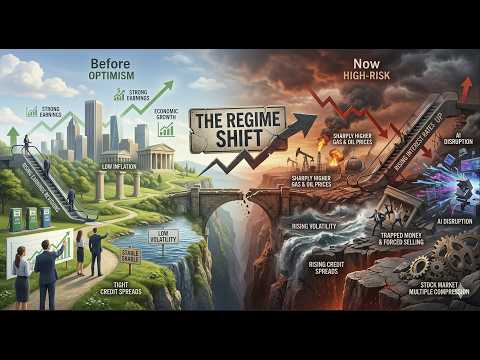
[0:29]And uh we started to discount more reality onto what's happening. So I'm going to go through that. Um, I'm going to highlight uh the fact that I think one thing is certain, uh, in my mind going through this is that we're at a regime shift.
[0:43]And what a regime shift means for all of you listening is uh confirmation that the environment that we were in definitely over the past couple years since since the launch of chat GPT, but honestly, uh since 2007, we're just in a different regime now.
[1:00]And I think AI is part of it, uh the major driver of it. Uh, you can separate commodities and kind of geopolitics if you want, but I think at a minimum people have to accept now a reality that is very different than last year where the majority of banks and investment banks all throughout the second half of last year were calling for oil to get down to the 40s and 50s.
[1:24]Uh, and again, I I think this is just a mistake that people have, uh, have done with AI and the fact that there's a massive amount of power that's needed and also that energy is something that's necessary for China. Uh, and since there's a rare earth strangle hold, there now appears to be a reality, regardless of uh what people want to say, that the vulnerability for Asia, which I'll go through, is energy and especially for China.
[1:53]Uh, so we're in this world that I think people have stay here. Hoarding is going to be going on, uh because we don't know when this is going to end and even when it does end, I think people don't want to have the risk that this continues again.
[2:05]So just remember as you go through this week's video that I do think a regime shift is something that you have to prepare your portfolio for. I've been saying multiple compression, uh, in general.
[2:16]I mean, it looks uh gloomier on the right hand side, but the reality is in a world of low inflation with strong earnings and good economic growth and more importantly, uh just not a difficult environment for credit.
[2:30]Now we're getting into a more volatile situation and I think this is the reality of what I was writing about. Uh, we have scarcity, uh and we have abundance and right now, uh you want to be short abundance and you want to be long scarcity and I think the market is emphasizing that more and more every day, but I think you have to accept the regime shift at this point.
[2:49]Uh, so let's go through this. AI, and these are all structural issues in my in my opinion. The AI software disruption is real. Uh everyone who was trying to pick the bottom of it, the the one thing the war has done is I don't hear this anymore from people. I think they've just accepted the beatdown. Uh, software is being rerated. Hyperscalers are being rerated.
[3:10]This is because we don't know three years from now based on the progress, which is accelerating, what the world is going to look like and then when you extend this out five years and you're in humanoids, you start to get into even murkier conditions.
[3:22]So I think anything that has a high multiple, the first question is, are you guaranteed to still be in business three years from now? Are you guaranteed to have revenue similar or more to where you are today? And I think that's getting harder and harder for software in particular, but I think it's also spreading uh from the disruption that's happened through credit and other places.
[3:41]The labor disruption. This is a reality, it's going to worsen, so we're not going to see labor pick up. You have to embed that into it because it's now been a year that we haven't had any job creation and now with oil prices moving higher, rates having moved up, fed rate hikes, we have a different situation than we did before.
[3:58]Commodity is in a bull market. You have commodities moving higher while rates are moving higher, uh and even though we've seen a pullback in gold and silver, they are still up sharply from six months ago, uh while equities are down.
[4:10]The credit cycle is going to continue and I hear way too many people, way too many on this side, uh, was at to dinner, uh a few times this week and I heard it repeatedly with people saying this is overblown.
[4:22]I heard this with software. The credit cycle is in a downturn. There is no doubt about it. I'm sorry for people who don't want to accept this, but when credit cycles start to unwind and you have people being forced to to take off positions, again, the tide of liquidity is going out and you get to see who's naked, who's been fraudulent, who's been carrying things over.
[4:45]And we've seen that starting in September, and now it's continuing. Uh, software is just one part, there's going to be more, so I think people have to accept this. And then long duration uh assets are being repriced.
[4:56]So don't minimize this stuff. Um, really stay on top of it. I think people need to be uh aware, uh that this is going on. And you can basically see how it's impacting and the reason I wanted to show this chart is because the problem is for the regime shift is the positioning.
[5:13]So if labor is not going to be created, then consumer discretionary is not going to be in the same side, particularly when you throw higher commodity prices or input costs, you have the affordability issues.
[5:25]So, discretionary is 10% of this. Financials are 13%, they're getting hit by software. Information technology is 33%, and then commercial services is uh 12.
[5:37]So when you combine this, this and this, you get over 53, or 50%. Remember, consumer discretionary includes Tesla and uh Amazon, and the financials are lumped in with it.
[5:50]And then over here, you have energy, materials. These are the current weightings of the things that are benefiting from this world. They're just not big enough. So, the reason I wanted to show that, believe it or not, in this quote unquote bear market that we're in, this is all about these names down for the year.
[6:07]The big weights, the ones that have worked since 2007. All of the small ones are up for the year. We have 11 sectors, six of them are up through Friday. That doesn't sound like a bear market, that sounds like a rotation.
[6:21]This will continue to be the story. There will not be a recession this year. Even if oil goes to 150 as I go through this, I'm not concerned at all about a recession, but I do think that it will be a year where there will consistently be multiple reratings for these sectors.
[6:36]So this is more about an overweight and I show this because for those people who were hoping for a pullback, this is the pullback. I talked at the beginning of the year about a 15 to 20% correction at some point.
[6:48]We're getting it earlier, it is on the back of oil, but then you're going to have the midterms at some point if this can at all, at any point over the next four, six weeks start to slow. We are going to go through repricing the stock market, which we should.
[7:00]Now, for uh subscribers, uh there's been a lot of requests and I'm going to do this. Uh I will have a model portfolio which will be up there.
[7:12]Um, this is going to be all of the thematic uh pieces that I've written as of right now, the total number is 95, but I included five other names, uh, that uh to me I've talked about and written about.
[7:23]But this model portfolio is hopefully going to help people in this world where we have the the the rotation going on. Again, chemicals, semiconductors, optical fiber, the whole rack, energy infrastructure, plus the other names.
[7:37]These are all hardware related names. This is where you want. These charts are not in a bear market. They are for the majority of them been in a very good uptrend. Some of them are getting uh are coming down now, but for the most point, you're in uptrends in these things and I think you're going to be there.
[7:51]Over the course of the last year, these names are up 75%. But more importantly, year to date, uh and this is an equal weight portfolio of these names.
[8:00]These go this starts with the piece of optical fiber in November, then it goes into December with the advanced packaging side and then the pieces that I wrote earlier on uh in the year. And the reason I want this to be there is because as I add names uh in terms of themes that are happening, uh all of this right now benefits from the Atic side.
[8:21]So this is something that's going to be there for the year for sure. Now, what I wanted to show you is what the market cap is of this because the Mag 7 market cap is still, well, might be just below 20 trillion at this point.
[8:33]Um, this name of 98 stocks comes to 16 trillion, but Nvidia, which is one of the names is 4 trillion. Uh if you cap weighted, it's obviously going to be very uh equal weight, it's going to be very different, but the main point is, these three names alone are almost half of it.
[8:54]So the bottom 95 uh start to get into smaller things and you still have Eli Lily, Exxon Mobile, ASML, you get the point here, and then we start to get into smaller. You can see down here that 19 of the stocks are mid cap, a lot of the names are sub 50 billion.
[9:09]Uh, in fact, the majority. So, uh you're going to be in there. I also am going to start putting up a technical analysis report for each of these, especially as we go through this.
[9:23]It'll just be a recap of every single name, so that way, the subscribers who are investors can start picking their points. During times like this, I think everyone should be looking for opportunities.
[9:30]I fully expect this year that earnings are going to grow in the S&P 500. Right now, what you've seen is actually estimates have gone higher. That's because energy, it's very easy to rerate energy higher because of how much crude has gone up.
[9:42]We're obviously going to see some names come down, particularly as I go through this, but the reality is at this point, remember, you're going to see revenues on the high side because inflation and or revenues are going to be on the uh on the nominal side.
[9:55]The difference between the 1970s and now are a lot, but one of the differences is the job situation in terms of our ability to cut things uh at at this pace, uh because of AI.
[10:08]So, import price. This was the big change that happened and this is where I think the market started to realize, oh my gosh, uh we're going to be in trouble in two months.
[10:14]In two months, as I said last week, as I've said in every interview, inflation is almost assuredly going to be above 4%. Uh if you haven't seen that or haven't factored it in, it is not good for stocks, and I have not seen economists adjusting to this because I think Taco had everyone kind of not wanting to go through what they went through last year.
[10:33]But this week we got the import uh price index. This is the jump that we saw. This is ex petroleum and this is through the end of uh February when oil was closed the month below $70. So below $70, and we already had import prices going higher.
[10:54]And the majority of this, again, was coming from computers, peripherals and semiconductors. This is the inflation that was already happening, which is going to continue.
[11:02]This is again, is what you want to invest in on the long side. The pricing power of these of these companies, which are technology related. And so you had capital goods import prices the most on record back to 1988.
[11:17]DRAM prices are finally flowing through. Here is oil now. So the orange line here is the second month contract of crude, the six month rate of change. This is overlaid with the six month rate of change of CPI.
[11:33]So six months as this has gone higher, this is saying that you're going to take the CPI to an annual to a monthly number of about 0.03 to 0.35. Well, that means we'll be dealing with 6% year over year inflation annualized if oil prices sit up around here based on history.
[11:51]At a minimum, you're going to see this stuff head up to four, but again, the risk for inflation, now that oil is gone up here and sat here, and as I go through the problems around the globe, this is going to spread because we're spending too much time on just oil prices and there's far, far more disruptions that are happening.
[12:08]Uh, two bearish things for the market that I think you have to expect are going to uh lead to more weakness on top of the fact that inflation is going to go higher.
[12:17]I don't think this is uh consensus in terms of investors' minds, but forces entering Iran by April 30th, more than 50%. The straight of formuz traffic returns to normal by the end of April? 27%.
[12:33]So you've now starting to get the OECD warns that it will surge to 4.2%. You've got Rob Kapito warning that, again, this week, they were mispricing the Iran risks. I think we're getting closer. Uh this chart is going to start to uh show up more and more.
[12:51]This is the wave, the first wave of inflation in the 70s down and this is overlaid with what we've done so far. This dotted line here is using one year break even implied, which is already gone above 5% to highlight what the market is effectively thinking.
[13:09]And like I said, I think four, four% to six% should be a foregone conclusion in people's minds, based on the disruption that's happening and the fact that the input prices for computers and peripherals are already driving things. So, when you get up there, you would expect that the multiple uh compression would continue.
[13:30]This is polyethylene going back to 2011. This is month to date. This is important for plastics. Uh and here you have plastic prices. I'm only bringing all this stuff up just to show you the extent of where oil is going to go.
[13:46]It's going to go into plastics. So anything that your food's wrapped in, your toys are wrapped in, anything. Fertilizer prices. So food. We've got the helium shortages and you're starting to see more panic setting in for the tech supply chains, uh specifically semiconductors.
[14:04]China back only six days into the war, uh halted gasoline and diesel exports to basically uh deal with their own country, uh and this is why the hoarding situation to me is going to happen.
[14:20]So you can see Australia's got a problem. I mean, they've got hundreds of uh petro stations that don't have diesel or gas. Same thing going on in South Korea and in Vietnam, but it's really throughout Asia.
[14:34]You've got problems everywhere. Cathay Pacific announced that they're going to increase the fuel charge on airlines 34%. You can go through this, but every single part of Asia is at risk uh for not only disruptions, but they have severe shortages and we are around the globe going through reserves at a very fast clip.
[14:50]Uh we've already gone through the oil on the water and now we're starting to go into the reserves at country levels. Uh this is from the Shell CEO. Next month, disruptions in the supply of energy resources from Asia will spread to Europe. If you remember COVID and the way it spread, it started in Asia, went to Europe and eventually came here.
[15:11]This is to me, why uh the market will have a sell on rally mentality until inflation gets up to 4 to 5%. So any bounces, which is why I said last week and will have been saying it for a couple weeks. This is no longer a bull bear for the index side of the market.
[15:28]If you're watching people say it's oversold, it's this, it's that, don't listen to it. At some point like 2022, if you listened every time the market was oversold, you ended up getting knocked down again and again and again.
[15:40]If you're a trader, you can do that. You can look for opportunities to buy into things, but the market is going through a very, very problematic situation of building in inflation and one thing is certain, we don't know how high it's going to go.
[15:52]So when I say 4 to 6%, if it goes to 6%, I would expect the S&P to fall at least 25% off the highs. If it only goes up to four and it peaks in May, I think we'll make the bottom right around that time period, but I think the bottom will be kind of a rolling bottom.
[16:04]It won't be some spike, but I do think the second half of the year, the earnings will dictate things and we will get back up because I'm not expecting any sort of recession. But I do think for the panic to reach a level, two things need to happen. There need to be recession fears. So we need to get up to people saying 50% chance of recession, just like we saw last year, just like we saw in 2022, just like we saw in 2021 and 2020.
[16:30]Even what we saw with SVB, only here I can uh remember have since the since COVID that we haven't talked about a recession in big ways was 2024. I think we need to get there and that's about the point that the bottom will be made.
[16:43]I thought this is a good way to uh that Mike Kanto went did uh this week from a visual perspective of the P the PE. We've got credit widening out and we've got P heading down. When you're in inflation, you should have a lower multiple. We were coming from a place of Goldilocks at the beginning of the year or towards the end of last year.
[17:03]So, if we get to stagflation fears or recession fears are going, you could take this all the way down. This is where we got in 2022. This is where we got in 2023. There's no reason why we can't get back down here in terms of the multiples, uh none whatsoever, if we start seeing the rest of the world going into a recession, then 40% of the S&P uh revenues come from overseas, you're going to have issues in terms of the S&P.
[17:27]Here's just a history of the world, using perplexity computer, I put in all the data and just said, give me the time period of the S&P from the day it prints above 4% and stays above it to all the you end up with 11 and a quarter percent annualized, uh 64 of the of the whatever it is, 93 years, uh, it's above 4%.
[17:53]That's when you make money. When you're above 4%, regardless of what people want to say, it makes it more confusing. Rates are a better alternative, it has people kind of in a mess. Here are the technical levels that I'd be watching. Um, I did close out some of my VIX about a third of it, uh, on Friday. Now about a quarter of it on Friday.
[18:13]Uh and as we go higher, I do think it's very likely that we'll bottom somewhere in this area beginning at this point here, at least for a bounce, and then we'll see what happens with the inflation data. That's the way I'm viewing it as the inflation risk is rising, we're going to keep taking this down lower, and I think people need to adjust to it and just deal with the fact that that's where we are.
[18:32]Uh, reminder, too, that midterms typically are bad leading into it, and then good post it. Uh, in fact, it's not just typically, you get a drawdown and then you this is what happens one year later after the midterm. So I think you should have that in the back of your mind because I do think that they will try or the administration will try everything to help for their.
[18:57]I think there'll be uh assistance needed in the credit side at some point. So I just bring that up to just keep in the back of your mind. John Roke this week put out his biggest fear, which is the fact that two year rates have started to move higher and the chart looks like it could move.
[19:12]Um, he highlights the relationship that's been there for the last two and a half or three years with crude oil. Uh, it's kind of a scary thing to think that we could get up to 5%. But if inflation goes to six, I don't think it's out of the question that two year rates won't go up towards five. I don't think the market has discounted enough as to what's happened.
[19:33]Uh we finally have seen a move in high yield CDX. We had a big blowout on Friday. I think the credit situation, again, I think people investors are very complacent, not retail obviously, that's trying to get out, but the banks seem to be trying to keep everything at bay, uh including uh the the the ones that have people trapped in it.
[19:57]They're trying to say this is just an overreaction. As we learned with software, um I I don't sit there and pretend that the market doesn't know something. There's a credit cycle that is happening and I think people have to adjust to it. Uh I think it I think credit spreads were too tight and I think now we're moving into a different world.
[20:13]Here's the Move Index for rates fall. Moved higher and we're approaching the levels we were at liberation day, which kind of highlights the fact that with inflation moving higher and rates moving higher, you're starting to get into a bad situation.
[20:29]For investors sitting at home and what can happen to the economy, we're set for the worst month in 6040 since 2022. And we're losing money on the alt space. This just is setting up to be a very, very difficult time where bonds are falling off at the same time that stocks are falling off.
[20:50]Crypto has already fallen. Now you've got privates and alts and everything's going down. Don't be surprised if the economy is weaker and if we start to get into those recession fears place. Here is the global 6040 month to date. This is through Thursday, it does not include Friday.
[21:05]I'm sure it'll be a little bit further down, but you can see where it's the worst on on pace for the worst month uh since 2022. The good side is this comes after massive moves higher over the last two years. And again, that's one of the reasons why I don't think a recession is in the cards.
[21:22]Um, I wanted to highlight another thing on the regime shift. I've talked about this uh as well. Uh I think growth assets are in major, major trouble. In this regime of all of the problems that I showed at the beginning, I don't think anyone can identify what a growth business looks like anymore.
[21:40]I think it is uncertain going forward. I think the growth that matters is coming from commodity companies and hardware and those typically are in the value side. This is the overlay of the S&P, white line, divided by commodities.
[21:58]So this is divided by the BCOM. So when the S&P is going down relative to commodities, so when commodities are outperforming the S&P, that is also when growth underperforms value. Well, that's what we're seeing right now and I think this has a long way to go.
[22:10]And since most of the money in the world is in the US and then most of the money from an asset uh from a growth versus value perspective has moved into growth and value has effectively been dead and we just made the highs since the lows made in here and when was this? This was the launch of the iPhone.
[22:28]So the last time we had a commodity bull market that was driven by China, this one is going to be driven by AI. You can see what happened. Growth continued to get hit versus value. I think the same thing is in the cards. So for all you growth managers out there, uh I would accept the fact that unless you believe we're going back to a world where credit's going to be great, credit spreads will be tight, inflation's going to be low and oil is going to be sitting back at $50 and AI's not going to disrupt anything, then great.
[22:58]I think all of that is pipe dream. Uh I think all of those things are structural and there needs to be uh an adoption to this. And the problem is it happens so quickly that as I showed at the beginning, the weighting is just so mispriced relative to the reality of what we're going into.
[23:12]It is going to take a long time and so there is going to be a wave of selling into any strength in my opinion. And God forbid, when we start to see the earnings tick down, at that point, I think it'll be a major, major problem for some of these names and I think you're already seeing some of the hyper scalers with the risk that are rising, I'll get into that.
[23:32]Uh so you're starting to get into these charts now and this is true and this is one of the reasons why oil is not going to create a recession in the United States. Um, it's just not as important or as intensive it was.
[23:45]Uh manufacturing was twice as important back then. Uh not only is the oil side just not as important, but the US is now a net exporter of BTUs. So it actually benefits.
[23:57]So I wouldn't get caught up in this. I do think if oil were to stay at $100 plus for the entire year, we'd have a global recession for sure, mainly because the rest of the world would go into it and the US consumer would fall off enough.
[24:12]I just don't think that's going to happen. The other part about this is just how much consumer household net worth has gone up. Household net worth has gone from 60 trillion when oil was the same prices it is today in 2000, early 2008. So oil today, right now with the spike we had is the exact same price as before, as early 2008.
[24:32]But here's how much consumer household net worth has gone up. We've gone from 60 trillion to 180 trillion, an increased of 120 trillion while oil hasn't changed. That is a lot of trillions of dollars to be spent on the economy.
[24:45]It may not be distributed fairly, but oil is not by itself is not going to take the economy down. Uh the housing market during the 19 uh or I'm sorry, during the 1970s was an inflationary pressure, uh or sorry, during 2022, I wanted to highlight in this where we are different today and why I'm also not worried as much as I was back then.
[25:00]Inflation we had inflation that was high, not only on the bottleneck side, but you also had a bull market in housing. This is just showing house prices, which peaked in 2022, have come down. So even though I think inflation is going to go higher on the on the headline, I don't think this is going to feed through to the core, which means the Fed can look through this.
[25:28]And more importantly, if oil prices do come down, you're going to see a sharp reduction once we start going through the reality. This is different than 2022, guys, for sure. Uh, again, you can see that buyers were happening in 2022 and now it's no buyers, all sellers.
[25:48]Housing and wages are both on the climb. For the wage side, here's where we were in 21, 22, when inflation was going higher and oil was going higher. Okay, great. So Russia is in here, we're above 100 for the entire time, but we also had massive monetary stimulus that was still in the system, and we had the fact that jobs were being created relentlessly.
[26:08]Now nothing. So remember how much wages were growing during this time. You had to beg people to get back to work. Well, now we haven't created a single job over the last year, which is why wages have come down and here's where wages were during 2021, 22.
[26:20]This is a very different time, so as you freak out in inflation, don't freak out that much. Um, here's the other thing. AI is still driving the economy. Um, these numbers are just staggering.
[26:33]So this is the imports of capital goods ex autos divided by the imports of consumer goods. Just look at how consistent this was and now all of a sudden, I mean, this is I I just unbelievable. I still don't think people realize how big a trillion plus dollars in spending is for AI.
[26:50]And how that will override anything that's happening. It will continue to happen. AI is a structural boom. And even though people want to find and talk to me about when CAPEX CAPEX will be canceled and all this stuff, if we cancel from 1 trillion to 900 billion, it is not going to make a difference on anything, except to get you more bearish at the lows.
[27:14]Uh, here's Taco Monday. He comes out at 7:00 and says we're going to delay the whatever he said over the weekend, the obliteration, the water plants, and here's what futures did the rest of the week.
[27:28]So the high was made the second he said it and went down. This is a clear sign that the Taco stand has no people anymore. No one's paying attention. S&P was down 2% for the week.
[27:40]Again, a fairly quiet week, but it's four weeks in a row of very quiet down week, uh, and then you also have a small down move. If you ask me, I think we'll make a low Monday or Tuesday this week and we'll start some sort of a bounce just because people at this point, as of Friday and if we get a couple of bit of follow through, we'll have enough hedges on for a bounce.
[28:03]Uh, I still don't think, like I said, it matters. I think uh rallies are to be sold into during this time period. I think we're in a different market. Q's down 3.4%, the worst week since Liberation Week. IWM was up for the week.
[28:22]I'm sure that hurt people. Uh one thing I want to say, I've talked about this before, but I think one of the pain trades this year and what's going on is there is massive deleveraging that needs to happen.
[28:32]That's the reason why I showed you guys the turbulence model back on February 3rd. The turbulence model was meant to represent the P&L of multi strategy funds or any kind of cross asset uh firms.
[28:43]It's showing the daily vol. I've had multiple readings as I've highlighted. Basically, the vol of the market has gone up. The message back then was to significantly take up cash because it was happening at a time when the market was quiet and liquidity was ample.
[28:57]Well, now liquidity and spreads are wider, and things like this where the Russell's up on a week that the S&P's down, and we all know that when you want to hedge over the past 17 years, you wanted to use the Russell.
[29:10]The Black Widow trade was trying to be short Qs and long IWM. Well, last week was one of the, you know, it was a 4% outperformance for IWM over Qs. Whenever this happens, it is not good for hedge fund portfolios because with oil going up, you would think that this will hurt small companies more than big companies.
[29:30]It'll hurt manufacturing, banking, whatever you want. Um, all right. And this is another indication that this is more about deleveraging and rotation, rather than people getting bearish. Uh, put call ratio, again, has not spiked.
[29:46]So I've shown I showed this last week. I just want to highlight it again. Every good low we've made in the market has seen the five day moving average of the put call ratio jump up.
[29:55]Yes, we got up to like the highest level since December. But I'm showing you guys, I think things that matter more uh in terms of looking for a sustainable bounce. I think we're going to need people seriously hedged up. And I also think we need to see everyone under a recession.
[30:08]Recessions happen when down volume to up volume makes major spikes, usually last for a few days. Um here's where we are in the five day average of down volume versus up volume. It's because people are rotating.
[30:20]You get I showed you at the beginning. Not every sector is down. Six of the 11 are up for the year, guys. This is not what you think. The S&P is weighted towards software in these other items.
[30:31]It's not weighted the proper way for the world we're going into. The VIX closed outside of the Bollinger Band. Pretty much, this is one of the good uh buy signals out there. It's one of the reasons why I think we'll make some type of a short low.
[30:46]Uh early in the week, uh and a bounce and maybe we'll finish up for the first week in five. Uh that's what my gut would be. Even if the news is horrible and we walk in Monday and everything's down, I I still think uh that you're going to you're going to get a bounce this week.
[31:01]Uh Gold down 15% for the month. Okay, this is the worst month since the great financial crisis and before then since the early 1980s. The reason I want to show this again, this is obviously was a crowded position. Unwinds.
[31:17]Uh, your Ibor, this is uh something I'm sure a lot of the equity people don't follow that much. This is a six contract of your Ibor, basically there, you know, what used to be euro dollar futures within inside Europe, or So for futures. Um, huge move down, uh for the month.
[31:37]More importantly, the last time we saw anything like this was during 2022, but I want you to see when this happened in 2022, this is where Vol was. So let's take it from before. Vol was actually already up here, five times the level.
[31:54]This was a 10 plus standard deviation move. Uh, this caught a lot of people. This is why when you see some macro funds that have taken losses that are significant, your Ibor was a big place. To get a reversal that quickly is a big deal. One thing that's been very quiet, um and I do think if this becomes an issue, this is one type of taco thing where they're going to have to do something to provide liquidity and this is where liquidity facilities get more interesting to me.
[32:17]Uh, this is 10 year rates and remember, when we started getting into the worst of last year during liberation day, you had this violent move where the basis trade was unwound. Things have been very calm so far, but I would watch uh 10 year rates just to see if something big goes on.
[32:32]Turbulence model getting less signals now, uh but that's because now we're starting to get a little bit more into uh higher correlation moves and everything is kind of moving like it should. But uh I do want to emphasize again the clusters that have been seen and what historically has happened at good bottoms in the market.
[32:51]And I think this is becoming more of a good bottom situation, especially with the rollover. You kind of want to see a lot of these happening down there. So I'll keep watching it, but for now, nothing. Oh, and by the way, uh China and the US tip for tap uh ahead of them meeting, uh again, not good for the market, but clearly this cat lost in the shuffle.
[33:11]Hyper scaler chart, horrible. Um I've used this as the funding side of many trades. I believe this is the way you want to be. I think this is going to continue to move lower. This repricing is not appreciated. I still have people asking me, when do I buy Microsoft? When do I buy Meta? When do I buy I don't think you do.
[33:28]I just think this is a multiple rerating. I think they're going to keep making earnings. Uh I think people are going to question the quality of the earnings. I think the debt situation is going to be an issue. People say what's going to happen? Are they going to cancel CAPEX? No.
[33:41]And I think they're going to have to issue debt. Remember, Meta has an off balance sheet SPV that they set up with Blue Owl for the Hyperian deal. This is an issue. So you got a sharp fall off here in the hyper scalers. Here's all of them. Um, the best performing one is now down 13% year to date, which is Google, 14 for Amazon, 20% for Meta, and Microsoft at 27.
[34:09]The drawdown for Microsoft is getting close to 40. Here's the Microsoft chart, brutal. Best case scenario, I could see a big head and shoulders forming, but I think we're going to undercut that. I'll show you the reasons why. We've obviously taken out a trend line here which came in here. The chart is just horrible and as I've said repeatedly, I can't think of a worse situation for Microsoft than myself.
[34:31]Using AI, I have multiple open claws. I use all LLMs all day long. I would not touch Microsoft copilot with a 10 foot pole. So I don't know how they're able to in a world where software companies are getting hit and they are one of they are the largest one in the world.
[34:50]How are they going to be able to do this without finding a way to embrace it? And they're connected to open AI. I just find it uh to be troublesome. Uh here's the 200 week moving average. I posted this on X this week. First time we've closed below it on a weekly basis since 2013.
[35:06]13 years ago was the last time. Here's the software index, the S&P 15 software index. We closed briefly below in 2022, we're way below now. This is the first time since 2010. Over 15 years.
[35:24]Here is the Hyper Scaler relative to the S&P, which is the orange line here, which is looking to break this support level. So the Hyper Scalers relative to the S&P and this is overlaid with software relative to the S&P. I will say it again and again, the Hyper Scalers are software companies, they get disrupted as well.
[35:42]You can call them cloud companies, but then you have to assume they get adoption, they get the build out of the data centers. That is all going slower than expected. I continue to believe that the Hyper Scalers for a variety of reasons should not be looked at as longs and it's best you can look at them as market performers.
[35:59]Uh Meta chart, horrible. They had more bad news come out this week. Uh drops almost 8% as two court defeats related to the dangers of social media for kids. Uh they just have a lot of bad stories happening. Amazon, uh chart is bad, but the main thing to me is, I don't know if people realize this, but Amazon for almost five years now is effectively unchanged.
[36:26]Uh it was here at about 180, right now it's about 200. You're talking about a 10% performance in five years. So it's not a new story. Um, here's Oracle CDX. Their CDS blew out last week. Um I've mentioned Oracle before. They had earnings, the stock traded up. They've not only given all that back, the stock has just zoomed to new lows. Uh, the growth factor. Again, I want to highlight the regime shift.
[36:59]Chat GPT comes up. We get a growth move. Now all of a sudden, and this is growth factor. This is not the Russell versus value. This is the growth factor. Uh we get Opus 4.5 and you get a shift the other direction.
[37:16]It's important and this is one of the reasons why the memory stocks were hit this week, but another way to think about it is that this is uh and this is Matthew Prince, who's the I believe CEO of CloudFlare. Um, this is Google's deep seek.
[37:59]The optimization of AI inference for speed and memory usage is a big deal and they released this paper. There's the visual on it in terms of what's happening. It enables you to get more performance out of it, so it should lower prices. But you can see here, one of the things that's really good for is it means you can get better models on edge devices. So edge devices, meaning computer, phone, car, anything.
[38:22]But it makes it more possible because of this efficiency gain. Speeds up AI memory eight times, cutting costs by 50% or more. Just remember this. Gavin Baker, by far the most plausible and scariest bear case to AI and data center CAPEX is edge AI running atom devices, not from data centers. This was in December. So this literally Gavin Baker talked about this.
[38:40]You can go listen to it, but if you don't want to, that's my job here. Uh Gavin said the clearest spare case for AI infrastructure demand is edge AI. He said that within a few years, people can run a pruned down but still very capable model directly on a phone, something like Gemini or Chat GPT can run at roughly 50 to 60 tokens per second. Then a lot of AI usage could shift away from the cloud. This is now going to happen.
[39:09]So the question is, how bearish is this? Well, as of right now, we'll see. Uh but it does move a decent amount away from the cloud, which I think was going to happen anyway because we've run into the major issue where the memory shortage has gotten far worse than even uh I think Gavin expected back when in December.
[39:28]Edge AI is the bear case because capable local models could absorb a meaningful share of inference, weakening the long duration demand story for cloud compute. I also believe that open source models are taking this on local devices. You're moving away from the total cloud story is really the case.
[39:46]If the cloud story is not there, then you have to go question or if the cloud story starts to shrink. Even though the CAPEX will come down, you still need to come up with the revenues for these guys because they're still building these for the training models as well. Makes it very challenging and I think that's one of the issues is the ROIC to me remains a big issue. I'm not going to go through this uh all these points.
[40:07]But again, I compared the Gavin Baker article in uh Chat GPT and I imported uh an article, the actual paper from the blog of Google and just said, go through it. And it lists out what the bear case is and why the Google story is true.
[40:24]So what ended up happening, like with Deep Seek, everyone assumes we won't need as much memory. And just like they did with Nvidia during Deep Seek, they puked all this stuff out. Uh Micron, which just blew away numbers, saw their shares fall from mid 400s to the mid 300s. So you had a decline of about 20 to 25% in the stock.
[40:48]And the funny thing is, uh a company which just beat earnings by from expectations of $9 to $12. Uh their PE now for 2027 is 3.8. I think we've built in kind of the weakness.
[45:00]And here's the long term chart of it. And yes, you could say this is like software. Except for one thing, this is hardware, guys. This is a commodity. If you ask me what I'd rather own, sales force at 10, 12 PE or Micron at three, four. Give me Micron all day long, especially for the next two year. Uh it could increase demand.
[45:24]So you've got the other side by the end of the week saying, well, this is Jevon's Paradox again, which was the right answer for that. Anything that reduces it, just brings in more memory. I happen to think that this probably is something not to fade in terms of the long term.
[45:37]If you take this out three years, and you just realize that we're going to have more efficiency gains happening across the board, I do think at that point memory will probably be in a position where it won't be as necessary. But we are nowhere near that at this point. Uh, so for the next year, year and a half, I think it's safe and then you just respond each day.
[45:57]Here are the price changes. This just came out this morning. Uh this is from Trend Force. Uh, just look at these numbers. Like this is not something to be fading when this is still going on. Uh one final chart for the week. Bitcoin trading in a range here.
[46:14]Still looks a lot like software. It's hanging in here. Uh I don't want to get interested in this until we get to a place on the S&P where I think we've built in recession fears. And once we've built in recession fears, I think the midterm and the printing and all the things that should happen for the private credit side will start to become more relevant.
[46:33]Until then, guys, on your risk assets, go through my thematic names on the paywall. Uh, go look at levels on all of them. I think those are still in a bull market. I think you still to be looking at all the things that I highlighted at the beginning. Uh, and yes, I now can start to focus more on the offensive side because I think the market is starting to discount things.
[46:56]The S&P is now down 10% off the all-time highs. We've got 20 plus% on many of the tech names at this point and I think a lot of the bull market names on energy and power and materials and all of that stuff for there. Uh there is one space I am constantly right now looking and buying more things on silver. So silver is the one that I want to be owning now.
[47:20]It's the place where I think people should be focusing for both miners and also the commodity. Uh but I think silver is going to come strongly out of this the same way Bitcoin will. That's it for this week. I'll see you guys next week.


