[0:00]Carhartt, the company has been a part of streetwear culture as long as streetwear has been around. Drake, Rihanna, and Obama are only a few of the big names who have dawned the brand. It's worn by folks that might be wearing Carhartt to tech jobs, or might be wearing Carhartt as they trade crypto on the daily. But Carhartt didn't chase after this consumer, and its popularity in fashion has little to do with the company's strategy. In fact, the workwear brand strategy has been rather consistent across 134 years. Even while its competition changed course. This is The Economics of Carhartt. When Carhartt was founded in 1889, the American workforce looked pretty different than today's. At the turn of the century, an estimated 38% worked on farms and 31% worked in mining, manufacturing, and construction. When a traveling salesman named Hamilton Carhartt asked railroad workers how their uniforms could be improved, he used his findings to create the first Carhartt product, a pair of overalls. These are some of our early styles of overalls from the earliest years of the company. Over time, Carhartt expanded. We start making work pants, which at the time were called waste overalls. We started introducing jackets and coats. The overalls, chore coat, and the double front pant laid the groundwork for Carhartt's brand, and they've remained relatively unchanged. We always have those core products. We always have that denim, we always have that duck. It's always going to be something that you're going to be able to get from us. Having that foundation is what allows us to do some of the experimentation we do. As the workforce evolved and the number of railroad workers and farmers dwindled, experimentation was key. And Carhartt's consumers gave the brand an idea. Today, there is no article of clothing that better represents Carhartt than what's known internally as the A18 Watch Hat, aka the Beanie. Google searches for Carhartt and its beanie have increased over recent years. At $19.99, the beanies are priced as an entry point for first-time customers and are a top-selling item for the brand each year. Carhartt's popularity right now is best described as this thirst for authenticity, this thirst for genuine clothing. The way fashion works right now, it's it's not necessarily that one trend is super dominant. Carhartt is finding purchase with a lot of different waves of trend right now. And it's not the first time the family-owned company exploded into the mainstream. Jump around. In the '80s and '90s, Dickies and Carhartt were picked up by skateboarders and famous rappers as streetwear. That had a trickle-down effect. Once rappers were wearing it, then other people wanted it as well. Dickies leaned into the attention. On its Instagram page, you'll find photos of farmers and woodworkers, but you'll also see a lot of skateboarders. Whereas Carhartt almost exclusively shows people working in its clothes. Dickies also expanded its product lines, adding more options for skateboarders. Today, it has a total of 159 men's pants and shorts, and its original 874 work pants come in 21 colors. Carhartt on the other hand, sells 67 items under the men's work pants and shorts section. This includes items like jeans and a single pair of sweatpants. At most, it makes a pair of pants in eight colors, but many have between two to four options. While Carhartt's websites and stores are important for the company, they're not yet the company's biggest source of revenue. Instead, the brand still relies heavily on wholesale distribution to other retailers, like Tractor Supply, Dick's Sporting Goods, and Bass Pro Shops. But recently, Carhartt explored a new way to reach workers. So in 2018, we started Carhartt Company Gear because there was a consumer need to provide uniform that can be embellished with different company's logos and names. Not long after, it partnered with United Airlines, providing uniforms to 28,000 workers. And in 2023, Carhartt and The Weather Channel announced a partnership. While Carhartt has presented an unwavering devotion to workwear, there is a caveat. Back in the late 1980s, when streetwear took off, a European retailer made the company a proposal. He'd take Carhartt's merchandise and tweak it for a European audience. Carhartt agreed, and in 1989, All American Concept was born. Soon after, it was renamed to Carhartt Work in Progress. As a licensee, Carhartt Work in Progress caters to anyone interested in streetwear and other apparel inspired by workwear. And in 2011, it expanded to the U.S. Importantly, Carhartt Work in Progress still reports to Carhartt. They make decisions together, and Work in Progress's revenue is a portion of Carhartt's. It's been really wonderful to have the licensee with Carhartt Work in Progress and it does allow them to address a different consumer, but it's still inspired by workwear. So that allows Carhartt for us to really focus in on building the most durable and versatile workwear for the job sites. Versatility is really something that our consumer has seemed to have created kind of on their own. We start off as this workwear company, right? And we all of a sudden, you know, see our stuff being used in the outdoors, camping, hunting, you know, all those other kinds of of uses for like a rugged heavy-duty product. Seeing this, inspired Carhartt to create a new product line called Superdux in the 1930s for all these other outdoor uses. But this line didn't take off back then. People already had outdoor jackets from Carhartt, their work jackets. They didn't eat another one. Still, Carhartt learned something key. It's workwear clothing was being used for far more than just work. Over the course of a few decades, this revelation changed workwear and the original companies that made it. In the 1970s, Carhartt expanded beyond outdoor apparel, starting with a sweatshirt. We can go out and make a T-shirt or make a beanie, or maybe play around with some sort of contemporary styles. This mindset defined the company over the century and helped it grow even while many Americans pivoted from working outdoors to offices. There were many workwear manufacturers in America at a certain time and a lot of them for a multitude of reasons, have fallen away. They don't exist anymore, they've gone bankrupt, they've been subsumed by a different company and those clothes just aren't existing anymore. Work and the way people think about clothing has changed significantly in 134 years. But Carhartt hasn't. Just because someone wears something for a utilitarian job doesn't mean they're not thinking about how that product looks on their body. This kind of fashion consumer and this function consumer, I think they cross over in a lot of places. And, you know, you might have the Carhartt jacket because it looks really cool, but then on a 30 degree day you might be really happy you have it.
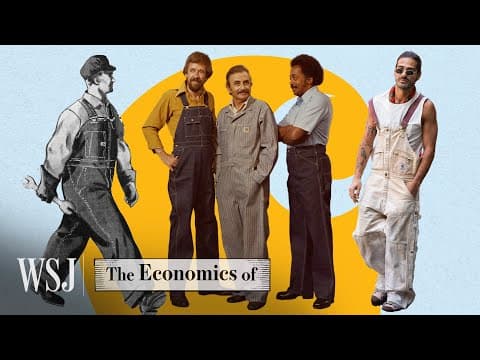
How Carhartt Helped Build a Cult Following Around Workwear | WSJ The Economics Of
The Wall Street Journal
6m 35s1,153 words~6 min read
YouTube auto captions
Transcript source
YouTube auto captions
This transcript was extracted from YouTube's auto-generated caption track. The transcript below is server-rendered so it can be read, searched, cited, and shared without opening the original YouTube player.
Pull quotes
[0:00]Carhartt, the company has been a part of streetwear culture as long as streetwear has been around.
[0:00]Drake, Rihanna, and Obama are only a few of the big names who have dawned the brand.
[0:00]It's worn by folks that might be wearing Carhartt to tech jobs, or might be wearing Carhartt as they trade crypto on the daily.
[0:00]But Carhartt didn't chase after this consumer, and its popularity in fashion has little to do with the company's strategy.
Use this transcript
Related transcript hubs
Watch on YouTube
Share
MORE TRANSCRIPTS


