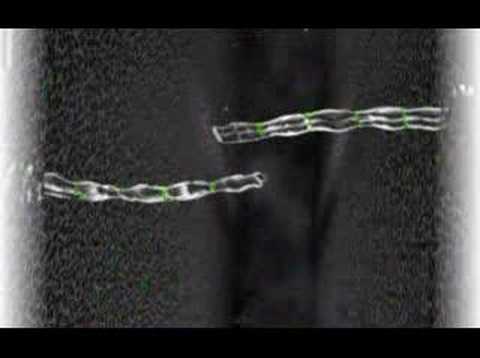
[0:01]After its translation from mRNA, the classic cadherin protein is transported to the cell membrane.
[0:10]The cadherin establishes itself as a transmembrane protein with distinct cytoplasmic and extracellular domains. As seen in this conceptual model, the extracellular segment, which is responsible for the cadherin's ability to link adjacent cells presenting cadherins of compatible type, includes five characteristic domains. These cadherin domains interact with domains on neighboring cells in a calcium-dependent manner. In the presence of calcium ions, individual cadherins pair up to form dimers on one side of the intercellular junction. These cis-dimers then bind with other dimers on the opposite or trans side. When calcium is removed from the environment, the cadherin molecules fail to bind, and cell-to-cell adhesion is disrupted.
[1:10]The cytoplasmic tail remains within the cell and forms a complex with a trio of catenin molecules, P120, alpha, and beta-catenin. This molecular complex links the transmembrane cadherin protein to the actin cytoskeleton. The cadherin-catenin complex is also important in cell-to-cell adhesion, as cells lacking catenins or expressing cadherins without catenin binding domains fail to adhere as normal.


