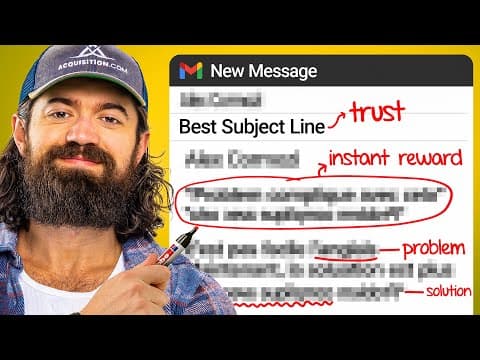
[0:00]In this video, I'm going to show you how to turn $1,000 into $45,000 through email. And over the last 90 days, we've spent just under 10 million emails from acquisition.com, and we generate tens of millions of dollars across our portfolio using email itself. And in this video, I'm going to break down emails that I've sent and I'll give you the 10 tactics that have worked very well for us so far. First things first, here's why I think you should do email. I was a moron and decided to not email for the vast majority of my life because I hate money apparently. And so, the average ROI for email, depending on the source you look at, is between 35 and 45 return. So that means that for every dollar you spend on software or putting time into your email, you can get like $45 back. Like imagine if there was a stock investment that you could 50x in a week. Well, that's kind of like what email is and people still don't do it, myself included. And part of the reason that making money on email is more profitable is because you actually already spent the time to acquire this contact. And so in a lot of ways, email is just follow-up. And so you spent the cost to acquire the lead, now you're just reminding them that you exist and so basically the only real cost is just whatever software you use and whoever, or whomever you may have to pay in order to write the emails. That's pretty much it and so one email writer can send an email to 10 million people and that is a tremendous amount of leverage that you get in your business that a lot of people ignore. On top of that, email is one of the most consumed media platforms and it hasn't died down. So 61% of people check their email multiple times per day, 20% of people check it multiple times per hour. It has almost the same consumption rate as social media in terms of how engaged some of the users are, of people reading their emails every single day. And what's cool about email is that it's actually uniform across age groups. And so you can see between 15 and 24, 25 and 44, 45 and 64 and 65 plus, pretty much everyone, 90% you know plus or 84 at the very end bracket there. Read email all the time. If you're going to master something, it's one that transcends age groups. And I'll bet you, even though we don't have the metric, it transcends countries as well. I would bet you that UK people probably respond similar to US people, probably even respond similar to Chinese people in terms of their email consumption. And I know just because I've gone back and forth with Chinese, you know, providers and warehouses and things like that, they're pretty responsible on email too. And so a massive, very invisible platform. And so as I think about email, the objective of the email has one of two purposes. One is to increase the likelihood that this person purchases in the future or that they purchase, that's fundamentally it. And so basically has the exact same objectives as content. And so it's just a different form of content consumption, except where you can guarantee that you get delivery, whereas when you make a post, the algorithm decides who gets to see it. When you send an email, basically your past performance determines whether or not they get to see it. And there's a couple of little tricks to make sure you get in the right email inbox and not get in the promo tabs, we'll go over some of that stuff. But big picture, you actually have the list and you send it directly to them. And if you're embarrassed by the way that you haven't sent email, then worry not because I am too. And I will show you the first email I sent to my list just not that many months ago. That's obviously within acquisition.com. The portfolio company sends emails all the time, but I hadn't sent anything to Mozi Nation. And so, this was it. So I started with subject, Is this on? And I just said that because I thought it was funny. I started with a quote that I like a lot, which is, It only takes 20 hours of focused effort to get proficient at any skill. The problem is, most people waste years before they start the first hour. So I've been making content for four or five years now and I had yet to send an email. And so that quote of mine felt rather appropriate for myself. The thing is is that I think you can model something like this, like if it has been a minute for you, like you're like, I should have been emailing. It's okay, you can start whenever you want and the day you start is the day you start getting 45x plus returns on email and the time and money you put into it. So I said, after 13 years in business, I'm finally going to write you. I know, wild. The fact that it's taken me this long counts as doubly stupid considering people think that I'm an author. And part of the reason I actually didn't send emails before is that I'm so selective with your attention. I don't want to waste it ever. And so I would rather not send you something at all, rather than send you something bad, that's number one. Number two is that I'm very picky with written word. And so if you ever see written word across any of my social channels, believe it or not, I wrote it. It either came out of my mouth or I physically typed it, it's directly from me, because for some reason, I feel like written word carries more umph than anything else does. And it's probably why even in like legal discourse, if you have written proof and contracts are legally binding, it's because it's written. There's something powerful about words. I basically break this whole down and say, hey, I'm starting Mozi Money Minute, which is basically the name of my newsletter. So my whole goal was, how do I provide value in under 60 seconds so someone can read it and immediately use it in their business. And so my goal is that I hope I pay for myself with every email I send. I'll also include one thought that's improved my life, which may or may not have to do with making money. And so for here, if I were to like apply this to this, it would be like, okay, this is kind of the thought that improved my life. And this one I don't have a tactic that improves their business, but maybe just reminding them to send emails would be the first thing. But everyone after that that are officially Mozi Money Minutes, do. So let's dive into those. Now, let's talk about different tactics. So first things first, everybody wants to talk about how much you can make from email, but no one talks about unsubscribing, right? No one wants to it's like the dirty, oh yeah, people unsubscribe. Every time you send a communication out, there's going to be people unsubscribed. And I don't see unsubscribing nearly as negatively as other people do. And I'll explain why. When I look at our people who show up to workshops, a lot of times they are people who unsubscribed. So it's not an insult, it's like they know who I am and they they're they're in. I don't see it as a negative per se. Also, every single day, thousands of people unsubscribe from my Instagram, thousands of people unsubscribe from YouTube, but I just have more people who subscribe. And so I just see the process of advertising as letting people know about your stuff. And so if someone unsubscribes, they absolutely know about you and your stuff. And it doesn't necessarily mean they don't want to buy, it just might not mean that that form of communication or that particular inbox they opted in with is the one that they want to use. Fine, no big deal. So instead of trying to hide it like, probably the like, I, if I see a brand try and make unsubscribing hard, I hate them. And so I have always tried to do the opposite of that. I think number one is that you want to make unsubscribing easy. Don't keep people captive and let me explain by that. Is I don't want to keep sending emails to an uninterested segment of my list because it'll actually make my domain deliverability go down long term. By sending it for vanity metrics of look, I sent more emails, I actually decrease the likelihood that the people who do want to read my emails actually get them. And so that's why you want to make unsubscribing easy because if you make it hard, they might not unsubscribe, but then they go dormant, which is actually worse for you. So make it easy. I want to be real with you for a second. If you haven't sent email or you you really don't send often like once every six months or something, the first time you send an email, you're going to have a higher unsubscribe rate than normal and that's okay. I call it shaking the tree. It's basically like pulling forward churn, it's the same thing if you correspond with customers who are on a recurring revenue business and you haven't been emailing them or haven't been reaching out to them, you will always get more churn. You'll get next month's churn and this month's churn all at once. And so the highest churn I ever had was on the first email I ever sent. And so it was like just over 1%, which is crazy, right? But now it's like 0.42% unsubscribe rate per email, which is fine, as long as we grow higher than that between emails, that's a that's a good ROI. And it's like, you have to take the logical extreme here. If you are unafraid to email because you don't want to get unsubscribed, why do you have emails to begin with? It's kind of like saying, well, I don't want to post content because then people would stop following me. It's like, well, the only point of them following you is to advertise your stuff. And so if the logical extreme of this is just never do anything, then that's probably not the right conclusion. Number two, and this one is a little bit more advanced, but very worth it. So Hubspot ran a really cool research study where they saw that they had an increase. So already an insane ROI for email, they had a 791% increase in ROI from email from one thing. Which is people who segmented their lists got way higher returns on email. Which should be somewhat unsurprising. Right? Like if you send the right emails to the right people, then they will be more likely to buy your stuff. So if I send a beginner email to a list of advanced people, they'll be like, this is not for me. And to the same degree, and also it doesn't have anything to do with the email. It just might not be right for them. And to the same degree, if I send an advanced thing to people who don't have a business or want to start a business, then they're going to be like, this doesn't apply. And so, it's way less about how good the email is and so much more about who's getting it. And so segmenting the list is basically like if you have any qualifiers on your opt-in. So like revenue or if they have a business or don't have a business, which are some of the ones that we have in our opt-in process. This allows us to send content that's more applicable to those people. And so when we have our list, we say, oh, let's just send this to the 500k plus. Let's just send this to the 5 million plus, let's just send this to the zero to 100k. And so a lot of people want to lie because they think they're going to get like a better experience if they go up, but like, you're just going to get stuff that doesn't apply to you. So just be honest when you're putting your info in. So let me pull up a sample email, so we can break down the structure, so you can think about it. Now, to be clear, you don't have to do this. I'm just going to explain what I was doing, and if it's useful for you, great. Number one on the subject heading, I thought a lot about this because on some there's a lot of internet marketers and and and digital guys who, you know, they they split test the hell out of their subjects. And I thought about this more as like a podcast where it's like podcast episode X and then it just keeps going. Because my thought I'll explain was, if I can basically develop the brand of Mozi Money Minute to be very strong, then eventually it'll get to the point where independent of what I have after Mozi Money Minute, when people know that they always get value in the past when they read it, they'll just click. Going back and forth on this, I was like, I want to build the brand of my email to be strong. And so on one hand, you could say, well, if they know it's from you, then that could be the brand, but we send other emails as well that are not Mozi Money Minute. So I wanted Mozi Money Minute to have its own kind of like little space in someone's mind. That was a choice I made, you can obviously just have your subject be proof of a promise, that's your call, but that's why I decided to stick with it and that's what I've done. So, right off the bat, I think about everything in terms of feedback cycles and reward. And so I want to reward every action that someone takes. And so if someone first reads the email, then if they've been rewarded in the past from Mozi Money Minute, they'll click and they'll open it. Now I need to reward them for that. So a lot of people think about behavior as what happened before that triggered someone to do something. But that's actually not how behavior works and that's been proven. The way behavior works is that you did that thing because you did it another time in the past and rewarded for it. So if you want to see why someone does something, look at what happens after they do it because when you do a behavior, you do it to get something to change or to improve your life in some way. Words I like, I start the email here because I want someone even in less than the time it takes to read the email to immediately be rewarded for clicking and opening. For me, a quote or a tweet is something that's in one glance, they can be rewarded for taking the first action. That's the first thing I'm doing. Now, the next thing is that I have kind of the meat of my email. Now, for me, my me to the email, I keep under, I think 200 words, because it's roughly a minute. And so that's been kind of like the Mozi Money Minute kind of promise. That being said, we also send other emails that are really long. So Layla sends emails to the kind of like the most qualified businesses on the list that, you know, generate the most revenue and hers tend to be a little bit longer. And that's because she tends to teach more via story. I have a little bit more like tactical style. Her emails do great too, so I want to make sure that this doesn't seem like rule of law. I want to explain why I wrote my emails this way. So we have our tactic. And I very clearly, there's a lot of times I'm like, man, I could put this other thing in. One concept, just keep it on one thing because as soon as you start introduce, you're not writing a book here. It's just what is one very clear thing and I just keep cutting it down until it's like, this is what's happening. And so you want to basically introduce a problem or a condition that makes the solution viable. So, no matter how good your product is, a stranger won't believe you because you're biased. Okay, so that's a problem. If strangers don't believe you, okay, so the easiest way to overcome this is overwhelming social proof. Okay, there's a solution. But now, how do I do that? And so, then I put a little extra line and yet so few businesses do it. Here's an easy tactic to display tons of proof you already have but aren't showing. This is one where they already have all this stuff, they're six inches away from gold and we just need to cross the barrier. And so I just said, cool, if you're brick and mortar, print out every five-star review or screenshot it across all review sites online. Then frame it with $1 frames you can get from the dollar store. Cover your lobby floor to ceiling in them. See the PS statement for a real-world example. So that also, and that's a little bit of foreshadowing I'll show you, for something else that we do in the email. Now, if you're online, then you read the one for online. After that, it's like, cool, I delivered my one minute of value that any business owner can immediately use in their business because almost every business has a few five-star reviews on some platform that they can immediately repurpose to get strangers to believe them more and then ultimately sell more stuff. I have my little sign-off and underneath I have a CTA. So if, hey, if you're for scaling your business, go here. If you want to start a business, go here. So this this goes to School, this goes to acquisition.com for workshops because that's for businesses that were not necessarily going to do a deal with or maybe we'll do one in the future. It's just an easy way for us to meet them, so it's just like, cool, come fly out, we'd love to meet you. Okay, so PS, I always have a PS statement in every email because beyond the headline, it's the most read part of the email. So not having a PS statement is PS stupid. So, have one. The thing is is that I think about this as again, what have they just done? So they have now read my email, so I want to reward them for reading my email and I want to encourage people to click because one of the things that I think a lot of people try not to do is try to get people not to click or send too many links. So sending too many links is a bad thing, so that's true. In terms of getting someone to click, you want to regularly get people to click because you want your audience to be rewarded for clicking in general. And so if you have a blog that you send out, don't put the blog in the email. Put a really interesting nugget from the blog in the email and then click there so that they can read it. And so you're just you're training the audience and rewarding them ideally if the blog is good, they will do it again. Just like Mozi Money Minute, if your blog is good, it'll increase the likelihood they do it again. If your blog is bad or your emails are bad, then it'll decrease it. And so this is why I see this very much as content because it has to be good and I and think about the alternative scenario. If you have four good emails and then one terrible one, it can just like that one was just so useless that they're like, ah, I'm not going to do this again. I would rather just extend a period of time where I haven't talked to somebody and just make sure that what I send them is good. And long term, if people don't open your emails, then you'll eventually end up in the promo tab, which is kind of like email death, like no one ever really checks that, even if you have good stuff. And so you want to obviously get people to read your emails quickly. So that's one email. Now, let's talk about different tactics. So mobile optimized design. So right now, 58, 60% of global internet traffic is mobile devices. And what's crazy is that a lot of people's emails are not optimized for mobile viewership and that's where a lot of people are actually going to be reading your thing. And so you want to make sure that you look at your emails on a desktop format and on a mobile format, so that they display the right way for the viewing platform they're being viewed through. When you do that, all you do is first objective of email, increase the likelihood that they convert. And this is especially true if you had images to your emails, this is more like e-commerce does a lot of this. That's where like images can get totally messed up, not look good. It just looks unprofessional and totally plummets the click-through rates for your emails. Number four, consistent layout/format. I tend to love templates. I love to just figure out what works and then do it over and over and over again. So, in the beginning you might experiment a little bit, but if you see that a certain format gets more responses or more click-throughs, then it's like, cool, let's just do that over and over again. And so you'll notice that the Mozi Money Minutes more or less have the same format. They have the thing, they have the content, they have the CTA and then they have some sort of PS statements or the CTA is the PS statement. But that's included in every single one of them. I want people to know what they're going to get. Think about McDonald's. It's like, I don't want any surprises. I'm expecting a Big Mac, I want fries, I want my Coke. And so today's Big Mac, fries and Coke is different than yesterday's, but I don't want it to be different. It's not the same burger, but I want it to still be just as good. So let's rock onto the second one. Same thing, Mozi Money Minute, 391% sales increase from one change. Okay, that's interesting. I'd be like, I would click that. So words I like, so this is the immediate reward, ideally for them clicking. So there's like, cool, I got some value from that. And I just use tested stuff because I just use the tweets that I know that people have shared the most. And so hopefully, also, you might get people who share your newsletter or your emails as well, which is kind of the point. Now, after that, I've got my content bucket, again, this is under, you know, 200-ish words. I just try to remind people that I keep this this promise. Like, that's all, kept this under a minute. Awesome. Then I have my CTA and then I have my PS statement. And so you'll notice the very common theme. So similar subject, reward them for opening, meat of the content, CTA, PS statement. You can alternate like where the CTA is, where the PS statements, like these things I think you can alter around. Because a lot of times I just make memes for my for my PS statement, I don't think there's any science around it, I just think it's fun. You can do that or you can obviously have your your PS statement be your CTA for whatever it is. All of those are kind of viable. I don't like rules in general. The fundamentals are always going to be to reward for every step in the process. So because I can provide value to you in under a minute, I'll also tell you what this tactic was. So speed to contact. So I believe in this so much, I almost started a fund of buying businesses to implement this one tactic. It's simple to understand, hard to do, but you can do it in a few minutes. Call leads within 60 seconds of them opting in. Harvard Business Review published a study that demonstrated an average of 391% increase in sales. That means you can do nothing else besides call your leads faster and you could unlock a 4x in your business. Hard to imagine anything else that will do that for your business today. And if you don't have the sales staff to handle that, hire them. You can afford to pay for them with the 391% increase in sales that you're going to get as a result. I love tactics like this that are just massive unlocks in businesses and that's the type of stuff that we go over in our scaling workshops, which is why that was the CTA. Next tactical nugget. So annual renewal fees. So this works for any business, recurring or reoccurring, but especially recurring obviously. So if you have a membership or recurring revenue model and keep people over a year, there's a great profit tactic that adds a ton of revenue. So it's a one-time annual fee on top of your monthly, so it doesn't interfere with front-end sales because it happens a year later. So people don't not sign up because of this fee. And if someone stays a year, they're also very unlikely to leave. And so the fee is usually the price of about one to three months. And by adding this in, you add 8 to 24% to your revenue without incurring any costs. So if you have a call it a 20% margin business and you add another 20% revenue with no added cost, you double the profit of the business from one thing, which is by adding an annual renewal fee. And so this allows you to keep your advertised pricing because that's what influences your conversions, whatever your monthly price is, but then also get the benefit of a price that's about 8-ish to 25% more than your current in terms of annualized. So, for example, if I charge $39 a month, I might make my annual renewal $99. This takes my annual revenue per customer from $468 to $567, a 21% increase. And so it makes my effective monthly rate $47 a month, so that's two months. Look at the difference here, but if I had it $47, I might convert significantly fewer customers. And so this kind of blends the benefits of a lower cost upfront, but gets the benefits of the higher price. And that's why it's such a cool tactic. Very effective if you use it well. So, again, CTA and then this one was a funny one where the other ones were more tactical, this one is like, hey, here's how I it just is a funny meme. So, in the spirit of PS statements, if you like these types of tactics and want 60 second things that you can immediately use to make more money in your business, you can just go to acquisition.com/newsletter, and you can opt in there. And I'll just keep sending this stuff twice a week, which actually brings me up to the next point before I get to the next theme, which is how often should you send emails and to whom should you send it? Big picture, after talking to the best email marketers I knew before deciding to start my newsletter. Number one is the perfect cadence seems to be around three times a week. All right, now, again, I don't like rules, and if you hate rules as much as I do, then nothing is a rule, all right? You could send two, you could send one, whatever. But most people found that, basically, the more often you email, the more you will convert. It's kind of like more content, but there is a spot where people are like, I'm getting bothered. But the thing is is that's where I feel like putting more effort into making the emails high quality pays dividends. Because think about it like this, if you send someone stuff that always makes them money, then how much would they like you to send them? Tons. And so that's why I'm I'm a big fan of like, I don't really have promotional emails per se. I'd rather just have every email be valuable and then just say like, hey, if you found this valuable, you can go here. And that way, I don't have to balance like, what's my give ask ratio or anything like that. It's like, I'm just going to only purely provide value here, just like content, and if you want to take next steps towards doing or working with us or something like that, you click the link that's made easily and available to you. So to me, I see like just having your link or like what you do or whatever your lead magnet is in there is kind of like having your link in bio. So like, if they want to find out more, you just make it easy for them. So cadence wise, if you haven't started yet, start with once a month and then you can move on. But I will say this, and this is the thing that broke the barrier for me, is that I actually was like, okay, how many emails do I want to send? And so I said, okay, I will commit to twice a month. And so I actually sat down and wrote 24 emails and it took me like half a day. And then I thought, well, shoot, I could have been doing this off a half day's work, I could have been emailing my whole list for a year. And so after I saw how, I don't want to say easy it was, but how I could do it, I then decided to commit to doing it. And now we do significantly more than that. But that was kind of like the if you just write 12 emails, and you're like, cool, I've actually written all my emails for the year and then everything else on top of that is bonus. And the reason I'm even making this video, because it's it's not typical for me to talk about something that I haven't done for an extended period of time. But I had had such a positive response from Mozi Nation, from the Mozi Money Minute that I thought I would make this video for you. Because honestly, like this is one of the I would say, honestly, one of the biggest mistakes I made in my career, was I waited so long to email. And actually, almost all my businesses, like Gym Launch, I didn't email until like two or three years in, which is insane. It's it's just saying no to money. And I should have just done it. It was just the amount of effort that it took. I didn't want to add something else to my plate because I was already so spread thin. But now that I understand how much the return for email per unit of effort, it's totally worth it. And I'll give you a side note, like we didn't do any email follow-up on school for a different reason. We had some technical stuff because we wanted to do it through the platform. And then as soon as we started doing email follow-up, we got a 40% conversion improvement. So it's like, dear God, like what else is going to get you that kind of lift? And again, it's free. Strongly recommend doing it. Start with once a month, get them all just block them all out and be like, okay, I've got that done. And then every time you feel like motivated to do one, you can just add on top and it's just gravy, it's bonus. I personally also don't like committing to a cadence. I don't really commit anywhere to a cadence. I never want to feel like I have to make something because then whenever I have to make it, it's not as good as I want it to be. And so I'd rather just have a quality threshold that if I've got two good ones in me, then two is what's going to go out. If I've got four in me, four is what's going to go out, but if I've got zero, it's zero. Let's talk about tactical nuggees, which is the actual stuff inside of the email. And so we want email, if you think about the hypothetical ideal email, it should be one that looks like emails that you would exchange every day. And so often times emails that you exchange every day are pretty much all text, a handful of sentences, and then that's about it. Maybe a link, maybe not a link. There's usually not a lot of images. And so we want our emails to approximate that as closely as possible because the equal opposite of that is that it looks like the Vegas strip inside of the email. Right? That looks like 100% promotion, which then the algorithm, you know, AI is pretty smart nowadays, they're like, oh, this is just promotion and so that they can put it into the promo tab. And so you want it to just look like an email and so you want it to be as much text as possible. For us, we don't send images and if you do have the link, it's you've got one, maybe two links in there max. And we've also noticed that if we put more money stuff in an email, it tends to get a higher percentage in the promo tab. And so I try to remove money language from the text itself to increase the likelihood it gets in the right place. If you're like, why am I why do I even bother making it only plain text? Why do I even bother only, you know, limiting the number of links? Why do I bother having, you know, less money in the title? Why do I even bother asking them to reply? Why don't I just send it to them automatically for whatever the lead magnet is? Well, I'll tell you why. Right now, for B2B, 16.9% of marketing emails don't even get into the inbox, let alone promo tab, they don't even make it. And so that's because of your domain authority. And so basically, you want to have you have a reputation with the email servers on how good or how high quality the emails that you send are. And so by doing these steps, it's it's kind of like a hundred Golden BBs. There's no one one silver bullet that solves all this stuff. It's just consistently providing emails that people engage with and that they do click and that they do open and that they do read. Those are all indications that the stuff that you're sending is high quality and that it's improving their overall email experience. And so, just like every other platform, I'll I will make this very strong statement, which is, do not try and figure out hacks. Try and simply align what you do with the objective of the platform. The objective of an email provider is that they provide the highest quality email experience and sift out the fewest important emails. Because that think about a terrible experience, if someone's like, hey, I sent you this email and I'm like, I didn't get it and they're like, yeah, I sent it to you. And I look and I'm like, I'm not I'm you know, Google is is is taking all these important emails, I might consider switching servers. I would say that's the worst thing that can happen. So that's why they like they will let emails through. The equal opposite of that, the false negatives is when I'm like, man, this the the filter on this spam is so weak, I'm just getting all these spam emails constantly. Now, that'd be less likely than the first scenario, but still an increase in likelihood that I might consider switching email providers. And let me give you a 201 advanced tactic. If you want an even higher click-through rate and deliverability, make the links something that's Google native. And so if I want to send a YouTube link, then that'll probably have a higher deliverability. If I want to send a sales letter, I can have it be accessed in Google Drive because they understand what the file is. If I want to send a VSL, I can also have it uploaded to Google Drive. And so sometimes these kind of like hokey, more duct taped look together type assets that you might send, sometimes actually convert even better. So if you haven't tested it out, worth a shot. Next nuggie is AB testing subject lines. So I told you that I'm trying to build the brand of Mozi Money Minute and so I'm willing to sacrifice a little bit of short-term open rate so that long-term the audience that becomes hardcore about Mozi Money Minute will just always open the Mozi Money Minute. But even so, the things after Mozi Money Minute will still have an influence on that. And so having an AB split test for your headline, or your subject, will test for a small percentage an AB and then once it has the winner, we'll then send the rest of the list, the the winning combination. And this more and more platforms are getting intelligent about this, like YouTube does the same thing for thumbnails and headlines. Because some of you guys are like, I, I see you're switching this out, it's like, duh, we there's a split test tool, of course, we're going to split test it. But the same thing works for email. So that's a perfect segue to, okay, well, how do I get people to opt into my list? And so what I want to do is I'll read you the email that comes in after you opt in. And so one of the things that I do is I like to peel like when I write my books, I always inevitably write a couple chapters that are really valuable chapters, but don't like really don't flow with the whole book's kind of theme, but they're still really good. And so rather than just like toss them or use them as like a YouTube script, I still finish them and make them book quality, but I just peel them out and say, hey, I'll just give this to you when you opt into my list. And I have other chapters that I've written that like when we do our next launch, I'll have those as bonuses for doing it. And so the only people that get them though is the people who are on the list. And so I like to have little bonuses that are platform specific that give people reasons to also be subscribed there. And so it's like if I could do something like that on YouTube, I would, but I have to do it through a link. So at least on email, I can make something that gives people a reason to sign up beyond just immediately getting tactics that will always make them more money. This one breaks the mold, but I want to walk through why I think this this email is important. And so first thing is, I have a little bit of anticipation. I've got a big announcement that's coming, right? And as long as you're subscribed, you're going to find out about it first. On top of that, I deliver on my promise, so that's reinforcing them opting in in general. And then on top of that, you want them to engage with the email. So there's a couple of things here. So when you reply to an email, you know, I said earlier about the promo tab. Well, when someone replies to an email, then you kind of like get reinforced in terms of the algorithm of the service, like, oh, this is something that they're engaged with. And so you want people to engage. And so for us, once you reply, yes, then we send you the chapter, so that gives them a reason to do it. And so you can have your opt in, have a widget, when they opt in, explain the value of why they should stay on, not just get the widget. Because I think that's just as or more important. If someone opts into your list for a lead magnet, then they just want the lead magnet, they don't want regular communication from you. So I want to sell them on regular communication from me, plus, by the way, here's that thing. And I put that near the end because it's like you have their attention until you give them the immediate reward that was promised, which you obviously have to do. But I would rather say, hey, by the way, here's the other things that you're going to get that I didn't tell you about. So it's like, I want to surprise and delight with the stuff that I'm providing them before I give them the other thing that of course I'm going to provide. You'll be like, you have this tiny tiny moment where they have huge motivation and so it's like you just want to capitalize on it. And think about everything is reinforcement loops. And so people have opted in for this lead magnet, they can get the email by replying, yes. Now, I also want to resell them on doing this. So inside the secret chapter it reveals things like, how to get people to engage with your stuff who otherwise wouldn't. Whenever I get into a new market, I almost always start with this. How to make your advertising nine and a half times as profitable, there are two things you need to pull this off and it's on page five. So putting the extra pages like, oh, this is actually like, it's right in there. The most powerful offer of all time, this will never expire, five ways to add hoops that increase lead quality, the four ways to display discounts and there's a lot more, but this is a solid start on how to design a winning acquisition strategy. So inside here, I have multiple things that I'm sending them and they just have to reply, yes. So it's cool. I've sold you in just these four lines on why you should stay subscribed and then all of this chunk is to get them to reply, yes. Because even though they said they wanted it, it's like, I really need them to reply, yes, so that I can segment myself to not the promo tab. And if you play out the alternative scenario, which is that you give a bad lead magnet or you just immediately send the lead magnet with nothing else, all right, which are both of those, I I consider bad scenarios. If you send a good lead magnet, but you don't sell them on staying, they'll just immediately unsubscribe or just get the thing and then never check anything again. The other scenario is that they do follow the steps and then they read the lead magnet and say, all of that work wasn't worth it and that is like the single thing that I it keeps me up at night. And so I just want to make sure that I always give a positive return on time relative to anything else someone could consume.
39m 12s7,490 words~38 min read
YouTube auto captions
Transcript source
YouTube auto captions
This transcript was extracted from YouTube's auto-generated caption track. The transcript below is server-rendered so it can be read, searched, cited, and shared without opening the original YouTube player.
Pull quotes
[0:00]In this video, I'm going to show you how to turn $1,000 into $45,000 through email.
[0:00]And over the last 90 days, we've spent just under 10 million emails from acquisition.com, and we generate tens of millions of dollars across our portfolio using email itself.
[0:00]And in this video, I'm going to break down emails that I've sent and I'll give you the 10 tactics that have worked very well for us so far.
[0:00]I was a moron and decided to not email for the vast majority of my life because I hate money apparently.
Use this transcript
Related transcript hubs
Watch on YouTube
Share
MORE TRANSCRIPTS


