[0:00]Operation Epic Fury in Iran, the capture of Nicolas Maduro in Venezuela. Both US military actions that were heavily supported by AI. And similar tech can also track you 24/7. What's next for AI in war and surveillance and most importantly, who's actually in charge? Let's dive in. So, what does AI assisted warfare actually look like? Think of it as Google Maps for war. But instead of finding the fastest route to work, it calculates the most efficient way to achieve a military goal. Lately, the US military command has reportedly used AI in three main areas. Identifying targets. AI can scan huge amounts of satellite and drone footage and flag changes like new construction, unusual vehicle movement or activity at sensitive sites. Simulating scenarios. It runs millions of what if scenarios. If we strike here, how does the enemy respond there? AI can explore risk and likely consequences much faster than humans can. Fusing intelligence. AI can help combine signals, sensors, reports and other data into one picture that updates quickly. The result, decision advantage. Military planning that used to take weeks now happens much faster. But beyond the battlefield, AI is already used for massive public surveillance. ICE is using similar tech to track immigrants. Many users worldwide strongly criticize this use of AI and the connection between government efforts and private AI companies. With the Iran War, that's at the center of a global controversy. Who powers the US's War AI? Anthropic is the US company behind Claude, the AI which has reportedly powered the military actions in Iran and Venezuela. Anthropic has consistently stated two red lines. One, no mass domestic surveillance using its AI systems in the US. Two, no use of Claude to operate fully autonomous weapons without human oversight. Because of these guard rails, Anthropic has fallen out of favor with the Trump administration. Trump has ordered all federal agencies to stop using Anthropic's technology. Now, stay tuned for a drama between AI companies and Washington that landed right in Yuse's lap. Enter OpenAI. Just hours after Anthropic was blacklisted, Sam Altman stepped in, quickly signing a massive deal with the Department of War. Critics were ringing the alarm, calling OpenAI's initial safeguards vague and full of legal loopholes. The public didn't wait for an explanation. They boycotted. ChatGPT uninstalls in the US skyrocketed by nearly 300% in a single day. Users fled to Anthropic and Claude became the number one AI app in several countries. Since then, Altman has been in damage control. He admitted the move looked opportunistic and sloppy and has now amended the deal to include explicit bans on mass domestic surveillance and unmonitored AI access to autonomous weapons. Why is this important? If the company with the seemingly looser rules wins the contract, and national laws on the use of AI in conflicts remain vague, all of us will feel the consequences. The way forward. The defense industry insists that AI in warfare is a moral necessity. They argue AI can reduce the effect of human error and leads to more precise decisions, which results in less collateral damage. Well, AI is fast, but it makes mistakes. And when applied to autonomous weapons or nuclear arsenals, those mistakes could become catastrophic. In simulated international crisis scenarios, leading AI models escalated to nuclear signaling in 95% of cases. Meaning, they threaten nuclear action. That's the finding of a recent study by King's College London. Under time pressure, one of the models became even more aggressive and crossed the highest nuclear threshold in some scenarios. The bottom line, if AI war systems operate on rules that aren't transparent to us, while governments hand over more and more authority to algorithms, we are in deep trouble. The line of whose actually in charge is blurring, and when you add private companies into the mix, entities driven by shareholder value rather than public safety, we are entering explosive territory. If you ask me, we need clear, enforceable regulations on AI in war affairs, not just for governments, but for the corporations building them, and we need them on a global scale. What's your tech? Let us know.
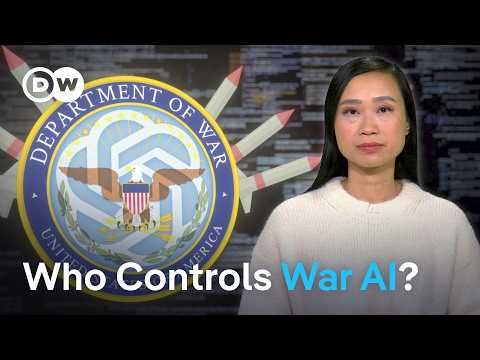
How AI is being used in war in 2026
DW Shift
4m 8s696 words~4 min read
YouTube auto captions
Transcript source
YouTube auto captions
This transcript was extracted from YouTube's auto-generated caption track. The transcript below is server-rendered so it can be read, searched, cited, and shared without opening the original YouTube player.
Pull quotes
[0:00]What's next for AI in war and surveillance and most importantly, who's actually in charge?
[0:00]But instead of finding the fastest route to work, it calculates the most efficient way to achieve a military goal.
[0:00]AI can scan huge amounts of satellite and drone footage and flag changes like new construction, unusual vehicle movement or activity at sensitive sites.
[0:00]AI can help combine signals, sensors, reports and other data into one picture that updates quickly.
Use this transcript
Related transcript hubs
Watch on YouTube
Share
MORE TRANSCRIPTS


