[0:00]Why can I understand English, but I can't speak? I get this question all the time and this is the struggle I managed to overcome. In today's video, guys, I'll show you five simple ways to turn understanding into speaking. And by the end of this video, you'll have a simple routine you can start following right away. Hi guys, welcome back to Wanna Speak by Veronique. My name is Veronica, I am from Poland, my native language is Polish. I'm also a digital nomad traveling the world, but most importantly, I'm a language learner, so I get your struggle. On this channel, we learn smarter, not harder. We live this language. So before we dive deep into fixing this problem, why you can understand but can't speak, we need to actually understand what's happening in the brain. Right now, your passive English, meaning everything that you have in your head, all the knowledge you gained, is like a giant. But your active English, meaning what you actually produce, what comes out of your mouth, is like a baby. And at this point, you want a baby to run a marathon. It's because we were trained to study the language, not to live the language. And this is the problem. Studying is fine, but it only stores information in your head. To actually speak, you need to pull these words out of your head really quickly. So, can you see that these are two completely different skills? So a very common trap a lot of people fall into is, I'll study more. Okay, my friend, but studying more is not going to help you. And please, don't feel judged at any point. I'm a language learner myself and I also made this mistake, and it kept me stuck for years. Okay, without further ado, let's go to the first strategy. Three-word rule. Our goal is to stop building perfect sentences. Present perfect, present perfect continuous, past perfect. For now, forget about all the complicated grammar rules. How? Answer with just three words. For example, when somebody's asking, how are you? You can say, good, a little tired. Three words. Somebody's asking, did you like it? Yeah, it's pretty nice. Three words. Then, if you feel confident, if you are like, okay, I spoke, you can add more context. You can add some comment. This is how you're going to warm up your brain, you won't get so stressed because you keep in mind the simple rule. Okay, I just need to say three words. I don't need to build a complex sentence. The second strategy to finally start speaking, and it's my favorite one, you guys know what I'm talking about. Shadowing. Your goal is to make speaking automatic. And I know you, you consume a lot of content, you watch a lot of YouTube videos, you binge-watch Netflix. You listen to podcasts, you scroll social media, so you have enough input. And now, how to make great use of that time? You're going to shadow native speakers, meaning you're going to copy them. You're going to repeat after them. So let's shadow some native speakers together, shall we? Here I have Netflix and recently I've been watching really chill, relaxing show, The Way Home. I think it's American/Canadian. Anyways, the actors are English native speakers. I pick a very short clip from 10 to 15 seconds. It depends on your level. If you are more of a beginner, then of course, listening to just one phrase is totally enough. If you are more of an advanced speaker already, then you're going to listen to a longer sentence and then repeat it. Felt like some pretty weird vibes back there. Felt like some pretty weird vibes back there. Let's repeat this one. Felt like some pretty weird vibes back there. Felt like some pretty weird vibes back there. One more time. Felt like some pretty weird vibes back there. Felt like some pretty weird vibes back there. Felt like some pretty weird vibes back there. Repeat until you feel you get it. I don't think that I got this sentence, so I'm going to repeat one more time. Felt like some pretty weird vibes back there. Felt like some pretty weird vibes back there. Felt like some pretty weird vibes back there. Oh my God, this sentence is long, right? Felt like some pretty weird vibes back there. Felt like some pretty weird vibes back there. The rule is very simple, repeat as many times as you can until you feel you get it. And make sure to copy exactly what you hear and to try to focus on intonation and rhythm. And if you feel that the phrase is too difficult, just skip it and try something easier. The third strategy is 4-3-2 technique, and this kills overthinking real quick. This is used by many English teachers, I also used it when I was teaching English at school in Spain in 2022. I think it was 2022. First we have to choose a topic, for example, my first week in the US. And round one is when you speak about the topic for four minutes. If you get stuck, try to continue, simply tell me about your first week in the US for four minutes. Round two, you talk about the same thing, but you try to reduce it to only three minutes. You can add some fun story like maybe visiting a doctor or maybe some cap. Make sure you do it in three minutes and round three, the same but in two minutes. It's super cool because you can do it alone at home in the comfort of your own bedroom, so nobody's judging you. And this is how you are actually training your facial muscles. You can try to do it during seven days and record yourself on day one and on day seven. I'm pretty sure that the result is going to be spectacular. Because by day five, your brain is going to be already familiar with what's happening and it's not going to stress you out anymore. The fourth strategy, retrieval sprints. Our goal is to access words quickly on demand. How? You're going to set a timer for 60 seconds, choose a topic that's really useful in your life. For example, maybe you're sick and you need to go to a doctor, you need to go to a drugstore, right? So that's going to be your topic. Maybe you are new to the US and you need to learn how to make small talk. Or maybe you have a business meeting. The challenge is that you speak for one minute without stop in this particular situation. Using whatever comes to your mind, maybe some filler words like, you know, why, um, I'm not sure. By the way, here on the screen, you can see some starter phrases. So these phrases are going to get you started. Once you start, it usually flows. The rule is very simple, you don't judge yourself. The final strategy, pressure ladder. I like to call it gradual exposure, but in reality the concept is from psychology. And in psychology, it's called in vivo therapy, meaning you expose yourself gradually to a trigger, to something that scares you. So let's say that a conversation with a native speaker scares you, right? So you don't want to jump right in. You want to practice in safe space and prepare your system to that exposure. How are we going to do that? The first step is talking to yourself for one minute a day. For that, you can use the previous step, which was retrieval sprints. Later you're going to grab your cell phone and record a voice note to someone, to a friend, to a stranger online, who you practice your English with, for example, on some app or maybe in some community. You want to make sure that your message is going to get out there. Then you want to ask one micro question in public. If you are an ex-pat living in the US, that's a perfect situation, you can simply go anywhere to a grocery store or to a drugstore and ask something. Hey, I'm looking for blah, blah, blah. Do you have this or do you know where I can find it? If you are not in the US or an English-speaking country, no problem. You can go to a different area of your city and pretend that you are not from the city and ask a question in English. Now I know that most probably some of you guys are going to tell me it's cringe, so okay, you don't have to do that if you don't want to. But try to ask a question, maybe in some online community. The final step here is to have a chat with a person who speaks English. So for that, you can use different apps, right? In my next video, next week, I'm going to talk about a wonderful app that will help you do that. If you don't want to use any app, you can join maybe some Facebook groups, Reddit, like the sky is the limit, you're going to find your way. But I want you to make sure to chat to real people. Chatting with AI is okay, I'm not saying it's not, but it's not the same as talking to another human being. As connecting with someone emotionally. So yes, you can practice with AI, but here, in this final step, I want you to talk to a real person. The rule here again is very simple, tiny repetitions, daily, beat big confidence plans. This is how you're going to build your speaking confidence. You can't talk yourself into being more confident. So your new speaking routine is very simple. Five minutes of shadowing a day. No more, you don't have to overwhelm yourself. Then, ideally, if you practice this four-three-two technique, meaning you speak for nine minutes. But if you are really busy and that's not possible, simply replace this practice with one minute sprint, meaning you choose one topic and you talk about it for one minute. That's it. So this can be your six minute routine. It's going to help you much more with speaking than studying for hours. Okay, guys, thank you so much for watching. I hope that now you understand why you understand English, but still can't speak. Let me know in the comments which strategy you're going to start applying today, right now, because the action has to be taken right now. Not tomorrow, not on Monday, not in January. Let me know your thoughts, reflections, opinions. You guys know that I love to chat with you in the comments. I hope to see you next week in my next video. You got this. Take care, and I'm going to go pack my bags because I'm traveling to Rio de Janeiro tomorrow morning. Bye-bye.
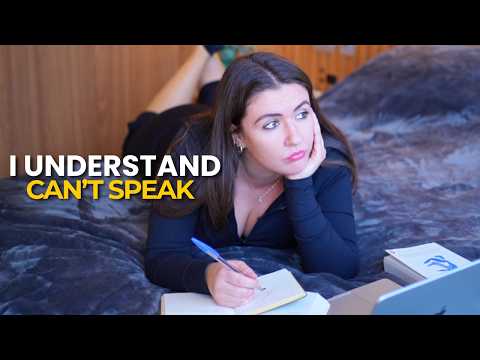
You Understand English… But Can’t Speak? Here’s How to Fix It
Wannaspeak by Veroniq
10m 47s1,838 words~10 min read
YouTube auto captions
Transcript source
YouTube auto captions
This transcript was extracted from YouTube's auto-generated caption track. The transcript below is server-rendered so it can be read, searched, cited, and shared without opening the original YouTube player.
Pull quotes
[0:00]I get this question all the time and this is the struggle I managed to overcome.
[0:00]In today's video, guys, I'll show you five simple ways to turn understanding into speaking.
[0:00]And by the end of this video, you'll have a simple routine you can start following right away.
[0:00]I'm also a digital nomad traveling the world, but most importantly, I'm a language learner, so I get your struggle.
Use this transcript
Related transcript hubs
Watch on YouTube
Share
MORE TRANSCRIPTS