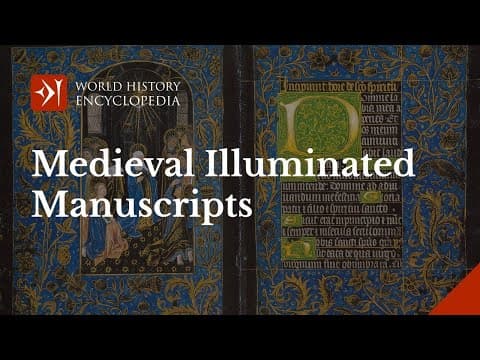
[0:00]Did you know that the shape of books today is due to medieval illuminated manuscripts?
[0:13]Hello and welcome to World History Encyclopedia. My name is Kelly and today's video is all about the handmade medieval illuminated manuscripts. Don't forget the easiest way to support us is by giving this video a thumbs up, subscribing to our channel and hitting that bell icon for notifications, so you don't miss out on any new uploads. World History Encyclopedia is a nonprofit organization and you can find us on Patreon, a brilliant site where you can support our work and receive exclusive benefits in return. Your support helps us create videos twice a week. So, make sure to check it out by the pop-up in the top corner of the screen or via the Patreon link down below.
[0:58]Illuminated manuscripts are handwritten books that are highly decorated in precious materials like gold or silver. The use of metallic materials like gold and silver is what gives these texts their name illuminated, as they reflect the light. They were created between circa 500 and 1600 CE, and their production declined with the invention of the European printing press in circa 1440 CE by Johan Gutenberg. Although at first, people were skeptical about printed books and preferred the old way of handmade works, eventually, they became the more popular and cheaper option, which marked the end of the handmade book and illuminated manuscripts specifically. These handmade books were often on Christian scripture, but some early examples have survived such as the works of ancient writers like the Roman poet Virgil. Muslim artisans also created books using the same technique to ornately decorate their books. But the term illuminated manuscripts usually only refers to works produced in Europe on Christian themes. Illuminated manuscripts were expensive to purchase, which means only those with plenty of money could afford them. Illuminated manuscripts were initially only created by monks in Abbeys, but as the demand increased and they became more popular, the production of them became commercialized. The Book of Hours, a Christian devotional of prayers, was the most popular type of book, given that more Book of Hours texts have survived than any other works produced during the time.
[2:35]What did they write on? Well, although paper was invented in China during the Han Dynasty in circa 105 CE and introduced to the Arab world in the 7th century by Chinese merchants. Europeans wouldn't accept it until the 11th century because they associated it with non-Christian peoples. Before the use of paper, the people of Asia Minor created writing surfaces out of animal hides. The hides of animals like sheep and goats were soaked in water, the hair was scraped off, it was stretched on a wooden frame to dry and then bleached in lime. The finished product of the detailed process was parchment. Parchment made out of calf skin is called vellum and became popular since it was a higher quality surface for writing on than any others. Monks in the Abbeys favored vellum and it became the standard material for their works. Because papyrus and paper were used by pagan writers in the past and the so-called heathens in the East, the use of these materials was discouraged and was considered un-Christian by the medieval church.
[3:43]As books became more popular, their production expanded from the Abbeys to secular merchants and they were sold in stalls and stores. Between the 5th and the 13th centuries, books were only produced by monasteries. In the 6th century CE, St. Benedict made it a requirement that every Benedictine monastery had to have a library, and these books sometimes were brought with the monks who came to live there, but most would have been produced on site. The monks who made books were known as scribes, and the room in which they made the books was a scriptorium. The scriptorium was a large room with wooden chairs and tables that angled up so they would hold the manuscript pages. And the monks didn't just write the books, but were a part of every step from processing the vellum, to copying the text, to the final touches of illustration and illumination. There would be a supervisor in the room who would distribute the pages at the beginning of the day. Monks only worked on the manuscripts during the day because it was a bit risky to have fire so close in the evening. And the supervisor would maintain the rule of silence for the entirety of the day. Often, a monk wouldn't work on one page until it was done, but swap with others in the room. The modern shape of books, being longer than they are wide, began with the monks in medieval Europe, who cut their vellum pages to that shape. After cutting their pages, they would rule lines for writing and leave blank spaces for illustrations. Then the text would be written in between the ruled lines, often in black ink. Then another monk would proof read it for errors. Then perhaps a third monk would add in titles with red or blue ink, and then it would be passed on to the Illuminator, who would add the color, the images and the gold illumination. They wrote with quill pens and ink colors were produced by grinding and boiling natural chemicals and plants.
[5:39]If this room of silence doesn't sound very fun, well, you wouldn't be the first person to think that. A scriptor monk was expected to turn up rain, hail or shine, no matter their state of health or whether they were interested in the particular project. In fact, there are many comments and remarks written on various pages that make clear some of the monks weren't exactly thrilled with their job. With some in the margins including, this page was not copied slowly. I don't feel well today. This parchment is certainly hairy, and three fingers right, but the entire body tolls. Just as the sailor yearns for port, the writer longs for the last line.
[6:20]The earliest European work to have colored illustrations and decorated capital letters at the beginning of each page is the seven pages of the 4th century CE text, Virgilius Augusteus. Although it doesn't have any illumination, the decorative capital letters and illustrations both became practices that define an illuminated manuscript. So it deserves a special mention. Moving to the next century, we have an illuminated edition of Homer's work, The Iliad, titled The Ambrosian Iliad, which was most likely completed in Constantinople. The 6th century illuminated manuscript titled The Saint Augustine Gospels shows many similarities to The Ambrosian Iliad and seems to have been influenced by it. One of the most impressive early illuminated manuscripts dates to the 6th century, has purple dyed vellum pages, and is both written and illustrated in silver and gold ink. This is the Codex Argenteus, or Silver Book, which is a Gothic translation of the Bible, and is commonly understood to have been produced for the Gothic King Theodoric the Great in Italy.
[7:26]It was between the 7th and the 16th centuries that the greatest examples of illuminated manuscripts were created. Since by then, the basics of illustration and decoration had been perfected. The best known and probably the quintessential illuminated manuscript dates from circa 800 and is known as The Book of Kells. The Book of Kells was produced by the monks of St. Columba's order of Iona in Scotland somewhere. But a precise location isn't known. Although, there are many theories about its composition, which place its creation in places like the island of Iona, Kells in Ireland, or Lindisfarne in Britain. What is quite probable is that it was made in Iona and then brought to Kells to keep it safe from Viking raiders, who struck Iona in 795, not long after their raid of the Lindisfarne Priory. In 806, 68 monks were killed in a Viking raid in Iona, and the survivors abandoned the Abbey and moved to Kells. And it's at this time that The Book of Kells probably traveled with them, and was then completed in Ireland. The Book of Kells is an illuminated manuscript of the four Gospels of the Christian New Testament and is highly praised for its grandeur, intricacy, detail, and high-quality illustrations.
[8:47]Literacy in Europe had greatly improved by the 13th century, and the higher demand for books meant the introduction of professional bookmakers. Since the 9th century in Britain and France, literature produced in the vernacular was encouraged, and this greater demand for books meant a greater demand for scribes. Since girls weren't taught Latin as often as boys, Latin was the traditional language illuminated manuscripts were written in. Women started to become scribes and they wrote their books in the vernacular. Nunneries began to produce books. Notations were left by women in the margins, and one manuscript ended with a request that the reader pray for the scribe with the feminine pronoun used. In circa 1440 CE, Johann Gutenberg invented the European printing press, and the first Bible, a Latin Bible, was printed in 1456 and is known as the Gutenberg Bible. A book comprising 400 pages, rather than taking at least six months to produce, could now be printed in less than a week. People, fearing new things, of course, rejected the printing press and opted for real books. People didn't want cheap imitations of manuscripts. And so, printers went to great lengths to make printed books look more like the handmade ones, with leather binding and gold gilt on the covers. Illustrators were even hired to provide images. These measures helped make the European people more receptive to the new books. And although illuminated manuscripts were still commissioned through the early years of the 1600s, the quantity and quality was inferior to the works produced before the printing press. Eventually, the skill of illuminating was forgotten as the printed book became popular, and the illuminated manuscript, which was eventually produced as a valuable item only for the very wealthy, became even more scarce and eventually were no longer produced. Have you ever seen an illuminated manuscript like The Book of Kells? Let us know what you thought about it in the comments below. If you enjoyed this video, make sure to give it a thumbs up, and don't forget to subscribe to our channel so you don't miss out on any new videos. This video was brought to you by World History Encyclopedia. For more great articles and interactive content, head to our website via the link below. If you like my shirt, you can find this design and a bunch more at our shop at worldhistory.store, or you can find the link for it down in the merch tab down below. Thank you so much for watching, and we'll see you soon with another video.


