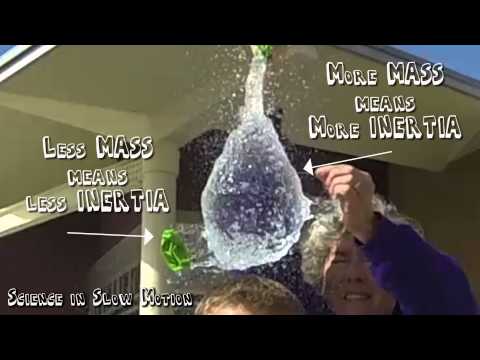
[0:05]Hey everyone. Welcome to another episode of Science in Slow Motion. In this episode, we're going to look at the inertia of water inside a water balloon. And Mr. Durfee is going to get wet.
[0:23]That's so cool. That's very cool.
[1:02]That was cold. Why would you do that to me? Sometimes you have to make sacrifices for science. Okay, fine. So, what exactly is inertia? Newton's first law of motion, also known as the Law of Inertia, states that an object in motion will remain in motion unless an outside net force acts on it. But an object at rest will remain at rest unless a net force acts on it and changes its motion. Cool language fact, the word inertia comes from a Latin word that means lazy or idle. So, does that mean matter is lazy and it resists changing its motion? Yeah, I guess you could say that. So, how does popping a water balloon demonstrate inertia? Right now the balloon is holding in the water with its elastic force. The force of gravity is trying to pull the balloon down and my hand is pulling the balloon up. So right now, the forces are all balanced. When I pop the balloon, the elastic force of the balloon pulls itself away. But the inertia of the water, because of its mass, makes it resist moving. So it seems to stay still for a moment before the force of gravity starts making it accelerate downward. But the green material of the balloon itself has way less mass and therefore, less inertia to hold it in place. So it flips itself away from the balloon quickly. And because the water has so much more mass and inertia than the balloon material, the balloon doesn't disturb the main mass of water. Basically, it does the easiest thing it can, which is to go around the water rather than move the water. So, it's lazy. Right. And look at that. Even as it starts falling, the water holds its shape right up until it hits my head because its inertia makes it resist any change. Notice the spray around the water. All the little droplets you see are being pulled away from the main part of the balloon because they adhere to the balloon. Wait, water sticks to the balloon. Are you saying water is sticky? That's right. We don't usually think of water as being sticky, but it does adhere to things. Okay, there's one more weird thing I'm seeing in the video here. What is that octopus arm thing coming off the rest of the balloon? That's interesting. What's happening there is that when I pop the balloon with a pin, there is a tiny fraction of a second in which there's a small circular hole before the rest of the balloon tears itself in half. In that tiny split second, the balloon's elastic force pushes water out the small hole creating the shape you see. Then, as the rest of the balloon flies away, the inertia of that area of water makes it continue to move outward away from the main mass of water. In fact, if your head hadn't been in the way, that arm probably would have kept getting bigger. That's kind of awesome. That's Newton's first law of motion.
[4:36]That's cool.
[5:01]You can tell you don't know when it's going to happen.


