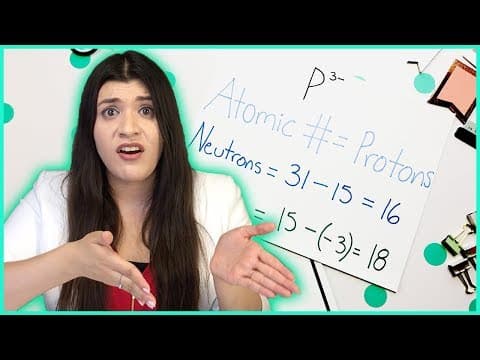
[0:00]What makes up an atom are three different types of particles: protons, neutrons, and electrons. Protons are positively charged, neutrons have no charge, or are known as neutral, electrons are negatively charged. Let's look at the setup for a chemical symbol. The X represents the chemical symbol or the element, A is the mass number, Z is the atomic number. For example, our potassium or K, has a mass number of 39 and atomic number of 19. On the periodic table, that 19 or atomic number is on top. Your atomic mass is on the bottom. Let's talk about the difference between an atomic mass and a mass number. A mass number is our protons plus our neutrons, versus the atomic mass is the average of all the different types of isotopes of that element. We will discuss isotopes in a separate video. In a neutral compound, like potassium, just meaning there is no charge, your atomic number, protons, and the electrons are all equal. And we see that each one of those is 19. To figure out how many neutrons you have, take the atomic mass and subtract that by your protons. Subtracting these two numbers will give you 20 neutrons. Let's talk about ions. Ions are elements with a charge. Phosphorus has a charge of -3. Let's figure out our atomic number and how many protons there are. Looking at your periodic table, let's figure out where phosphorus is, then the atomic number will be on top. Your atomic number is equal to the same amount of protons. So our atomic number and protons will both be 15. If we're trying to figure out how many neutrons, you take your mass number or atomic number, which we'll round to 31, and subtract it from the total amount of protons. That then gives you 16 neutrons. To figure out your electrons, take your proton count and subtract it from the total charge. Our charge was a -3. These two will then multiply becoming a positive, so we'll have 15 + 3 giving us 18 electrons. What you could have also seen was, since this is a -3 charge, this is going to add to the amount of electrons because electrons are negatively charged. So they're becoming more negative. Let's look at our next example with an ion with a positive charge. Phosphorus now has a 3+ charge. We're still going to figure out our atomic number, atomic mass, protons, neutrons, and electrons. However, our atomic number and proton count will not change. Neither will our atomic mass, we'll also round it to 31, and our neutrons will still be the exact same. Our electrons are the only thing that changes. So we'll take our protons and subtract it from our total charge of 3, and that'll give us 12. Once again, our charge is a +3. So this is actually going to subtract from our electrons since electrons are negatively charged. Now, what if you're given the amount of protons, neutrons, and electrons, and you're asked to figure out is it a neutral element or isn't it an ion? Determine the element or ion that has 26 protons, 30 neutrons, 29 electrons. Here's a trick on figuring out if it's a neutral element or if it's a charged element, which is an ion. If your protons and electrons are equal to each other, that means it is neutral. If your protons and electrons are not equal to each other, that means it is an ion. In this case, our protons and electrons are not equal to each other, that means it will be an ion. First off, our atomic number is the same amount of protons, so we know that it is 26. Looking at your periodic table, let's look for the atomic number of 26. As you can see, it is Fe also known as iron. If you were asked to figure out the mass number, you would add your protons plus your neutrons. That would then give you 26 + 30, which is 56. To figure out your charge, take the atomic number or proton count and subtract that by your total amount of electrons. 26 - 29 gives us a -3 charge. We have iron with a -3 charge, this is our final ion. Get ready for some practice problems. Hit it, Johnny.
[5:36]I hope you got everything right. As always, I've linked up practice problems with step-by-step answers in the description box below. Let me know what you're struggling with. If you have a homework problem that you don't quite understand, leave a comment and I'll answer it. And I'll see you next time.


