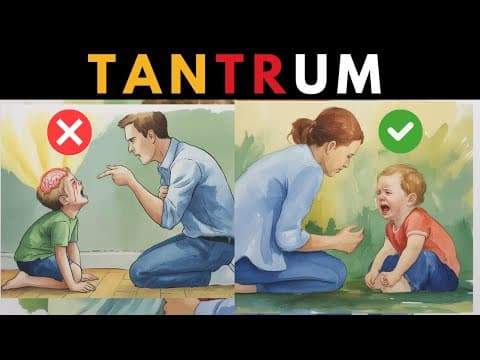
[0:00]If you've ever been in the middle of a grocery store, your living room or the car while a child is screaming, crying or completely melting down and thought,
[0:11]Nothing I say is working.
[0:14]You are not alone.
[0:17]Tantrums are one of the hardest parts of parenting and caregiving.
[0:21]They can feel embarrassing, exhausting and sometimes even personal.
[0:25]But here's the most important thing to understand right from the start.
[0:29]Tantrums are not bad behavior.
[0:32]They are signs of an overwhelmed brain.
[0:35]Today we're going to talk about five brain friendly ways to handle tantrums, strategies that work with a child's developing brain instead of against it.
[0:44]These approaches don't just stop the tantrum in the moment.
[0:48]They help children build lifelong emotional regulation skills.
[0:52]Let's start with what's really happening in the brain.
[0:56]What's happening during a tantrum? When a child has a tantrum, the emotional part of the brain, the limbic system takes over.
[1:04]Stress hormones flood the body.
[1:07]The thinking brain or prefrontal cortex goes offline.
[1:12]That means they can't reason.
[1:15]They can't just calm down.
[1:18]They can't learn a lesson yet news. So if we try to lecture, threaten or punish during a tantrum, we're talking to a part of the brain that simply isn't available.
[1:30]Regulation has to come before education.
[1:33]Let's walk through the five brain friendly strategies.
[1:38]Strategy one, regulate before you educate.
[1:42]This is the foundation of everything.
[1:45]When a child is disregulated, your first job is not to fix the behavior, it's to help the nervous system calm down.
[1:52]That starts with you. Children's brains are wired to co regulate.
[1:57]They borrow calm from the adults around them. If you're tense, rushed or angry, their brain senses it immediately.
[2:04]So instead, take a slow breath.
[2:08]Drop your shoulders as speak more quietly than usual.
[2:13]Slow your movements. You don't need to say much. Your calm body sends a powerful message of safety.
[2:20]Remember, A calm adult is the best regulation tool a child has.
[2:26]Strategy two, name the feeling.
[2:29]Once you're grounded, the next step is helping the child feel understood.
[2:35]Naming emotions helps activate the thinking brain again.
[2:38]It builds a bridge between the emotional storm and logic.
[2:42]Simple phrases work best. You're really frustrated.
[2:47]You're sad because it didn't go the way you wanted.
[2:50]That felt unfair. You're not agreeing with the behavior, you're acknowledging the feeling underneath it.
[2:57]When children feel seen and heard, their brains don't have to scream as loudly to get attention.
[3:03]This is why validation often shortens tantrums instead of making them worse.
[3:08]Strategy three, offer physical calm.
[3:12]The body and brain are deeply connected. During a tantrum, the body is often flooded with energy and stress hormones.
[3:20]Physical regulation helps the brain settle faster than words ever can.
[3:25]Depending on the child, this might look like
[3:29]a hug or gentle touch only if welcomed age.
[3:33]Sitting close by, breathing together, rocking or swaying, offering a soft object or blanket.
[3:41]Lude, you might say, I'm right here. You're safe. We'll get through this together. Physical calm tells the nervous system the danger has passed.
[3:53]Strategy four, limit words, increase presence.
[3:58]One of the biggest mistakes adults make during tantrums is talking too much.
[4:04]When a brain is overwhelmed, extra words feel like noise.
[4:08]Even well meaning explanations can add stress.
[4:11]Instead, use fewer words.
[4:15]Keep sentences short. Repeat calm phrases if needed.
[4:20]For example, I hear you.
[4:23]I'm here. We'll talk later. Silence paired with steady presence is often far more powerful than any speech.
[4:32]Your presence communicates safety when words can't.
[4:37]Strategy five, teach after the tantrum.
[4:41]This is where real learning happens.
[4:44]Once the child is calm, the thinking brain comes back online.
[4:48]This is the moment to guide, reflect and teach.
[4:53]Later, not in the heat of the moment, you can say, earlier, you were really upset when it was time to stop playing.
[5:00]What could we try next time when that feeling comes up?
[5:03]You might practice using words instead of yelling,
[5:08]asking for help, taking deep breaths, choosing a calm down strategy.
[5:14]The goal isn't punishment, it's skill building.
[5:17]Every tantrum is an opportunity to strengthen emotional regulation, problem solving and resilience.
[5:24]A final reminder for parents and care givers.
[5:27]Tantrums are not failures.
[5:30]They are signs of growth. A child's brain is under construction and emotional regulation takes years to develop.
[5:38]Every time you respond with calm, connection and understanding, you are literally helping wire the brain for the future.
[5:46]You won't handle every tantrum perfectly and you don't need to.
[5:51]Repair matters more than perfection.
[5:54]Showing up, staying connected and trying again is what builds trust and emotional strength.
[6:01]If this video helped you, consider sharing it with another parent or caregiver who might need reassurance today.
[6:08]And remember, you're not raising a bad child. You're raising a human with a developing brain.
[6:15]Thanks for watching. If you'd like more brain friendly parenting tools, don't forget to like, subscribe and take care of yourself too.
[6:24]You're doing important work.


