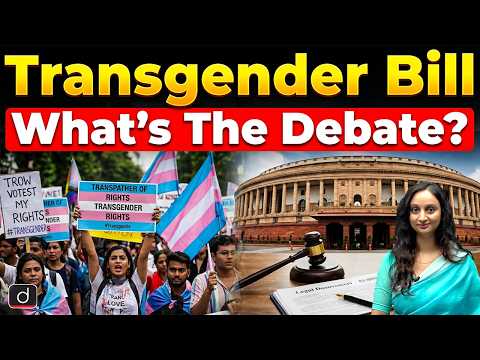
[0:00]is the identity of transgender people at risk in India? What is this new transgender bill that the transgender people themselves are unhappy with?
[0:09]In this session, let us discuss all of that. Hello students, welcome to Drishti IAS. My name is Saloni Nandkeolyar. Let's get started.
[0:16]So the Lok Sabha is all set to take up the transgender persons (protection of rights) Amendment Bill today for discussion.
[0:26]So this has been picked up by the Lok Sabha for discussion. Post this, this may or may not be referred to a parliamentary standing committee for review.
[0:33]But right now it is under discussion by the Lok Sabha. And this is an amendment bill, meaning it is going to amend certain laws.
[0:40]So it is going to amend the law of 2019.
[0:45]The Transgender Protection Act of 2019, this is an amendment to that law. Now, why is this being contended by the transgender people themselves?
[0:54]They are demanding a withdrawal of this. For this, we'll have to understand the provisions that were given in the 2019 law and the provisions that have been proposed in this amendment bill.
[1:04]So we'll do all of that, but before we do that, we look at a timeline. A timeline of the recognition of transgender people or third gender in our country.
[1:15]Now, before 2019, no such law existed for the protection of transgender people, a universal law for the protection of transgender people in India, no such law existed before 2019.
[1:26]A turning point came in 2014.
[1:31]In 2014, we see the NALSA judgment.
[1:37]NALSA judgment. In this judgment, for the very first time, a formal recognition was given to the third gender.
[1:49]So the court for the very first time highlighted that there needs to be a formal recognition that needs to be provided to the third gender. Other than the regular two genders, male and female, there should be a formal, there should be a formal recognition given to the third gender also.
[2:04]For the very first time, this was stated under the NALSA judgment. And most importantly, one of the most important statements that were made over here was that these people or the transgenders will be given a right of self-identification.
[2:14]Self-identification in order to protect them from the social stigma, in order to protect them from all the loss of dignity that they have to face. Because if they need to go, if they need to have these approvals from medical boards or from the DM or from the government, there's a loss of dignity that these people have to face. There's a stigma that these people have to face.
[2:41]In order to get rid of all these things, in order to protect their fundamental right of privacy, under the Puttaswamy judgment, in order to protect their fundamental right of privacy, third gender or the transgender people were given a right of self-identification.
[2:58]The court highlighted that gender is a matter of identity. No such approval should be required.
[3:05]These people should not be, uh, you know, testing or proving themselves, getting themselves evaluated for anything. If they feel, if they feel associated with a certain gender, if they identify as a certain gender, they should have the right of self-identification.
[3:18]This was highlighted in the NALSA judgment and based on this is well, we have the 2019 Act.
[3:28]The 2019 Act, wherein a formal recognition was given to the third gender and the third gender was given a right of self-identification. These things happened.
[3:36]And now in 2026, we are looking at the amendment bill.
[3:42]So what are the key provisions that have been introduced in this amendment bill that are demanding or that are basically inviting such opposition?
[3:51]In order to understand that, let's do a before and after comparison. So first and foremost, the first issue here is of gender identity.
[3:59]I told you under the 2019 Act, self-identification was allowed because we need to protect the right of privacy.
[4:09]of transgenders, we need to protect the right of privacy, we need to give them a dignified life under Article 21.
[4:18]So self-identification was allowed. Now what has been proposed? The government basically felt that people are misusing this.
[4:25]That's why the government has said that now a medical verification, a medical verification is going to be mandatory.
[4:36]Meaning self-identification has been restricted. Now, self-identification alone is not enough.
[4:41]Medical verification will be required. So a proper medical board is going to sit, it will be chaired by the chief medical officer, evaluations are going to happen, testing is going to happen, and only when the medical board recommends the DM, the DM is going to issue a certificate.
[4:56]Which was not the case before. Earlier it was only self-identification, a full and free freedom of self-identification.
[5:04]Now that freedom has been restricted. Now we need to have an approval from the medical board. This is the first point of contention.
[5:11]Because this is giving rise to something that's being called clinical gatekeeping.
[5:21]Clinical gatekeeping. Because these medical officers, medical practitioners, they are going to have the final right.
[5:27]Whether they give the approval or not is at the discretion of these medical officers. It is no longer a matter of self-identification alone.
[5:35]So clinical gatekeeping is happening here, and it's kind of, uh, you know, treating something as a disease that you need to be tested, you need to be evaluated, approvals need to be given.
[5:46]So it's like a violation of their right to live with proper dignity. So this is the first point of contention.
[5:53]Second, again, certification. Earlier it was simple, simply you apply to the DM, self-identification, apply to the DM, DM is going to give you the certificate.
[6:00]Now, you apply to the DM, then a medical board is going to sit. If the medical board verifies and approves, then the DM is going to give you the certification.
[6:09]Definition, definition also has been changed. So a proper precise definition, in fact, has been given for transgender people.
[6:17]Earlier the definition was very broad. They, it included like everybody, the LGBTQI+ community.
[6:27]So it included everybody, gender fluid people, non-binary people, all sorts, anybody who relates with any kind of an identity. Everybody was included. It was very broad. Now it has been made very narrow and precise, where we are going to focus only on some groups, like the socio-cultural groups.
[6:44]Socio-cultural groups like the Kinnar Samaj. So basically, these groups that have been existing for centuries in the society and they have certain cultural values, traditions, customs or a role that they play in the society.
[6:55]Only those socio-cultural groups are going to be identified, the Hijra Samaj or the Kinnar Samaj. Such kind of socio-cultural groups are going to be identified, but not everybody is going to be included. In fact, the government has specifically stated that this rule or here, or the law basically, was not to protect everybody or, you know, not to protect people with self-perceived identities or gender fluid identities.
[7:28]The goal here was not to protect those people. The goal here was to protect only socio-cultural identities, socio-cultural identities that have been existing in the society for centuries, and they have had a role to play.
[7:40]So the definition also has become narrower. Earlier it was broad and now this is narrow.
[7:47]Earlier the approach was rights-based.
[7:51]Because we see self-identification was given, there was a right to privacy, no approvals were required, dignified life could be given, right approach, rights-based approach.
[8:00]If somebody identifies as a particular gender, they can simply live that life with dignity. Now this has moved to more control and verification based.
[8:10]Because we are not going to protect everybody, only certain identities are going to be protected and then also proper, even those identities will require what, proper medical verification and approvals.
[8:21]So it's more control based and restricted. And penalties have come up.
[8:25]Which is a good thing. Earlier we had very narrow penalties, basic protection was there.
[8:30]Now those penalties have been made stronger, which is good. The penalties have been made stronger. But the downside here is so penalties like imprisonment and fine have been introduced if any forceful, coercive kind of a, you know, treatment is seen where people are allured to get into the transgender community.
[8:45]In that cases, the people who do so and their family members are going to be facing penalties. But the problem here is that how are you going to justify or how are you going, how are you going to verify that such a coercive method has been followed or not?
[9:05]Proper identification of things has not been proposed in the bill. It's very broad and it's very vague. That's why the transgender community itself is feeling that now their rights are being restricted, now their privacy is being restricted and this is not something, it's it's kind of a regressive step is what they feel.
[9:37]That earlier the 2019 law was more progressive and this one is now more regressive, where we are narrowing the definition, we are also taking away the right of self-identification, we're making it more like a disease because we need proper approvals and verification, medical board needs to sit and everything of that sort.
[9:54]And these things were not existing earlier. So instead of moving forward, we are now kind of regressing.
[10:01]So this is not something that the transgender community of course is happy with. But we are yet to see what happens, what kind of a discussion takes place in the Lok Sabha, and after that what happens, if it is referred to a parliamentary committee or not, what does the Rajya Sabha say, this only time is going to tell.
[10:14]But we can quickly revise the concerns. So rejection of self-identification principle has been done. Clinical gatekeeping, I already told you. Exclusion of gender fluidity.
[10:25]Because the government has explicitly said that we are not going to, you know, protect self-perceived identities or gender fluid identities, we're not going to do that.
[10:33]Threat to those outside socio-cultural groups.
[10:39]Narrow definition. Most importantly, reversal of progress and statistical impact. Now, under the 2019 law, many people already have received the transgender certificate. Now what is going to happen to those?
[10:52]What is going to happen? Is there a reversal that's going to happen? Will they have to like re-prove themselves and go through this entire approval process again to get a certification?
[11:00]What is going to happen to that? That again is ambiguous. And concerns over 'forced identity' clauses.
[11:08]Again, punishment has been introduced, great. But how are you going to verify what counts as an evidence and what does not?
[11:13]This again here is ambiguous. So that was all for this discussion.
[11:18]I hope you were able to draw a comparison between the key things that have been proposed in this amendment bill versus what actually the law said in 2019.
[11:28]Now we'll look at a practice question for prelims. And before we do that, you know that the Selection Mahotsav Sale is ongoing, where you can get up to 50% off.
[11:38]All on our online courses, pendrive courses and test series and 25% off on books, DLP and magazines.
[11:45]So this is going to stay live till 26th of March.
[11:50]Go ahead and enroll yourselves in any course that you like. And if you have any further queries, you can call us at this number 8750187501. And you can also download the Drishti Learning App.
[12:01]Now, let's look at a practice question. Consider the following statements regarding the Transgender Persons Amendment Bill 2026.
[12:09]One. It retains the principle of self-identification of gender as laid down in the NALSA judgment.
[12:15]Two. It proposes the requirement of certification by a medical board for recognition of transgender identity. Choose the correct statements.
[12:22]A, one only, B, two only, C, both one and two or D, neither one nor two. Please attempt this question and provide your answers in the comment section. Thank you for watching.
[12:37]For more informative content, like, share and subscribe, and do not forget to press the bell icon to get the notifications.


