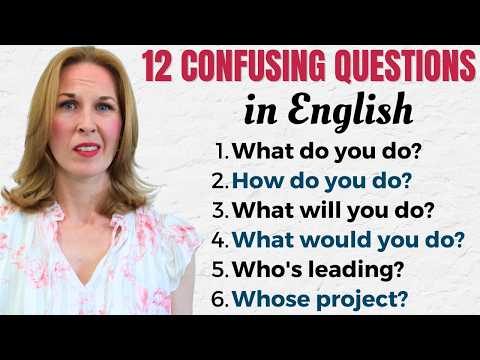
[0:00]What's the difference between what do you do, how do you do, how are you? Today you'll learn how to use these confusing but very common English questions.
[0:13]Welcome back to J Forest English. Of course, I'm Jennifer. Now let's get started.
[0:17]Our first question is one of the most common, what do you do? What do you do?
[0:22]But many students, even my most advanced students, look at me with a blank expression when I ask them this.
[0:29]So what do you do? So this is to ask about someone's job or occupation.
[0:35]Now, the full form is what do you do for a living?
[0:40]But native speakers generally don't include for a living.
[0:44]It's very uncommon to include that.
[0:47]So you need to get comfortable with understanding, what do you do?
[0:51]And notice the pronunciation, what do you? That's what it will sound like.
[0:54]What do you? What do you do? What do you do? And this is in the present simple. We have what, and then do, does, depending on the subject, then you have your subject, and then do.
[1:09]So, for example, what does your sister do? So, what's your sister do?
[1:14]If I'm trying to get to know your sister.
[1:18]And you can answer, she's a professional juggler, why not?
[1:22]Or what does John do again?
[1:25]And notice you add again, if you already told me what John does, or I already knew what John does, but I forgot.
[1:36]And then you could reply, I think he works in sales.
[1:40]If you want to express uncertainty. Now, don't worry about taking notes as we go through this lesson.
[1:45]I've summarized everything in a free lesson PDF. You can find the link in the description.
[1:50]So, in a social setting, it's very common to say, nice to meet you, Jennifer.
[1:56]So, what do you do?
[1:59]What do you do? Is one of the first questions you're asked in a social situation.
[2:03]Now, to answer, I teach English as a second language.
[2:06]And you? So you state your job title or what you do, and then to turn it back to the person, you can simply say, and you, and you.
[2:17]Do not say, what is your job?
[2:20]That's a direct translation that natives don't use.
[2:24]And also, do not ask, how do you do?
[2:29]Which is our next question, how do you do?
[2:32]This is not the same as what do you do?
[2:35]This is a formal greeting when meeting someone for the first time.
[2:39]But keep in mind, this is outdated and it's not used today.
[2:43]How do you do, Mr. Lum? I'm only explaining this so you don't get confused with what do you do?
[2:49]But today, as a greeting, you would say, it's a pleasure to meet you.
[2:56]That sounds formal and professional. In a more casual everyday situation, you would say, nice to meet you.
[3:04]Now, you can do this in the moment when you're meeting someone, but you can also use this as a farewell as you're leaving a conversation.
[3:13]And then because it's a farewell, you would say, it was a pleasure to meet you.
[3:18]Because you met them 10 minutes ago when you started the conversation.
[3:22]Or you can say, it was nice meeting you.
[3:26]So it was nice, but notice I changed to the Jarren.
[3:29]It was nice meeting you.
[3:32]You can use the infinitive to meet or the Jarren meeting in the past form only.
[3:39]But just know the infinitive is more common.
[3:42]Let's move on to how are you? Of course, you know how to use this question.
[3:49]But just know that this is a common question about well-being, and is often used in polite situations.
[3:56]And is often used when you don't actually provide a real answer about your well-being, and the other person does not care, is just a formality.
[4:07]So out a grocery store, when you go to check out, the clerk would say, hi, how are you?
[4:17]It's just a formality in North America. Now, as a formality, because this is a stranger you will never see again, you don't actually tell them how you are sincerely.
[4:26]You just say, fine, thanks. And you, and you. It's polite to ask them as well.
[4:34]Or you can say, good, you. So we keep our answer very short. Hi, how are you? Now it certainly is possible that a friend would say, hi, Jen, how are you?
[4:46]But because this is my friend, I will provide a real answer.
[4:50]I will not just say fine or good.
[4:53]So I might say, oh, it's been a crazy week.
[4:57]So I'll provide a full answer.
[5:00]So with friends, yes, you can absolutely ask, how are you?
[5:04]But it isn't the most common because it sounds impersonal.
[5:09]It's way more common to ask, how are you doing?
[5:12]And then to answer, I'm doing great, or simply doing great.
[5:17]How's it going?
[5:20]This is what I use 99% of the time.
[5:24]Now, to answer, it's going great, because the question is, how is it going?
[5:29]How's it going? It's going great, or simply great.
[5:33]And in a more informal situation, and to be honest, I hear it more with younger males, what's up?
[5:41]What's up? And then to answer, not too much.
[5:45]Question four, how many?
[5:48]What do you need to complete this?
[5:52]Well, you need how many?
[5:55]A plural countable noun.
[5:59]Is that what you said? So, for example, how many projects are you working on?
[6:07]Okay, because it's plural, you must use a plural.
[6:11]And it has to be accountable, which means it can be singular, one project, or it can be plural, two or more projects.
[6:20]That's the standard form of nouns.
[6:23]However, there are exceptions, which we will learn next.
[6:28]To answer, you would say, I'm working on four right now. Four projects. You don't have to include the projects because it's obvious.
[6:36]How many projects are you doing at the same time?
[6:39]And this is, of course, used to ask about a countable quantity or amount.
[6:45]So, for example, how many apples do you need for the pie?
[6:50]Now, you can provide a range, get me five or seven, depending on size.
[6:57]So you don't have to provide a precise number. But do not say, how many rain was there last night?
[7:03]How many works do you have?
[7:07]This leads us to our next question, which is, how much?
[7:11]How much? How much? What do you need?
[7:16]An uncountable noun.
[7:20]So these are the irregular nouns, the exceptions to the regular form.
[7:26]So, how much work do you have this week?
[7:30]Now, notice there is no S on work because it's uncountable.
[7:35]And we use much. Now, you can simply reply and say, a lot. I have three deadlines this week.
[7:43]Remember, no S. And then if you want, you can continue on with something countable.
[7:48]I have three deadlines, one deadline, two deadlines.
[7:53]So the noun deadline is countable. I have three deadlines this week.
[7:59]How much work do you think he got done? And of course, this is to ask about an uncountable quantity or amount.
[8:07]So, with our rain example, because rain is uncountable, you must ask, how much rain was there last night?
[8:16]So again, you do not add an S.
[8:19]And then you might say, I think about three inches, because inch is a countable noun.
[8:26]Three inches of rain, but rain does not take an S.
[8:31]In a job interview context, you may be asked, how much experience do you have?
[8:38]This is uncountable, the word experience.
[8:41]To answer, you can say, I have over 10 years of experience.
[8:47]So experience, no S, but years is countable.
[8:52]Now let's review question six, what plus noun?
[8:56]This is to identify, describe or provide information on something.
[9:00]What projects are you working on?
[9:04]So again, projects, that's accountable noun, singular, plural.
[9:08]And then to reply, I'm working on the website redesign project.
[9:15]Now, just know that the verb tense that you need depends on the time reference.
[9:22]So you would ask, what movie did you watch last night?
[9:26]So, of course, did is in the past because of last night.
[9:30]And then to answer, I watched the new Jack Black movie.
[9:33]What movie did you watch? Now, with this structure, you can use a singular or plural noun.
[9:42]So for a plural noun, what courses have you taken?
[9:46]So far, I've only taken an AI course.
[9:51]So you can answer in the singular or plural, I've taken three AI courses.
[9:55]Let's compare this to question seven, which plus noun.
[10:00]Hmm, do you know the difference between what plus noun and which plus noun?
[10:04]Well, which is used to identify or choose something specific from a known or limited set of options.
[10:13]So you can absolutely ask, what projects are you working on?
[10:19]In this case, it's general, no limits.
[10:22]But if I ask, which projects are you working on?
[10:26]It's limited to a specific set of projects.
[10:29]That's known, previously defined.
[10:37]The answer to both can be exactly the same, I'm working on the website redesign project.
[10:46]That's part of the specific set of projects or just a general set of projects.
[10:50]You might ask, which lesson did you complete yesterday?
[10:55]So did, because it's yesterday. And there's a specific set of lessons in the course curriculum.
[11:02]And you choose one of those specific lessons, I completed the phrasal verbs lesson.
[11:07]Or which movie do you want to watch?
[11:11]And then you can provide choices, the action movie or the romcom.
[11:16]So what about you? Which movie do you want to watch? The action movie or the romcom? Definitely the
[11:24]Put your choice in the comments. And remember, I only gave you two.
[11:28]You must choose between those two.
[11:31]So, which movie do you want to watch tonight?
[11:34]Or how about this? Which shirt should I wear tonight?
[11:38]The black one or the bright pink one?
[11:41]Hmm. So again, I'm giving you a limited set of options.
[11:45]So you choose for me. Jennifer, you should wear the.
[11:51]And then you can say black or bright pink.
[11:54]Now, you can answer with the black one or the pink shirt, for example.
[12:00]So share your choice in the comments. Question eight, what will you do?
[12:04]I hear a lot of confusion with using the future simple, especially in question form.
[12:11]What will you do? This is to ask about a real future decision or plan.
[12:17]For example, what will you do if the client cancels the contract?
[12:24]Now, based on this sentence structure, there's a real chance the client will do this.
[12:32]So to answer, use the future simple.
[12:36]I'll offer them a discount to hopefully win them back, if they cancel.
[12:43]So the structure is what plus will, plus subject, plus base verb.
[12:50]So I might ask you, what will you do when your contract ends?
[12:53]And this is a real situation.
[12:56]And you can reply back in the future simple and say, I'll talk to the CEO about extending it.
[13:03]Or I might ask you, what will you do if the system crashes again?
[13:09]There's a real chance this could happen.
[13:12]Answer in the future simple, I'll call it.
[13:16]Sometimes students use the future simple to ask about the weekend, what will you do this weekend?
[13:22]But native speakers don't use that.
[13:25]We use the present continuous. What are you doing this weekend?
[13:30]This is to ask about future plans and arrangements.
[13:35]What are you doing this weekend? Now let's compare what will you do to what would you do?
[13:41]And this is to ask about a hypothetical or imaginary situation.
[13:46]And students practice this a lot for their IELTS or in the classroom.
[13:51]Just remember that when you ask, what will you do?
[13:55]There's a real chance this could happen.
[13:59]But when you ask what would you do if the client cancelled the contract?
[14:07]So notice, the sentence structure is different because we have what would subject base verb.
[14:14]Now the next clause is if, subject, past simple, okay?
[14:20]Previously it was present simple.
[14:23]Now, to answer this, you would say, I would, which a native speaker would form the contraction.
[14:31]I'd, I'd offer them a discount to hopefully win them back.
[14:36]So notice the answer is different. We have subject, would, base verb.
[14:40]So these are your classic hypothetical scenarios.
[14:43]What would you do if you were the CEO?
[14:47]If I were the CEO, I'd give everyone a free car, or what would you do if you had more time?
[14:55]A very common IELTS question and a very common icebreaker question.
[15:00]So why don't you practice answering. If I had more time, I'd, share your answer in the comments.
[15:07]What would you do if you had a million dollars? And let's move on to question ten, who's.
[15:13]But notice, we'll practice who is.
[15:18]This is to ask which person is doing something.
[15:21]For example, who's leading the meeting today?
[15:25]So notice who's, as the contraction, who is.
[15:29]Pronunciation who's, who's.
[15:32]Keep in mind, this is not slang. This is a grammatically correct and natural contraction.
[15:39]Who's, who's. Who's leading the meeting today? Merick is. That's all you need to say. Merick is. You can provide the full form, Merick is leading it, it being the meeting.
[15:52]Use the contraction, Merick's leading it, or the absolute full form, Merick is leading the meeting today.
[16:01]Now notice, this is the present continuous.
[16:06]That's why we have who's, and then you see your verb in ING.
[16:11]Now, as the present continuous, you need to change your verb to be based on the subject.
[16:15]Who's presenting first? I am. I am. This is also used with to be expressions.
[16:24]For example, who's responsible for this project?
[16:29]Who is responsible for this? David is responsible for this project.
[16:35]So the structure is to be responsible for something.
[16:40]It's not the present continuous, it's a to be expression.
[16:43]So to get energy up in a classroom, I could say, who's excited about my next lesson?
[16:49]Who's excited? And then hopefully, I see a lot of people say, I am, woohoo, me, me, me.
[16:58]So to be excited about something.
[17:03]This is also a to be expression, and hopefully you're excited about my next lesson.
[17:09]Number eleven, let's compare this to who's, but here the contraction is who has.
[17:15]And this is to ask which person has already completed something.
[17:20]For example, who's finished the report?
[17:23]So here, who's is who has.
[17:26]And again, it's not slang. It's a grammatically correct and natural contraction.
[17:32]But this is a present perfect question.
[17:36]So I could ask you, who's been to Ottawa? That's where I live. Who's been to Ottawa?
[17:42]So I'm asking a room of people, and then people will say, I have, or I've, the contraction, I've been to Ottawa twice.
[17:51]I think Sarah has. I think Sarah's, Sarah has, been to Ottawa.
[17:58]Or in the negative, nobody has, nobody has been to Ottawa yet before.
[18:04]I haven't been to Ottawa yet before.
[18:08]So just remember your answer is in the present perfect, but it may be present perfect negative.
[18:13]Who's been to Santiago, Chile twice in one year?
[18:17]But you cannot say, who's a cat?
[18:21]You have to say, who has a cat?
[18:24]Because has is the main verb, who has a cat?
[18:29]And then to reply, I have a cat, or Sarah has five.
[18:34]So only a contraction with the present perfect or the present perfect continuous if you need the continuous form.
[18:42]And finally, let's compare this to whose. This is to ask about ownership or possession.
[18:49]So I could ask you, whose laptop is this?
[18:52]Now, do not write who's apostrophe S, laptop is this?
[18:59]Because that would either mean who is laptop is this, which is not grammatical, or who has laptop is this, not grammatical.
[19:09]But in spoken English, this isn't an issue because the pronunciation of who's is exactly the same as the contraction, who's, who's.
[19:19]Just remember, grammatically, who's is a possessive determiner, and we use who's plus noun.
[19:27]Whose wallet is this? Not mine. That looks like Sarah's.
[19:33]And notice, it has the apostrophe S because that looks like Sarah's wallet.
[19:39]The wallet belongs to Sarah. So I need that apostrophe S even if I don't include the noun.
[19:44]Or you could use a different structure, it belongs to Sarah, it being the wallet, belongs to Sarah.
[19:50]In a meeting, someone might ask, whose idea was this?
[19:54]Whose idea was this? And then someone replies, Maria's.
[19:59]But just notice, they would absolutely include that S in pronunciation, Maria's.
[20:06]Or they might do the longer form, it was Maria's, still with that S, and the full form, it was Maria's idea.
[20:17]Because the idea belongs to Maria. Now you know how to ask and answer twelve confusing English questions.
[20:23]Do you want me to keep helping you with your grammar? If you do, put yes, yes, yes, yes, yes, yes, put yes, yes, yes in the comments below.
[20:30]And of course, make sure you like this lesson, share it with your friends and subscribe so you're notified every time I post a new lesson.
[20:36]And you can get this free speaking guide where I share six tips on how to speak English fluently and confidently.
[20:41]You can click here to download it or look for the link in the description.
[20:45]And here's another lesson I know you'll love, watch it now.


