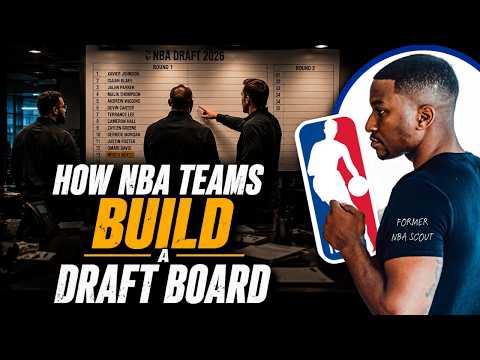
[0:00]How does an NBA team turn 500 draft prospects into one name on draft night? That's the question. Every year, NBA teams spend millions of dollars scouting players all over the world. They send scouts across the country, they send scouts overseas. They watch thousands of games, conduct interviews, gather intel, run background checks, hold meetings and debate players for months. And after all that work, they still only get one or two picks. So how do they organize all that information? The answer is a draft board. Today, I'm going to walk you through how I will build an NBA draft board from start to finish. Now, every NBA team does things a little differently. This isn't the only way to do it. This is simply how I would approach it based on my experience working in the NBA front office. I'm Anthony Goods, former NBA scout. I appreciate all the support. If you got a second, head over to my website. I just released an audio companion to go with my book, Breaking in Without a Jersey. It'll go even more in depth with some things that I didn't put in writing. Now, let's get back to the topic. My hope is by the end of this video, you guys are going to understand why NBA draft boards aren't really about just ranking players. They're about helping teams make decisions when nobody knows the right answer. So let's dive into it. Before we talk about how to build a board, let's talk about why they exist first. Imagine you have an entire scouting department. You have college scouts, international scouts, analytics staff, executives. Everybody has spent the last nine months studying players and everybody has opinions. And with opinions comes favorites and concerns. If you don't have a board, you have chaos. You can't have a room where the loudest voice wins. You need a system that organizes all the information your organization has gathered. The board becomes a collective opinion of the scouting department. It's a way to organize thousands of hours of work into something decision makers can actually use. Let's build our first board. For me, the process starts before the college season even begins. Most scouts have already spent the summer watching many of the top incoming freshmen and draft prospects. So after our preseason meetings, I'd ask every scout to build their way too early top 30. Not because anybody's top 30 is going to be right. It's not. It's because it's the easiest way to identify who matters. Once everybody turns in their list, you start combining names. Maybe you expected 30, but you end up with 40 or maybe even 50 names. Now you have your initial board. This isn't your final ranking. This is just a starting point. These are the players your organization believes deserves the most attention heading into the season. All right, now let's talk tears and pegs. Now, once the board starts forming, we need structure. The first thing is tiers. Tier one plus is the best tier of the group and that's where we tag our lottery level talent. These are players you believe have the upside and likelihood to become franchise changing players. Tier one is first round value, high-level prospects who project to contribute to winning teams. Tier two is second round value, players with a defined NBA pathway and a realistic chance to earn meaningful minutes. Lastly, tier three is developmental. This is where you have your two-way players, exhibit tens, long-term projects, players who still need significant development. But ranking isn't enough. We also use pegs. Peg stands for player evaluation grade. A peg is your projection of what a player ultimately becomes, franchise, core, top starter, low starter, key reserve, rotation player, situational veteran, situational developmental, two-way or international or G-League level. And this is where things get interesting. Let's say you have a player ranked fifth on your board and his peg is top starter. And then you look at the player that's seventh on your board and his peg is a core player. Now you have a problem. If a player's seventh on your board has a higher ceiling, then why is he below the player that's fifth? That's where discussion begins and that's where boards evolve. We usually assign two different pegs to each player. So we'll have a peg for years one to three, and then you'll give a peg for after that. So you're almost estimating his floor and his ceiling. So all this will happen at the end of September and October, November, guys are going out and watching games. Then we have a checkpoint in December. By the end of December, my goal is simple: everybody needs exposure to the top players by the end of the month. Even if a scout hasn't seen a player live, I want the entire department familiar with every player on our top 30. The board starts becoming more informed and the rankings become less theoretical. Now we're replacing assumptions with observations. Now, the most important part of putting a board together that fans never see is Intel. Most fans think scouting is evaluation. I used to think that too. The longer I worked in scouting, I realized that evaluation is only one part of the job. Intel is where things get serious. I'll never forget my GM told me something that will always sit with me. He said, I don't care if the kid is a F'n bank robber. But don't let me draft the kid and then find out he's a F'n bank robber. Let me know ahead of time and I'll make my decision from there. And that's really the purpose of the Intel. Your job isn't to judge players, your job is to supply information to the decision makers. As much information as possible. Who is the player on basketball taken away? What is his work ethic like? How does he handle adversity? What is his family situation? How does he treat people? Those are the questions that matter because basketball is only part of the investment. You're investing in the person, not just the player. And sometimes organizations become obsessive about it. I've had times where I had to go dig for Intel from years and years prior. Not because they wanted to find something, but because they wanted every piece of the puzzle. Leave no stone unturned. After the new year turns, usually you'll have your mid-season meetings. This is where the scouting group will get together, you have calls, you watch film, you discuss Intel. And you really start to debate players and adjust rankings. This is where disagreement becomes valuable. The goal is not to align. The goal is to find the truth. If everybody agrees on something, then somebody's probably not doing their job. Once the college season ends, the NBA combine is pretty much the next major checkpoint. The public usually focuses on athletic testing, the vertical jump, the speed, the lane agility. But for me, the most important part was always the interviews. This is where you really get to sit down and hear a player's story. You get to hear how they think and how they carry themselves. And you get to find out if they'll lie about something that we already knew about. Some players will lie about any and everything, and then some players will be brutally honest.
[7:07]You're really just trying to get a feel for these prospects. The interviews matter because now the player becomes a person, not just a scouting report. Now, around the combine, sometimes slightly before and sometimes right after, that's when we start doing our video assignments. Your video assignments could be to watch two to three games of five shooters in the draft and then rank them. And then we'll have a call and we'll discuss them. And then the following week it could be something different, like, okay, we're picking at 17. So let's watch all the players from 15 to 20 on our board, watch two to three games, discuss it, rank them again. These video assignments will go on until about a week before the draft, and it's really about the same thing as all the other projects and exercises that we do. We just want to find our truth. Once we know what players are staying in the draft, that's when it's a good time for everybody to submit their top 60. Now, again, with the top 60, we don't expect 60 names. It'll probably be a lot more than that. But we have an idea of who the scouting department likes the most in that one to 60 range. One exercise I used to have a lot of fun doing when we would all get together was mock drafts. Every scout gets assigned two to three teams depending on how big the department is, and we use our personal boards to select players. I really like mock drafts because they expose your blind spots. I have plenty of times where I was on the clock, I looked at my board, and the player that was next on my board was not the player that I wanted to draft. And I ended up drafting a player that was a few slots behind, and it really rewired my thinking, and I realized that, okay, maybe I don't like this player as much as I originally thought. The mock draft has a way of bringing out your subconscious feelings about players. So it's also good after this exercise to go back and readjust your board if necessary. Now, one question I always get asked from a lot of people is why do teams miss? They do all this work for nine months and then they still get the pick wrong. The answer is simple. Nobody can predict the future. A player with great Intel can fail and a player with bad Intel can succeed. These players are human and they can enter into a new environment and become a completely different person. The hardest thing to project isn't basketball, it's people. You never know how they'll handle expectations, exposures, money, playing time, the ups and downs of a season. There's so many factors that are coming at them. And all of this gets magnified for the top picks of every draft. When you're drafted into a situation where the franchise is counting on you, that's hard. I'm sure we all can point to a couple players that would have faired a lot better if they were drafted 10th and not first or second. Because expectations change everything. And lastly, we got draft week. Usually a few nights before the draft when all the discussions have been had, and we've argued, we've debated, and we've come to a consensus on what our board looks like, we finally submit it to our GM. Now, the general manager has the board of the scouting department, and then he'll also have his own personal board that we never get to see because obviously they want to avoid group think. The draft is chaos. You never know what players are going to be available when your time comes. And that's why the board exists. Player A is gone, player B is gone, player C is gone. No problem, move on to player D. The work has already been done. People think a draft board tells them who to draft. It doesn't. A draft board organizes nine months of work, hundreds of thousands of dollars, thousands of reports, countless phone calls and endless arguments. And all that turns into 60 names. No team is perfect, and no scout is 100% certain. And no board is perfect. You're simply trying to make the best decision possible with incomplete information. That's all the draft board really is. I appreciate y'all for listening and I appreciate all the messages and support. I'm going to try my best to keep the video content coming. I'll catch y'all on the next video.


