[0:00]If you're about to make your very first cake, there's a lot to think about, and with these 10 tips, I hope to make the process easier and also enjoyable. After following whichever recipe you choose, spray your cake pans with non-stick spray and then, tip number one, only fill your cake pans half full. So that there's space for them to rise in the oven without overflowing and making a mess on the floor of your oven. This might mean using two or three or four cake pans and dividing the batter evenly between those, or if you only have one pan, you can bake cake layers one at a time. After baking your cake, leave the pans for 10 minutes on the counter top before you turn the cakes out. Straight out of the oven, the cakes are very fragile, but 10 minutes gives them a chance to firm up. You can slide a spatula or knife around the pan to loosen the edges of the cake. After 10 minutes, when the pans are just cool enough to touch with your bare hands, the cakes will be firm enough that when you flip the pans over, the cakes slide out easily without crumbling or cracking. Your cake layers need to cool completely before you use them, which takes several hours. Even when they feel cool on the outside, heat is still slowly being released from the middle, and that can melt buttercream if you try to frost the cake too soon. While the cake layers are cooling, prepare your filling and frosting. My favorite is my four-minute buttercream, which is easy to make and delicious, and it stores well. And it can take on hundreds of flavors and I have a full tutorial on that, and you can watch it by clicking up here. When your cake layers are cool, prepare them for your cake. This means shaping them by trimming off any domed tops with a serrated bread knife, and this makes the cake layers flat so that they stack on top of each other without making the cake lean to one side. If you want to create more layers of cake, cut each layer in half horizontally, using that same serrated bread knife, and that way, instead of two layers, you'll have four. If you like, you can drizzle them with simple syrup, which will keep them moist for several days. Simple syrup is just equal parts of water and sugar simmered together until the sugar dissolves and then let it cool before drizzling. Pay special attention to the edges of the cake layers, which are the parts that will dry out fastest, so they're the most important to keep moist. Before assembling your cake, you'll need to choose a cakeboard to build it on. This needs to be flat so that you can use a cake scraper to smooth the frosting all the way down the sides of the cake. Choose a board at least two inches bigger than your cake to leave room for frosting and decorations and to give you something to grip onto when you lift the cakeboard up. Find a cakeboard with a greaseproof surface so that the butter in the buttercream doesn't stain it. Pipe or spread a dot of buttercream onto the middle of your cakeboard and this will act as glue. Press your first layer of cake down onto the dot and center it on the cakeboard, and then spread or pipe your filling, lining up the next layer of cake so that it's directly on top of the layer below, and this will give you straight sides. Alternate cake and filling and then chill your cake in the freezer for 30 minutes, or in the fridge for an hour before frosting it. And that's very important because it sets the dot of buttercream on the cakeboard, and that will hold the cake in place so it doesn't slide around when you frost it. You might have heard of crumb coats, and I'll show you what that is now with tip number seven being, do it. Don't skip the crumb coat. It's a very thin layer of frosting that completely covers the cake from the very bottom to the very top, and it traps any crumbs that come off the cake. There won't be many crumbs if you chill your cake after assembling it, because cold cakes are firmer and less crumbly than room temperature cakes, but there will be some crumbs, and this layer of frosting will catch those. Smooth the frosting with a cake scraper, and this is where tip number eight comes in. Use two bowls. Your batch of buttercream will be in one bowl, and as you pull your cake scraper away from the cake after each scrape, you need to scrape that excess buttercream off into a bowl, but use a second bowl for that. It doesn't need to be big, but this bowl is essential because the buttercream that you scrape off the cake will have crumbs in it. And if you put it into your main bowl of frosting, then you'll use that crumbly frosting for your final coat of frosting, and then it'll have crumbs in it. Your crumb coat doesn't have to be perfect because it's going to be covered up next. For the final coat of frosting, I have several tips, so I'll combine them all into this ninth tip. Use a lot of buttercream to create straight sides. Spread it above the top edge of the cake to create sharp angles and a flat top of the cake. Rest the base of the frosting smoother down on the cakeboard to line it up straight against the side of the cake. And for the top of the cake, wipe your offset spatula clean after each swipe to create neat edges of the cake. Phew, that was a lot. I have a very detailed tutorial on seven secrets for smooth frosting, and you can watch that by clicking up here. Now that your cake is beautifully frosted, you can decorate it or leave it simple. Store it in the fridge until two to four hours before serving it to prevent bulges in the sides of the cake and drooping of any decorations. And after two to four hours on the counter, it will come to room temperature and the cake and frosting will be soft and delicious. I hope this has been useful and that it's given you the knowledge and also the confidence that you need to make your very first cake. I'd love to hear how it goes, please tell me in the comments all about it, and check out my online cake school for lots of different classes and courses on different cake decorating techniques. Subscribe to my channel for a new cake decorating tutorial every week. Thank you so much for watching.
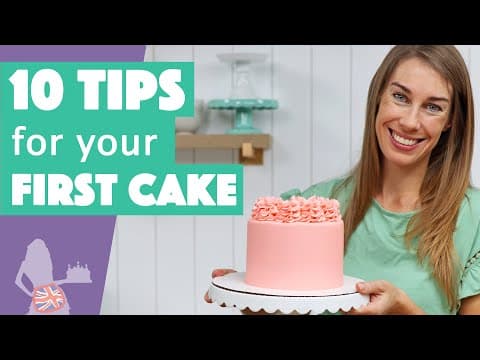
10 Tips for your First Cake
British Girl Bakes
5m 39s1,157 words~6 min read
YouTube auto captions
Transcript source
YouTube auto captions
This transcript was extracted from YouTube's auto-generated caption track. The transcript below is server-rendered so it can be read, searched, cited, and shared without opening the original YouTube player.
Pull quotes
[0:00]If you're about to make your very first cake, there's a lot to think about, and with these 10 tips, I hope to make the process easier and also enjoyable.
[0:00]After following whichever recipe you choose, spray your cake pans with non-stick spray and then, tip number one, only fill your cake pans half full.
[0:00]So that there's space for them to rise in the oven without overflowing and making a mess on the floor of your oven.
[0:00]This might mean using two or three or four cake pans and dividing the batter evenly between those, or if you only have one pan, you can bake cake layers one at a time.
Use this transcript
Related transcript hubs
Watch on YouTube
Share
MORE TRANSCRIPTS


