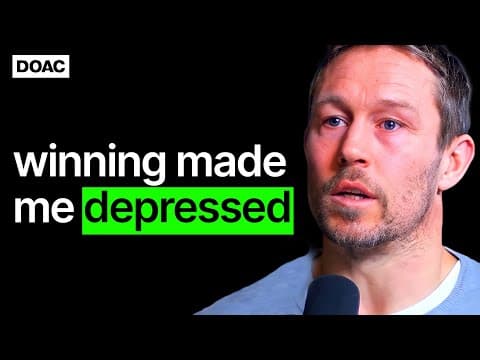
[0:00]Could you do me a quick favor if you're listening to this, please hit the follow or subscribe button. It helps more than you know. And we invite subscribers in every month to watch the show in person. I had to achieve. I had to be perfect, I guess ultimately take on the suffering. The player of the tournament, Johnny Wilkinson. A genuine sporting legend. How much pressure has this man been under this week? For me, it was do or die on the field. So therefore, where other people kind of called it quits and threw in the towel, I didn't have the choice. Here it is for Johnny. This will go down in history. Was your mental health better or worse after that moment? When I was on the field in the zone, I was operating at a level I couldn't even understand. Waking up the next morning, you know, leaves you in the cold light of day. I thought there was going to be joy here. I was convinced there isn't. I spent my life being very fit, but not really that healthy. Health is about what fitness can come out of. And unless you look after health, it's dangerous. People say, oh, I wish I'd made more of my life. I wish I'd enjoyed every moment. But that starts with health. Working on someone else really doesn't work for anyone, but working on yourself tends to work for everyone. So without further ado, I'm Steven Bartlett, and this is The Diary of a CEO. I hope nobody's listening, but if you are, then please keep this to yourself.
[1:23]Jonny, you went on to become one of the real greats in rugby. And I remember watching you in my living room as a very, very young kid on the screen in awe. Not just in that 2003 moment, but but long before then. And when I think about, and when I sit here with guests that are athletes or successful entrepreneurs or whatever they might be, they sometimes, but not usually, can give me a sort of a fairly accurate description of what happened in the earlier phases of life that would would mold them to become that champion or that CEO that they later were. You're someone that is incredibly self-aware. So I was very much looking forward to asking you the same question, which is when you reflect on that early stages of your life, what were the, like, defining, um, molding experiences, for better or for worse, that you would point to and say, that's probably why, or at least that led to in part who I became later in life. Um, I think the best way of answering that would be to say that in my younger days, and very young, without any, any kind of triggering event, certainly not that I can, um, remember or ever, ever sort of come into contact with. I had enormous passion and some kind of adeptness for ball skills. So if I had a ball in my hand, things just made sense. I could work out, I could, I could, in my sort of head, I could have a, some sort of target, some sort of goal, something to do with that ball and I could, I could work it out. That was part of the intelligence I had was just, I could bring those things about relatively effortlessly. And I had a real passion for exploring that. It still is the case with me. I still find myself playing basketball and often so much of this I'll do on my own, because it's my relationship with that inner capacity I have that interests me. Not to show what I can do, but it's that sense of, I guess, being at home and that's where a huge amount of the revelations that I have in life come from, from that kind of relationship. However, there was also another relationship, which again, without the triggering event, um, I grew up with an immense sense of doom and fear about everything. So I had this incredible sort of passion and inclination towards expressing myself with with balls and skills and and in competition as well. But the competition side was a need. That wasn't a desire. The the achievement, um, all that stuff was obsessive, um, but from a negative perspective. Because I had this sense of doom surrounding everything, that was my disconnect, if you like. I saw other people handling situations that seemed so simple to them, but for me, insurmountable. And yet, when they looked at me with regards to oh, you know, with the ball in my hand, what they thought was impossible for me just was relatively straightforward. And I think those two sides of my path meant that I had this constant, uh, drive to just find myself in a garden with a ball in my hand. That's all all hours of the day and night most of the time. It's all I talk about, all I talked about, all I spoke about, all I did, and yet, on the other hand, I had this ever-present fear that I built this, if you like, defense mechanism, coping strategy. But ultimately, identity, around how to somehow survive that fear. And that that for me, that mechanism I put in place was I had to achieve. I had to be perfect. And I had to, I guess, ultimately take on the suffering and and live that kind of martyr, savior, stroke, warrior archetype. And as such, I found myself really, really uncomfortable with when things were seemingly going well. It just, yeah, I found that horrendously difficult to handle. As a result, I would revert to that defense mechanism of creating problems if there weren't. I was constantly looking in a state of kind of survival for where the next problem was, because I was convinced with this ever-present sense of fear that there was a threat and it was there.
[6:13]And so, yeah, those two paths essentially weaved in and out with each other throughout my entire life. But there was no doubt that my ability on the field at times to be in that zone was was where I felt my genius. But at the same time, the other strength I had was that for me, it was do or die on the field. So therefore, where other people kind of called it quits and threw in the towel, I didn't have the choice. Yeah, the fear didn't just drop off and let me just sit down for a bit. So I could go and go and go and go. When you talked about your childhood there, you said despite there being a traumatic event that had created this kind of perspective you had about, um, this sort of fear, but also this sense of real peace and homeness, you described it when you have a ball.
[7:00]Um, your dad Phil was a rugby player and a football player. Uh, cricket. Cricket. So, yeah, yeah, rugby and cricket, yeah. Okay. What was his influence on you? Because it's, you know, when I, when I read that he was also a sports player in his own right, um, that's kind of typically the story you expect to hear. I sat here with Eddie Hearn as well. His dad worked in the same business. I've sat here with CEOs, their dad worked in the same business. And the interesting thing I I the dot I connected, and I'm not making any assumptions here. This is why I'm asking the question is, in the case of Eddie, in the case of Omar, Camani, who was at Boohooo, they describe a very similar thing. A real sense of kind of almost innate feeling of pressure to succeed. And they also at times couldn't necessarily tell you where it comes from. Was did your either of your parents play a role in that in that perceived sense of pressure to to succeed? No, I sort of, like I said, I'm heavily into the introspective side of all this. And and part of that kind of search now for potential is is where that's moved. It used to be grabbing the external and trying to expand physically, you know, what more can I have? What more can How can more people know my name or everything that could almost, yeah, expand my reach and and and presence on a physical level? Now no really no longer interests me. It's it's how to allow my presence, you know, in that non-physical space. Um, and my sort of journey of looking into that has meant, you know, I've I've questioned everything and yeah, my my upbringing was was, you know, fantastic. In terms of that, you know, I had every opportunity to go and do what I wanted to do. Um, I have my brother there as well. And my parents all sporty. But there was just something in me which had latched on, you know, and and this is something I I feel maybe it's something I brought with me into this world from a, you know, like a karmic positioning, whereby I was always going to grab things that way. I was susceptible to understanding things a certain way. Um, but for me, you know, I I I sort of pushed my parents hard.
[9:18]Yeah, I can't imagine it was easy. My brother two and the way that I was I was sort of, I challenged them in ways, you know, I didn't give up. And a lot of that, like I said, was, well, all of the the irrational stuff came from the need. For them, it was baffling, but you know, that is always the case that people are always doing their best. And that's what I remember about our family the most is that everyone's always doing their best.
[9:49]And and what's been so, so powerful for me is just being able to switch that interest was what giving my best means is more than unlocking and letting go and shedding than a what more can I grab? And and you know, where that path turned around is perhaps where, you know, where I felt the the true understanding of of what this journey's been about, as opposed to where I was looking to where did it come from? What happened here, et cetera, et cetera. It's more of a kind of, ah, it was just about that. You said something there, which some people might skip over, which is you said, it might have been something you inherited karmically or, you know, and and that reminded me of something I I'd heard you say previously about being able to sort of inherit generational messages or, um, whatever that might be. Do you believe in that? Do you believe that we're passing messages from one generation to another within within ourselves and that that is shaping our lives? Yeah, I, I believe that the the role of Karma is basically a memory and it's that kind of, it's it's the way we've remembered things. And whilst for me, example, for example, when I'm stuck in that really physical identification of this is who I am, as in I'm me, I'm Jonny, and then I do have a start to my story and an end. But as I've been sort of exploring and letting go a bit more of that, that kind of physical identity of right now, I just tend to feel that it opens up a a different understanding of memory, you know. If we're a process of that evolution, then the cells in our body have a memory that goes back a long, long way. Yeah, and and that's impossible to separate, you know, where we come from, from parents, where they from their parents, from their parents, you know, everything is all interconnected. But we put a stop and a start on it. And it seems, yeah, one of the things I find so, so interesting when looking at that is that I'm very interested in the science side of it, too, and looking at the desire of science to find, you know, what it is that we're made of. And yet, they keep coming up with it's nothing. And then they go to well, what is it we're living in? And they keep finding out that it's unending. And yet, who we are, we seem to manage to say, despite the fact it's made of nothing and it's unending, we found a way of saying, but we're made of this. We start here and we stop there. It it just doesn't make sense to me anymore. Whereas before, you know, you're living in those boundaries. What you see inherits those boundaries. And I think, as I've released those, you start to not so much question, but just allow for different understandings to take hold. And one of those is that, you know, I find it fascinating to look at, you know, I've got a young child and I find it fascinating to look at children and and they're all so different. How are they so different? And then you say, oh, well, yeah, it's it might be to do with how their parents behaved during the during the sort of, um, yeah, the the months preceding the birth and you say, yes, but even then, why the parents behaved that way? It goes on and on and and it just goes back to the same way that I still believe that we're all doing our best. But there's a part which we bring with us into this into this space.


