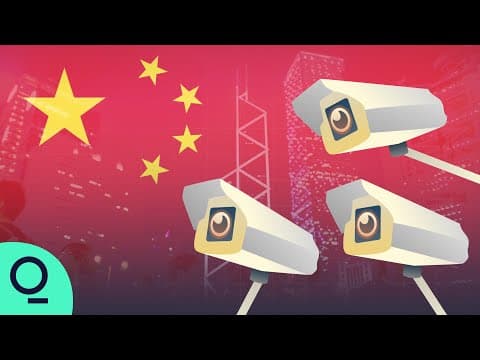
[0:01]Running on vast amounts of real-time data, traveling through high-speed networks, the cities of the future will be technologically smart.
[0:10]The company's designing these smart systems say they'll make our urban environments more livable. They'll keep traffic flowing, save energy, and even help keep us safe. Countries all across the world are embracing smart cities, but none more so than China. This is China's newest and most exquisite blueprint in the new era, that presents the image of a confident, beautiful, and innovative China. This is a concept favored by Xi Jinping himself, the notion of smart city is to smart society, and that has become a sort of like, for me, national strategy. To sustain its already high levels of productivity, Beijing has pumped an estimated $800 billion into high-speed rail, autonomous vehicles, smart grids, and 5G networks, and is piloting more than half the world's smart cities. But for many, the trade-offs are alarming. High-tech surveillance is already widespread for Chinese citizens, and it's a growing concern for countries who import these systems from Chinese tech firms. China is exporting elements of its surveillance complex to third countries through the export of what they call smart cities. By 2030, China is set to overtake the US and become the world's number one economy, and it's betting that smart cities will be a key part of that success.
[1:45]The story of China's urbanization is one without historic parallel. Every year, 20 new cities are built from scratch in China. More people now live in China's cities and towns than live in its countryside. During the last 20 years, almost every year, we have 30 million new people move into the city. The economic reforms of the 1970s drove hundreds of millions of people out of rural poverty and into China's cities in search of work. Many would end up in the factories that powered the nation's meteoric economic rise. Today China has a 63% urbanization rate. That means almost 900 million people in our country is a citizen, is a resident of the city. That's more than 10% of the world's population living in Chinese cities. Such is the pace of development, it can be hard to get your head around the numbers. China has over 100 cities, each with their own population of over a million people. Despite this, China's urbanization rate, the percentage of people in cities, is still some way behind other advanced economies like the US and Japan. But by 2050, urbanization is expected to hit 80%, and it's all part of Beijing's plans. Everybody knows that China have very fast economic growth, but the urbanization plays a very important role. This is why China's government wants to promote that urbanization very much, because they want to use this way to driving the economic growth. We have moved our people from the countryside to the city, because when people produce the cell phone, they can they can feed more people and create more jobs. So this is why China redesigned the economic systems, it very much depends on the urbanization. That's where smart cities come into it. A new smarter urbanization had already been designated a national priority in the National New-type Urbanization Plan (2014-2020). As well as encouraging permanent migration to cities, that plan called for high-speed rail links and other infrastructure. But to sustain these urban populations, the cities also have to be digitally advanced. In the Communist Party's latest five-year plan, five interconnected city clusters will be rolled out by the mid-2030s. Beijing contends they'll be world leaders in smart city infrastructure. Each will also be home to as many as 100 million people. Xiong'an is designed to relieve Beijing of functions not essential to its role as the capital and provide a Chinese solution to urban problems. This smart city strategy fits into the economic transformation for the qualitative upgrade of its economy very well, because smart city and ticks all the boxes. Innovation, technology, new economy and economic upgrade, it's a sort of like new urban utopia or new urban imaginary that gives the policy makers in China some aspirations and some inspirations as well. In the Pearl River Delta cluster in the south is one of the most advanced cities, Shenzhen. China's answer to Silicon Valley used to be a fishing town 40 years ago. As its population grew 40-fold, GDP grew 11,452-fold. When I entered China in January 2015, the city of Sanjen, if I'm correct, had around 13 point some million people living and working. Right now, if we look at the amount of people living and working there now, it is close to, I think, 18 or 19, maybe even 20 million. Headquartered in Shenzhen, Huawei is China's biggest tech firm. When it comes to intelligent cities and connected cities, we have supported the majority of the world with global and mobile broadband infrastructures. All these digitized technologies are helping this industry to also move higher up the value chain in a much shorter time frame. In 2020, Shenzhen deployed next generation 5G and high-speed broadband. Huawei, the market leader, played a major role. Huawei has completed a series of 5G new radio tests. The downlink peak throughput has reached over 6 gigabytes per second for a single user. In Shenzhen, average broadband speeds are about one gigabyte per second. That's given local companies an edge when it comes to productivity. The timing of smart traffic lights are adjusted to improve flow efficiently. Surveillance camera systems capture traffic violations. It sits within a horizontal layer of mobile and broadband and fixed technologies to connect it all. That's what makes it intelligent, it understands what it is for, it optimizes and it utilizes all these broadband connectivities for applications for people to stay at home. And whilst at home using applications from the government, for example, to do this citizen or residency registration or transfer from one city to another city, the same for taxation, the same for utilities, gas, water, electricity and what have you. No more need to go to City Hall, which is downtown City Center for paperwork and what have you. In the process of all of this, in return, it lowers the burden on traffic, of course, because these millions of people in five, six years time frame added to the population of Sanjin itself, would also burden traffic in in a tremendous way. But of course, these smart cities are imprinted with the characteristics of China's surveillance state. The Chinese people are being watched in ways that earlier generations were not. To be honest, as a citizen, I am used to being monitored by so many cameras along the street. Earlier this year, I think this is a very hot topic, a lot of debate about capturing my face and the analysis of my behaviors. So, so I think today, the public awareness on the data and the privacy issues are more discussed. I think there's a pretty crucial distinction to make in privacy in terms of protection of one's personal data against companies misusing it. And privacy in the sense of an intrinsic civil liberty to protect against overly excessive government interference into one's personal life. Privacy in the first sense, there are actually very robust discussions in China. There are personal information protection laws being drafted, data security laws being drafted that are meant to protect privacy from company intrusion. As for the privacy in the second sense, there's very little discussion, very little protection from government intrusion upon one's personal privacy. If companies are collecting less data and are being more secure with how they manage your personal data and your personal information, that might also limit the ability of the government to get data from companies. Regarding Chinese citizens' reactions to AI intruding upon their personal lives, there's a lot more discussion in Chinese social media, Chinese blogs than we would assume in the West. Inside China, local governments now have a more effective way to monitor citizens on a real-time basis. Under China's cybersecurity law, companies must store users' data on local servers and decrypt the data on request from the authorities. new data security law, which just passed, uh, June 11th, is something that Chinese government really cared about, and no one is going to get past this. Others worry that Chinese companies may share sensitive information picked up abroad with Chinese intelligence services. Huawei has famously been accused of being dangerous because countries like the US think it could use its telecom equipment to spy for the Chinese government. Huawei denies the allegations, arguing that US restrictions aren't about cybersecurity, but are really designed to safeguard American dominance of global tech. China's ambassador to the UK tells the BBC that Britain's decision to drop Huawei from its 5G network is a bad move for the country. I think UK should have its own independent foreign policy rather than to dance to the tune of Americans. Despite the international scrutiny, there still seems to be a demand for China's smart city model. Chinese vendors have won contracts for smart city infrastructure in about 50 cities worldwide, according to a study by RWR advisory. Most are in illiberal societies. Whether such privacy fears are overstated or not, the opportunities are too great for China Big Tech to ignore. Chinese CEOs lined up to pledge their support for President Xi Jinping's recent common prosperity policy, despite the hit their businesses would take as part of his crackdown on various industries. regulation of the technology giants, and to what extent our behavior, our action, even our travel patterns or shopping and preferences, they are being utilized for commercial purposes. And I, I, again, this is a global issue and the global concern, that huge, you know, market opportunities. So they work together and to promote what I call the smart city movement in China. But Beijing's dreams of utopian living could come crashing down. The very urbanization that's led to smart cities also resulted in vast ghost towns as the pace of building was too fast for newcomers moving in. The price of the housing increased very fast. This is the challenge for Shanghai, Beijing and Hong Kong, no young people go there. For the developers, kickstarting these projects means taking on huge debt. So when buildings aren't filled quickly enough, that can mean companies going bust. Chinese authorities are now grappling with how to handle developers like Evergrand Group, which now account for almost half the world's distressed debt. If China's economy takes a hit while its property developers go bust, smart cities suddenly become a lot harder to build. Despite its Orwellian overtones, this convergence between the state and private tech firms to create smart city technology, clearly has major benefits. Smart city apps help China contain the spread of the COVID-19 virus, allowing Beijing to turn its economy from contraction to growth faster than any other nation. And smart city ambassadors like Edwin Diender at Huawei see their technologies as essential to our future. It creates more insights in terms of how and where is this city, for example, consuming electricity, uh, consuming power. And only with digital we're able to create a visualization for that, create a better understanding for that, but most importantly, have a principle of big data analytics to help us understand and create insights in how to anticipate. But I think the most important one, and the one that is the most sustainable, of course sits with energy transition. I truly believe energy transition is the next wave of innovation for digital transformation. 85% of the carbon emission is happening inside the city's geography, so that city will be very important into how to reduce the decarbonization. That's how smart cities can plan to contribute. The real question is whether smart cities will be designed for the people who live in them, or for the governments and tech firms who run them. I strongly believe that smart city, even though it's built upon technology, but it should not be technology-centric. It's about the livability, sustainability and the, the, the public good and social inclusion. Our cities will thrive in the future by building and upgrading infrastructure with technologies that tackle the biggest challenges of a rapidly urbanizing world. China aims to be a leader in this field, both at home and abroad. One thing is for sure, China's urban landscape will be dramatically refashioned in the decades ahead.


