[0:00]So you have been to China many times. What what what strikes you as the most remarkable change in China since your first visit there? And do you think the China story can be of some kind of reference to other developing countries? Well, the success of China in so many ways is amazing, uh starting with agricultural productivity, improving the health, a very strong education system of some of the top universities in the world, and now contributing innovations that are going to help us uh not only with health but things like climate change and uh help some of the other countries that are not as far along as China, uh help accelerate their development based on the lessons that come from China. So about the upcoming trip to China, what is at the top of the agenda and who will you be meeting in China? I'm there in Beijing for two days. The two anchor events for me will be a tenth anniversary of the work we've been doing on tuberculosis. So, together with the uh uh Ministry of Health, uh we'll be talking about the progress there and what the plan is to reduce TB even further. I'll also be attending New Economic Forum, which is outside of Beijing, and there we have top leaders from all over the world and a lot of Chinese leaders, both government and private sector talking about, uh, how do we cooperate together better? How do we uh advance, including on tough issues like climate change? The Foundation has been uh uh making efforts for a long decade to uh trying to control the tuberculosis in China. Uh, what has been achieved so far and what are the preferences of the current phase? Well, one of the uh really great things is that we've gone from having a patient having to take 13 pills to only two or three every day. And uh that really helps with the compliance, you know, simplifies things for the patients. So, that's been a big improvement. Apart from the TB uh TB program, how would you describe the the job the Foundation has done in China over the past 12 years? So the Gates Foundation is in China really for two reasons. One is to uh work on some issues like tuberculosis where China still is working to do even better, and to partner with China uh to go to some of the developing countries, including in Africa, and work in a three-way partnership to help those countries. Our health work has been our most intense work, uh work related to reducing smoking, uh to helping with HIV where China got on top of its epidemic and also did a good job with that. Now we're involved in the poverty work where China's got a very impressive goal to completely get rid of extreme poverty in the country and has a dedicated group that's working on that, keeping track of the progress. So, we've partnered with them to help out, including in the health area. So, we have a rich set of programs that are in the country, all of which we feel good about. Uh compared with years ago, would you say that China is playing a quite different role in global governance? Oh, no doubt. Uh, you know, China's over 20% of the world's population, so you always would have expected that. But if you go back to 1980, uh, you know, China was not that engaged and other countries weren't paying as much attention because, in fact, the trade levels were very, very low and people really underestimated uh what would happen in China. You know, since 1980, the growth of the economy, uh including lots of innovation, uh now China's one of the top two economies in the world. You know, lots of countries are trading with China. Uh, you know, lots of Chinese companies are going out in the world with their products. And so, yes, they on the political side, engaging in the UN institutions, contributing to those institutions, thinking about foreign aid, you know, the conference with the African countries, the FOCAC, which has been done uh almost ten years now, that's a great example of how China's now a big part of countries working together, which when I first went was not the case at all. You've been focusing mainly on three areas: health, energy, and climate change. Can you give me an order of priority on these three sectors? Well, my biggest uh work through the Gates Foundation is the global health work. Now, at the same time, the sad fact about climate change is that it's the poorest who will suffer, even though they have done nothing to cause the problem. And yet the temperature increase near the equator is affecting particularly farmers who have very small amounts of land. The one that concerns me the most, though, is the uh Paris Agreement, because we need all the countries uh to engage on this, most importantly, the United States and China. Without them setting a really good example of driving down the emissions and uh innovating to make the cost of that much lower, then we will never achieve the goals of staying below two degrees of warming, we'll go potentially way past that. And so, it is critical uh that future U.S. leadership reverse this decision and rejoin the Paris Accord. China showed a strong commitment uh to uh be one of the leaders, both in reducing its own emissions but also in helping to invent new approaches that will help all the countries be able to reduce their emissions. We do need the U.S. uh to get engaged and to really, you know, work with China to get all the countries engaged, to make it so very hard for a country not to participate. That's the only way you get to global zero (emissions), which is what the goal is.
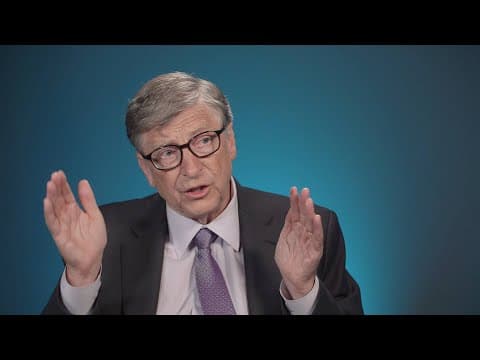
China's advances helpful to world in addressing health, development challenges: Bill Gates
New China TV
6m 47s998 words~5 min read
YouTube auto captions
Transcript source
YouTube auto captions
This transcript was extracted from YouTube's auto-generated caption track. The transcript below is server-rendered so it can be read, searched, cited, and shared without opening the original YouTube player.
Pull quotes
[0:00]What what what strikes you as the most remarkable change in China since your first visit there?
[0:00]And do you think the China story can be of some kind of reference to other developing countries?
[0:00]So about the upcoming trip to China, what is at the top of the agenda and who will you be meeting in China?
[0:00]The two anchor events for me will be a tenth anniversary of the work we've been doing on tuberculosis.
Use this transcript
Related transcript hubs
Watch on YouTube
Share
MORE TRANSCRIPTS