[0:00]Let's get right into it. Number six. You rehearse conversations before they happen. You have entire arguments in your head before they occur in real life. Full dialogue, multiple characters, possible branching responses. You play out scenarios, anticipate reactions, and mentally stress test what you're planning to say before it leaves your mouth. Most people think this is just anxiety. Sometimes it is, but underneath the catastrophizing, there's something genuinely sophisticated happening. You are simulating social cognition in advance, using your own mind as a testing environment. Psychologists call this mental simulation, and it's deeply tied to metacognitive ability. You're not just thinking about what to say, you're thinking about how it will land, what it reveals about your reasoning, and whether it actually holds up under an imagined response. You're essentially running your own thoughts through a peer review before publication. The anxious version of this is exhausting. The metacognitive version is strategic. The trick is that they often happen at the same time, in the same brain, using the same nervous system. Your pre-conversation rehearsal isn't a neurotic tick. It's a cognitive simulation engine that most people don't have access to. They just walk into the room and wing it, then wonder why things went sideways. Number five. You read the room by reading yourself. Most people think social intelligence is about reading other people, picking up on body language, tone, facial micro expressions, all that. And sure, that's part of it, but the version you do is more interesting and significantly weirder. Before you read the room, you read yourself. You check in on your own emotional state, notice how it's coloring your perception, and then adjust your interpretation of everyone else accordingly. You walk into a tense meeting, and your first instinct isn't, what's wrong with them? It's, am I already primed to see this negatively? That internal calibration is called effective metacognition. Awareness of how your emotions are actively shaping your thinking in real time. It's the difference between having feelings and watching yourself have feelings. Most people are so inside their emotional experience that it becomes invisible to them. Like trying to see the glasses on your own face. You've somehow developed the ability to step slightly outside it. Researchers studying emotional intelligence found that this particular skill, noticing your own emotional bias before projecting it outward, is one of the strongest predictors of healthy relationships and sound decision making. Not because you're emotionally detached, because you're emotionally honest with yourself first. Your empathy is more accurate because it's filtered through self-awareness rather than assumption. Basically, you fact check your feelings before filing them as reports about other people. Number four. You're uncomfortable with shallow thinking. Someone presents a half-baked idea with enormous confidence, and something in you physically recoils. Not because you're an intellectual snob, well, maybe slightly, but because your brain has this compulsive need to check whether the foundations actually hold. You pull on loose threads. You ask the question nobody asked. You notice when a conclusion arrived suspiciously fast without stopping to collect evidence along the way. It's not that you enjoy being difficult. You just genuinely cannot turn off the part of your brain that asks, but how do we actually know that? This is what cognitive scientists call epistemic vigilance, a heightened sensitivity to the quality of reasoning, both in others and in yourself. It evolved as a social mechanism to detect misinformation, but in metacognitively intelligent people, it runs almost constantly in the background, like an anti-virus scan nobody installed on purpose. The downside is that you find a lot of everyday conversation mildly exhausting, because you're quietly auditing it while also participating in it. The upside is that you are extraordinarily difficult to manipulate, mislead, or sell a bad idea to. Grifters, pseudo science, and motivational posters with no logical content all bounce off you like foam darts. Your thinking has quality control. Most people's doesn't. That's not arrogance. That's just a cognitive immune system doing its job. Number three, you learn from watching yourself make decisions. After a decision, while everyone else has already moved on, you're still back there doing a quiet post-game analysis. Not obsessively, just methodically. You notice which information you weighted heavily, which you dismissed too quickly, where emotion snuck in disguised as logic, and what you'd adjust next time. You're not just living your life, you're archiving it as case studies in your own decision-making patterns. It sounds exhausting because it occasionally is, but it also means you get smarter from experience in a way that most people simply don't. Psychologists, studying expert performance, found that what separates genuine experts from experienced beginners isn't just time spent doing something, it's the quality of reflection between attempts. Deliberate practice only works if the feedback loop is closed, and closing that loop requires exactly the kind of meta cognitive review you do automatically. You've essentially been running deliberate practice on your own thinking, without anyone designing the program for you. Every time you catch a pattern, I always underestimate how long emotional conversations take, or I make worse financial decisions when I'm tired. You're updating a personal algorithm. Most people collect experiences. You extract principles from them. That's a completely different and significantly more useful thing to do with a life. Number two. You question your own certainty, most when you feel most sure. This one is subtle and slightly maddening to live with. The moment you feel absolutely, completely, unshakably certain about something that's precisely when a small, irritating alarm goes off somewhere in your brain. Not loud enough to paralyze you, just loud enough to make you pause and ask, is this confidence legitimate, or have I just stopped looking for contradicting evidence? Most people treat strong conviction as the finish line. You treat it as a yellow flag. Psychologists, studying judgment and decision-making, call this calibrated confidence, matching how certain you feel to how certain you actually have reason to be. It's extraordinarily rare because the human brain is wired to reward certainty. It feels good to be sure. It feels safe. The neural systems involved in confidence and reward overlap significantly, which means that feeling certain is literally pleasurable, regardless of whether the certainty is earned. Your metacognitive system quietly disrupts that reward by asking uncomfortable questions at the worst possible moment. You're the person who, five minutes before a major presentation, thinks, wait, have I actually verified this statistic? And then checks. Not because you're anxious, because your intellectual honesty runs deeper than your desire for comfort. That's not a small thing. That's arguably the whole game. Number one. Thinking tires you out more than doing. Here's the one that probably explains a lot about your life. You've noticed maybe without having words for it, that purely mental effort exhausts you in a specific, distinct way that physical activity doesn't quite replicate. A hard conversation, a complex decision, an afternoon of deep problem solving and you emerge from it genuinely depleted, like something was consumed. Meanwhile, people around you seem to breeze through the same interactions without needing two hours of quiet afterward. You've probably wondered if something is wrong with you. Nothing is wrong with you. Metacognitive processing is computationally expensive. When you think, you're not just thinking, you're monitoring the thinking, evaluating the quality of the thinking, adjusting the thinking based on that evaluation, and then monitoring the adjustment. It's recursive. It's layered. It burns through cognitive resources at a rate that single layer thinking simply doesn't. Neuroscience research on prefrontal cortex activity shows that higher order self-regulatory thinking, exactly the kind you default to draws heavily on glucose, attention, and working memory simultaneously. Your brain isn't inefficient. It's running more processes than most people's brains run in a day. The fatigue isn't weakness. It's overhead cost. The price of operating at a level of cognitive depth that the majority of people never reach and wouldn't particularly enjoy if they did. Basically, your nervous system is billing you correctly for the premium service you keep requesting from it. That's all for today. I'll be making similar videos in the future. Subscribe to see them.
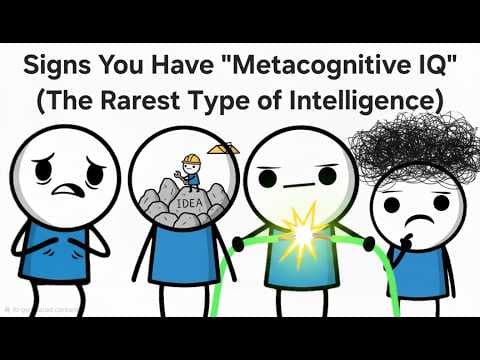
Signs You Have Metacognitive IQ (The Rarest Type of Intelligence)
Quiet Dude Explains
8m 27s1,369 words~7 min read
YouTube auto captions
Transcript source
YouTube auto captions
This transcript was extracted from YouTube's auto-generated caption track. The transcript below is server-rendered so it can be read, searched, cited, and shared without opening the original YouTube player.
Pull quotes
[0:00]You play out scenarios, anticipate reactions, and mentally stress test what you're planning to say before it leaves your mouth.
[0:00]Sometimes it is, but underneath the catastrophizing, there's something genuinely sophisticated happening.
[0:00]You are simulating social cognition in advance, using your own mind as a testing environment.
[0:00]Psychologists call this mental simulation, and it's deeply tied to metacognitive ability.
Use this transcript
Related transcript hubs
Watch on YouTube
Share
MORE TRANSCRIPTS


