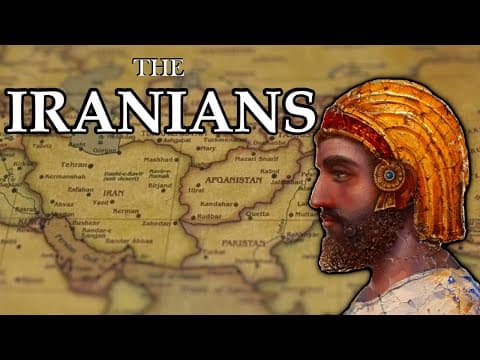
[0:01]In the heart of Asia, a population sweeping south from the steplands of Russia would reshape the world and leave its own significant chapter in the compendium of history.
[0:13]In the ancient world, they created the largest known empire before the Romans, cousins to theans, far removed relations to the English, and the old arch Nemesis of classical Greece.
[0:25]The Iranians are frequently seen as foes of the West and sometimes depicted even as comic book villains.
[0:32]Yet in the not so distant past, the Western view of them was far different.
[0:38]The German writer, Johann Wolf, Gang Von Gotha said of them, when we turn our attention to a peaceful, civilized people, the Persians, we must first go back to the earliest period, to be able to understand more recent times.
[0:53]It will always seem strange to the historians that no matter how many times a country has been conquered, subjugated, and even destroyed by enemies.
[1:03]There is always a certain national core preserved in its character, and before you know it, there re-emerges a long familiar native phenomenon.
[1:13]In this sense, it would be pleasant to learn about the most ancient Persians and quickly follow them up to the present day.
[1:21]That is exactly what we will now do in order to greater understand them as a people, their history and as a great center of world civilization.
[1:33]Now, to some, even the word Iranian is controversial.
[1:38]Many people prefer to use Persian instead.
[1:41]Some view the distinction as between an ethnic group and a state identity, which is correct in a sense, but doesn't fully capture the complexity.
[1:51]Both terms have very ancient origins, and someone can be an Iranian of Iranian origins, and yet not be a Persian.
[2:00]The English word Persian is derived from the Greek Persis, which the Greeks derived from Old Persian Parsa.
[2:09]They were an Iranian-speaking tribal group in what is now South Central Iran's Fars province.
[2:17]It probably comes from a proto-Indo-European word meaning axe, thus identifying them as the axe wielders, calling to mind the famous bronze age weapons.
[2:29]During the Middle Ages, the Persian P shifted to an F.
[2:34]Thus Fars comes from Pars.
[2:38]The modern name of the Iranian language is Farsi, from the earlier Parsi.
[2:44]Because the Parsi had gained the dominant position in ancient Iran and established the ruling dynasty, the Greeks referred to their empire as Persian.
[2:54]And today, the name is used as an ethnonym for people in Iran of Persian ancestry.
[3:01]But in modern cultural and linguistic studies, Iranian can refer to any people descended from what was once a common ethnolinguistic grouping.
[3:12]Thus similar to Kelts or Germanic people.
[3:16]This includes Persians, but alsoans, Kurds, Pashtos, Lurs, and many other modern ethnic groups.
[3:25]But it also includes ancient peoples like the Scythians, Sarmatian, and Alans.
[3:31]Because of the confusion, the term Iranic is sometimes used to distinguish the modern Iranian population from the ethnolinguistic grouping.
[3:41]But the early stages of linguistic and cultural development are common to the whole of the Iranian people.
[3:50]Arguably, Iranian is one of the oldest continuous ethnonyms in existence.
[3:56]It appears in the Avesta, the most important surviving Zoroastrian text, and the king Arshier the first founder of the Sasnian empire titled himself King of Kings of the Iranians.
[4:11]It was also used to refer to the Sasnian Empire, which in ancient Persian was known as Iran Shar.
[4:20]Yet, its use is even older than this, for it is also found in Sanskrit, where Iranian denotes one who speaks the language of those of the Vaders, or who upholds the values of those people.
[4:36]This means that it was used as a common ethnonym before the divergence of the Indic and Iranian languages, perhaps as early as 2000 BC.
[4:50]Now, the word Iranian, or Arian, was taken up in the 19th and 20th century by certain European scholars to describe people that we now usually refer to as proto-Indo-Europeans.
[5:03]And which some later political movements likewise adopted and used incorrectly for their racial propaganda.
[5:11]However, while Iranian may not have been used as a common Indo-European ethnonym, there is some reason to think that it originates from an Indo-European term of nobility.
[5:24]While earlier theories tried to link the etymology of Ireland to Iran are wrong, there is an old Gac cognate for Iranian, which means a free man, chief or noble.
[5:38]In proto-Germanic, it was Iranian, meaning the same.
[5:43]They're thought to come from a proto-Indo-European word Hios, which probably referred to an assembly of men, most likely a war band.
[5:53]This title was taken up as an ethnonym by those warriors of the proto-Indo-Iranians to refer to themselves as free men or lords, as opposed to those that they conquered, who they refer to as an Iranian, non-Iranians or unfree people.
[6:12]Linguistic studies have long determined that the Iranian languages descend from a common origin, shared with European languages like English, French, German and Russian.
[6:26]In some cases, it doesn't even take a linguist to tell. Modern Persian still possesses such visibly identical words with English, such as Modar, Pedar, Baradar, Dochtar, Setara, Tarik, Dar, Abru, Lab, Nam.
[6:45]Linguistic and genetic evidence shows that the origins of the proto-Indo-Iranian culture, which first developed on the steplands of Central Asia, was predominantly of Indo-European origin, and more specifically,
[7:01]They seem to have developed out of an eastern movement of the Corded Ware culture.
[7:05]The same cultural group which spawned the ancestor of the Germanic and likely Slavic, Baltic, Celtic and Italic languages.
[7:15]Its eastward branch is known as the Fatyavo-Balanovo culture.
[7:20]They dwelt primarily in the forests of Russia and engaged in copper mining.
[7:25]They had basic wagons pulled by oxen and the same type of technology possessed by the Corded Ware.
[7:31]In genetic tests, they grouped together with modern northern Europeans, and all tested carried the male Haplogroup R1A, specifically carried the R1A2-Z93 subclade.
[7:48]A subclade which is most prominent in South and Central Asia, as opposed to Europe.
[7:53]In other words, it's very likely that those of the Fatyavo-Balanovo culture represented the early ancestors of those who would go on to spread the Indo-Iranian languages into Central and South Asia.
[8:07]It may be that the Fatyavo-Balanovo culture, possibly mixing with other Yamnaya derived groups in the region, such as the Poltavka culture, who would spread still further east and form the basis of the Sintashta culture and others in the region.
[8:24]The Sintashta can be rightly praised as the earliest known culture to have developed the chariot and the spoke wheel.
[8:31]They had massive copper mines, as well as unexpectedly large fortified sites, such as Sintashta and Arkheim.
[8:40]The Sintashta is one of the most famous and impressive.
[8:45]Other closely related proto-Indo-European groups in the region were likely also speaking a proto-Indo-Iranian language around the same time and played a role in the formation of the language group.
[8:59]These miners, pastoralists and chariot makers would expand across the Central step and gradually make their way south, likely raiding and trading at first, but gradually winning lands and expanding their territories.
[9:14]It was from these people that the technology of the spoked wheel and chariot would spread further south to the Hittites, Egyptians and Greeks, and further east into China.
[9:26]These were the Iranians described in the Rigveda, the oldest source for their customs and language, dated tentatively to around 1500 BC.
[9:39]One of the hymns says, for Puru, thou hast shattered Indra, 94 forts.
[9:44]For Divodasa, thy boon, servant with thy bolt, O dancer for thy worship.
[9:50]For Attigva, he, the strong, brought Sambara from the mountain down.
[9:56]Distributing the mighty treasures with his strength, parting all treasures with his strength.
[10:02]Indra in battle helps his Iranian worshipper.
[10:07]He who hath hundred helps at hand in every fray, in frays that win the light of heaven.
[10:13]Flagging with the lawless, he gave up to Manu's seed the dusky skinned.
[10:20]Blazing, twere he burns each covetous man away, he burns the tyrannous away.
[10:26]Wax strong and mighty dawn, he tore the sun's wheel off, bright red, he steals away their speech, the lord of power, their speech he steals away from them.
[10:40]As thou with eager speed, O sage, has come from far away to help.
[10:44]As winning for thine own, all happiness of men, winning all happiness each day.
[10:52]Lauded with our new hymns, O vigorous indeed, save us with thy strengthening help, O shatter of forts.
[11:01]These were the Iranians riding like the wind across the steplands in their chariots, winning the cattle from the non-Iranians, the dusky skins as they call them, smashing their forts and worshipping the lightning wielding war god, who would impart to them the strength to, as Conan would say, Crush your enemies.
[11:24]See them driven before you, and hear the lamentation of their women.
[11:30]Genetic studies of the Central Asian Iranian people show many still possess a high level of step ancestry, which groups with modern European populations.
[11:41]Something one can see with the untrained eye.
[11:46]The Tajiks and especially the Yagnobi, a small minority group in an isolated valley in Tajikistan, who speak alone Eastern Iranian language descended from the Sogdians, have very high rates of step ancestry, as high as many central and even northern Europeans.
[12:06]They still differ from modern Europeans, however, due to the different underlying ad mixtures.
[12:15]As various groups associated with the Sintashta and then the Andronovo moved south, they came into contact with another large population group with a sedentary lifestyle based on agriculture, identified as the Bacteria Margiana archaeological complex, or simply BMAC.
[12:37]For a period, they traded and raided them, but eventually, the Indo-Iranians absorbed their entire culture, in much the same way that the step pastoralists who moved into Europe did with the Neolithic farmers there.
[12:50]They also preserve the Iranian ethnic identity, but they took on genetic elements of the other population.
[12:57]Though more genetic testing needs to be done for the region, the tests which we do have paint an interesting picture.
[13:05]The Iron Age Iranians of Central Asia had mixed extensively with the Bacteria Margiana population.
[13:13]This is not only represented by the overall ad mixture, but by the introduction of the Y male Haplogroup J2, which exists fairly prominently among modern Iranian populations.
[13:26]This was also the case for the step herder population that moved into Europe, mixing with the Neolithic farmer population there, a mixture which reflects the diversity of modern Europeans North to South.
[13:41]While the earlier Andronovo culture still clustered with European groups, reflecting its Corded Ware ancestry, by the Scythian dawn, the populations had diverged further, yet still retained close affinity.
[13:56]The ancient populations of the Middle East and Iranian step were not so far removed from the Neolithic farmers of Europe, after all, those farmers had migrated into Europe from Anatolia a few thousand years earlier.
[14:11]Even today, though arguably the demographics in the Middle East have shifted some during the Middle Ages, the Middle Eastern population is still, globally speaking, not really so far removed from Europeans.
[14:27]Some Iranian groups have a lot of step ad mixture, and some, such as those dwelling in western parts of Iran, have fairly low amounts.
[14:38]Some have a high degree of R1A male ancestry from the step, while others have less.
[14:44]Yet even regions with lower percentages of step ancestry still have levels similar to that of Greece, Southern Italy or Southern Spain and Sardinia.
[14:55]The Iranian groups are culturally, linguistically, and genetically, descendants of the proto-Indo-Europeans, just as they are also the descendants, of course, of those people in the region stretching back to the impenetrable mists of the Stone Age.
[15:57]One can only wonder about what forces drove the Iranians to push into the harsh landscapes of Afghanistan and beyond.
[16:05]Some have speculated that the split was related to the rise of Zoroastrianism, with those who rejected it, leaving and finding lands to the south.
[16:16]But this is also unlikely.
[16:19]Zoroastrianism likely wasn't adopted by most of the Iranians on the step.
[16:23]It was probably developed within the Yaz culture in the south of what is now Turkmenistan, where it seems that excarnations first began being practiced.
[16:35]It became prominent, but never the dominant religion of all Iranians, most of whom continued to practice Iranian folk religion, which Zoroastrianism ultimately based itself on, though in an extremely modified form.
[16:50]While the Indo-Iranians were dwelling mostly to the south of the Hindu Kush, the Iranian tribes were still roaming the step, where the later stage of the Andronovo culture would eventually morph by the Iron Age into the Scythians or Saka.
[17:06]The first Iranian movement west is likely represented by the Cimmerians.
[17:12]Yet it was prior to the rise of the Scythians that the first Iranian speakers entered and settled in what is now northeastern Iran, starting around the South coast of the Caspian Sea, perhaps around 1400 BC.
[17:25]This early Iranian migration is thought to correspond to the Iron Age 1 period, marked by the introduction of gray and gray black pottery from the northeast.
[17:36]By 1300 BC, Iranian groups had likely already reached the Zagros Mountains in the west, and by the 9th century BC, Assyrian cuneiform texts were writing about the troublesome Iranian groups.
[17:50]The Medes had established themselves in the West along the eastern side of the Zagros.
[17:55]They raided Assyrians and Babylonians from the mountains.
[18:00]They and other associated Iranian groups likely pushed out or assimilated earlier Indo-Iranian speakers in some of these regions, south of the Hindu Kush and near the straights of Hormuz, during the Iron Age.
[18:13]The modern Pashto people are descendants of Eastern Iranian speakers in the region and the largest of the remaining Eastern Iranian languages, to which Old Avestin belongs.
[18:26]The breakup of the proto-Iranian language likely began once the Andronovo culture began to expand.
[18:33]Tribes would have lost contact and language shift would have happened.
[18:37]By the time of historical sources, many of the Iranian tribes had developed their own unique languages, some more related than others.
[18:44]Old Persian and Old Parthian were closely related, both belonging to the western Iranian branch, along with Median, now extinct.
[18:55]Some have tried to use the existence of these many different languages within the Indo-Iranian grouping as proof that this grouping is actually older than European languages like Germanic, Celtic or Greek.
[19:10]This isn't the case. As we have seen, Indo-Iranian originated from an eastward migration of the Corded Ware culture.
[19:16]The timeline for this development is roughly the same as the linguistic developments in Europe.
[19:22]The key reason why there are so many more varieties of Indo-Iranian languages is the geography and the social customs of the region.
[19:31]Modern Iran alone is 1.6 million square kilometers.
[19:37]That's roughly the same size as Germany, France, Britain and Spain put together.
[19:42]Now, all of those countries speak completely different languages, yet all emerged from the same westward flow of proto-Indo-Europeans at around the same time.
[19:53]So really, what we should be comparing Indo-Iranian to is all of the branches of European languages which exist in Europe.
[20:02]And that diversity of languages reflects the diversity found in Indo-Iranian languages.


