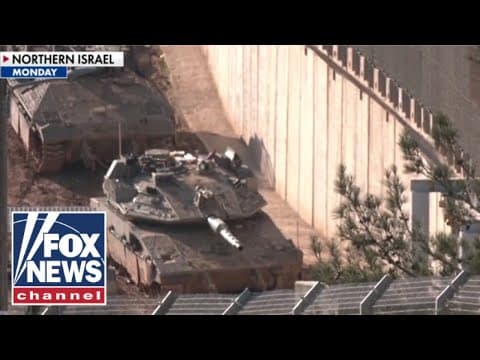
[0:00]Meanwhile, Israel is now facing a two-front war with missile and rocket attacks from Iran, as well as Hezbollah in Lebanon. For the latest on the ground, we go to our chief foreign correspondent, Trey Yingst, who is live in Tel Aviv. Trey. Hey guys, good morning. I do want to start with some breaking news. A senior Israeli official telling Fox News that more than 1,000 enemy combatants have been killed in Iran since the operation began. This is based on their latest battle damage assessment. As we continue to track developments here, we are looking to Israel's northern border with Lebanon, where overnight the Israelis sent forces into Southern Lebanon to take what Israeli officials are calling a defensive posture against the Iran-backed terror group Hezbollah. This posture is expected to remain over concerns about cross-border attacks. Overnight, more rockets were fired into Northern Israel from Lebanon, and the Israelis striking back, hitting more targets in the Lebanese capital of Beirut, specifically around the Dahiya neighborhood, a Hezbollah stronghold. Israel's Prime Minister Benjamin Netanyahu speaking with Sean Hannity overnight, saying this. with these ballistic missiles, these weapons of mass death, these weapons of terror, they're terror weapons. They bombed all these countries, and when they developed the intercontinental ballistic missiles, they'll threaten you and eventually they'll bomb you. This is what President Trump understood and alone among US presidents that I worked with, he took action and we're all very, very lucky that he did. Israel's Prime Minister making clear that this Iranian threat, it's all connected across the region, whether it's their proxies, their ballistic missile program, or their attempts to rebuild their nuclear program. And overnight, the Iranians launching more attacks toward the Gulf, targeting the US Embassy in Riyadh, Saudi Arabia with two drones. The embassy was vacant at the time. There were no injuries reported. We're also following developments out of Kuwait, where smoke was seen rising as these attacks against Gulf countries continue. Now, Vice President JD Vance tried to lay out a timeline overnight, describing new details about the plans of the Trump administration. Take a listen. There's just no way that Donald Trump is going to allow this country to get into a multi-year conflict with no clear end in sight and no clear objective. He's defined that objective as Iran cannot have a nuclear weapon and has to commit long-term to never trying to rebuild their nuclear capability. Intense days of battle are expected ahead. The Israelis are still going after Iran's ballistic missile launching positions, but this morning sirens have sounded across this country multiple times amid new incoming fire. Guys. So Trey, based on your source and I know the American government is trying to figure this out as well. But who is running the operation in Iran right now? Do we know? I know there was, you know, they had four guys out in case this happened. Have you heard anything? It's a great question, and the short answer is we don't know. There are very few senior leaders still alive in Iran, more than 40 were taken out, including Iran's supreme leader, the Ayatollah Hamenei. President Masoud Peseskian is still alive. There is a top security council official named Ali Larijani who has quite a bit of power inside of Iran. But the leadership structure has been basically dismantled along with many IRGC positions. There is close coordination between the United States and Israel to not only go after the launching positions and the commanding control centers, but also try to degrade as much of the leadership as possible. So the Gulf states are are are under fire, and so far, I understand Bahrain says they've intercepted 70 missiles. Cutter is down two Iranian jets. Uh, they've uh uh maybe over 100. The UAE has been hit pretty hard, detected 174 ballistic missiles destroying 161, 13 fell into the sea. Do you think it's caught them by surprise that they're under persistent attack and do you think the number of interceptors they have in their arsenal will begin to become an issue? I don't think they were caught by surprise, but this was largely seen as an outlier in possible responses from Iran. It's been seen by many analysts as a miscalculation by the Iranian regime to go directly after these Gulf states because it's only strengthening their defense and their resolve to stay together and actually help the Americans and the Israelis with this operation against Iran. And we talked about this yesterday, but it's a very important point to underscore. President Trump has been able to do something across the Middle East that wasn't done before. He's built trust between these Gulf countries and regional allies of the United States, including Israel, and despite the fact we've seen public statements in the lead-up to this conflict, all of these countries understand the threat against the Iranian regime. They heard President Trump lay out his vision for peace across the Middle East, and he was able to through his special envoy, Steve Witkoff and his son-in-law Jared Kushner, not only delivered the message of who the number one threat in the region really is, but also ensure that these countries are working together because they see the Iranian regime as the last hurdle to peace in the Middle East, to stability, the regional stability that President Trump has said is possible. And that is why this operation is unfolding right now. There were diplomatic opportunities given to the Iranians. The Trump administration extended a branch at the negotiating table, both in Oman and in Switzerland. And the Iranians were unwilling to make a good faith nuclear agreement, and they were continuing to expand their ballistic missile program and support of regional proxies. Not to mention the massive crackdown on protesters earlier this year that led to the deaths of more than 32,000 civilians in their own country. And so, these are the reasons that this operation began, but the fact that these Gulf countries are under fire, it's an indication that the Iranians are really in a desperate place, given the fact they were hit so hard in that opening strike campaign that was coordinated between both the United States and Israel. Yeah, I thought the same thing when when you're talking about the other Gulf states, the best way to make sure they're not going to help you is to attack them. So might not have been the best move on Iran's part. Is anyone else helping Iran? Is China helping Iran? Any other countries? They're not. Right now they are isolated. Of course, in the past they've received air defense systems and and weapons from the Russians and the Chinese, but at this point, they're incredibly isolated and that will only get worse for the Iranian regime. And it's interesting to watch these leaders who are still alive among the top political echelon inside of Iran, still threatening the United States. It's as if they didn't receive the message, despite the fact that they're entire political and military leadership was decapitated.
[6:54]And so they're not receiving outside support right now, and the Iranian regime in the days ahead will continue to weaken as the United States and Israel launches these strikes across the country. Hey, Trey, one real quick, on the Hezbollah, Lebanon, Israel dynamic. Israel's calling on Lebanon to crack down on Hezbollah, else we're going to we're going to finish them off, we're going to get in there. Uh, and it's going to get really worse for everybody. Does Lebanon have a strong enough government to actually crack down on a weakened Hezbollah, which we hear is now being run by the IRGC? They do. And this is a massive achievement for the Trump administration. The fact that yesterday you had Lebanon's Prime Minister calling on Hezbollah to stand down, that's unheard of. If we reported that a year ago, people would have laughed, but they have sent Tom Barack and others to the region to say, look, there's only one future for Lebanon and that is a future that does not involve Iranian proxies. It doesn't involve threats against Israel and US forces in the region. And so there is a change in tone from Lebanese leadership after all of these efforts from the administration, and they're going to help in trying to ensure that Hezbollah isn't attacking Israel or US forces in the region. And already, we understand, they are trying to implement the framework of that ceasefire that was reached last year, in order to dissuade Hezbollah from getting more directly involved in the fight. While this is taking place, you have a parallel track that now includes Israeli forces in Southern Lebanon over the border and they are hammering the Lebanese capital of Beirut with air strikes. All right, Trey, thanks so much for the reporting. I'm Steve Ducey. I'm Brian Kilmeade. And I'm Ainsley Earhardt, and click here to subscribe to the Fox News YouTube page to catch our hottest interviews and most compelling analysis.